


Sequencing Disadvantage: Barriers to Employment Facing Young Black and White Men with Criminal Records
- PMID: 23459367
- PMCID: PMC3583356
- DOI: 10.1177/0002716208330793
Sequencing Disadvantage: Barriers to Employment Facing Young Black and White Men with Criminal Records
Abstract
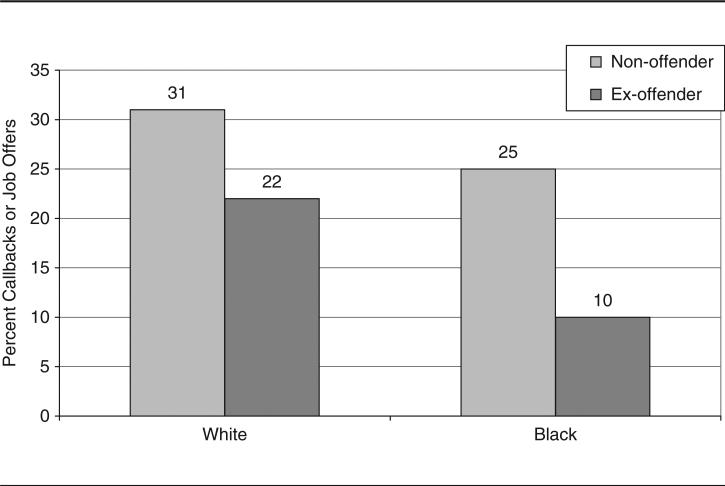
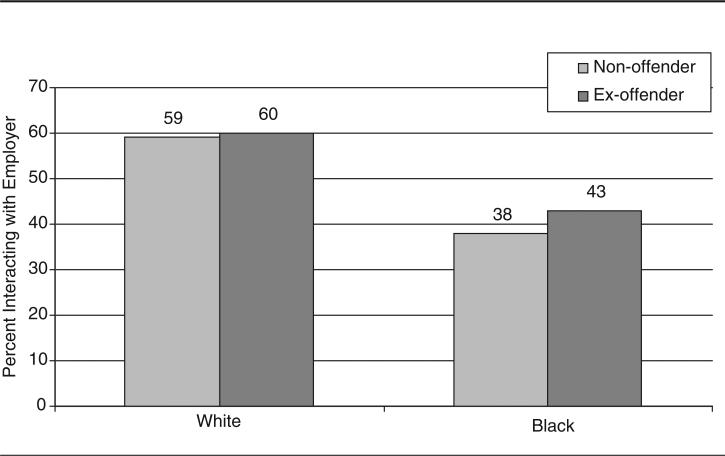
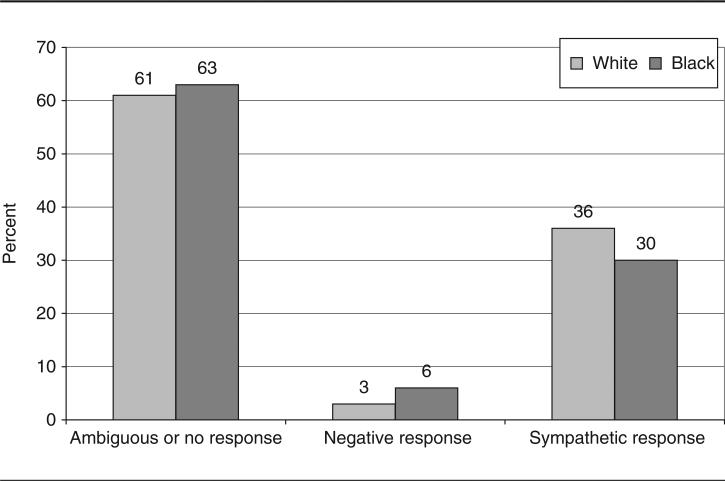
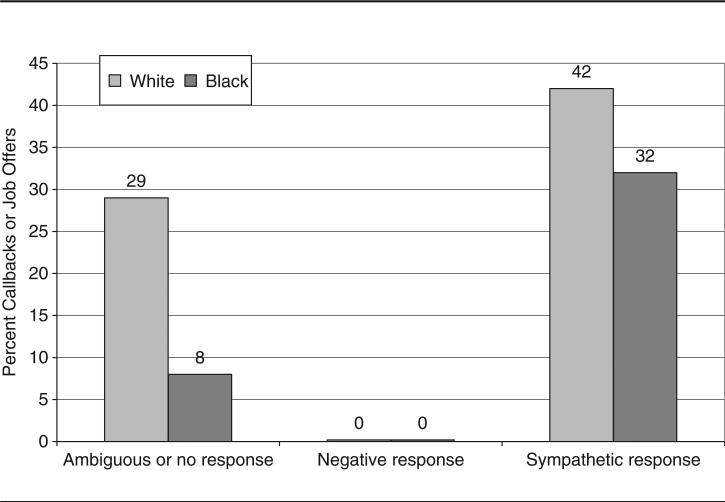
In this article, the authors report the results of a large-scale field experiment conducted in New York City investigating the effects of race and a prison record on employment. Teams of black and white men were matched and sent to apply for low-wage jobs throughout the city, presenting equivalent resumés and differing only in their race and criminal background. The authors find a significant negative effect of a criminal record on employment outcomes that appears substantially larger for African Americans. The sequence of interactions preceding hiring decisions suggests that black applicants are less often invited to interview, thereby providing fewer opportunities to establish rapport with the employer. Furthermore, employers' general reluctance to discuss the criminal record of an applicant appears especially harmful for black ex-offenders. Overall, these results point to the importance of rapport-building for finding work, something that the stigmatizing characteristics of minority and criminal status make more difficult to achieve.
Keywords: criminal record; discrimination; employment; low-wage labor markets; race.
Figures
References
-
- Allport Gordon. The nature of prejudice. Doubleday Anchor; New York: 1954.
-
- Anderson Elijah. Code of the streets: Decency, violence, and the moral life of the inner city. Norton; New York: 1999.
-
- Bureau of Justice Statistics . Recidivism of prisoners released in 1994. By Patrick Langan and David Levin. U.S. Department of Justice; Washington, DC: 2002.
-
- Bureau of Justice Statistics . Reentry trends in the U.S. U.S. Department of Justice; Washington, DC: 2004. http://www.ojp.usdoj.gov/bjs/reentry/reentry_contents.htm#contents.
-
- Crocker Jennifer, Major Brenda, Steele Claude. Social stigma. In: Gilbert D, Fiske S, Lindzey G, editors. The handbook of social psychology. McGraw-Hill; Boston: 1998. pp. 504–53.
Grants and funding
LinkOut - more resources
Full Text Sources