Latent infection with Leishmania donovani in highly endemic villages in Bihar, India
- PMID: 23459501
- PMCID: PMC3573094
- DOI: 10.1371/journal.pntd.0002053
Latent infection with Leishmania donovani in highly endemic villages in Bihar, India
Erratum in
- PLoS Negl Trop Dis. 2013 Apr;7(4). doi:10.1371/annotation/f096e293-9b24-46e6-bf1e-a18696611b4d. Wilson, Mary Elizabeth [corrected to Wilson, Mary Edyth]
Abstract
Introduction: Asymptomatic persons infected with the parasites causing visceral leishmaniasis (VL) usually outnumber clinically apparent cases by a ratio of 4-10 to 1. We describe patterns of markers of Leishmania donovani infection and clinical VL in relation to age in Bihar, India.
Methods: We selected eleven villages highly endemic for Leishmania donovani. During a 1-year interval we conducted two house to house surveys during which we collected blood samples on filter paper from all consenting individuals aged 2 years and above. Samples were tested for anti-leishmania serology by Direct Agglutination Test (DAT) and rK39 ELISA. Data collected during the surveys included information on episodes of clinical VL among study participants.
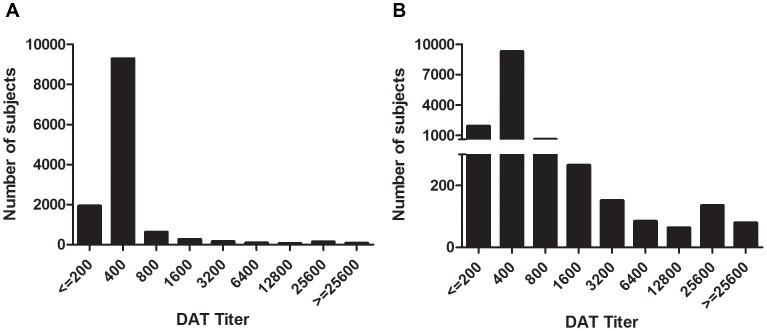
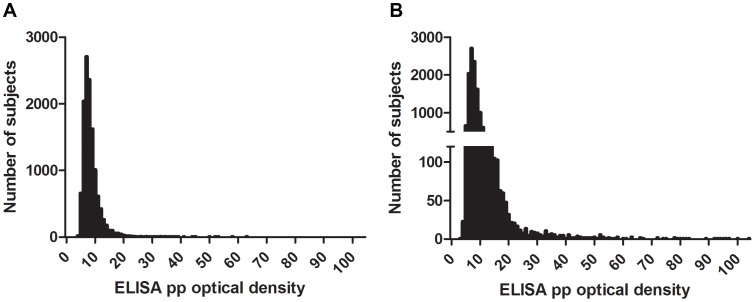
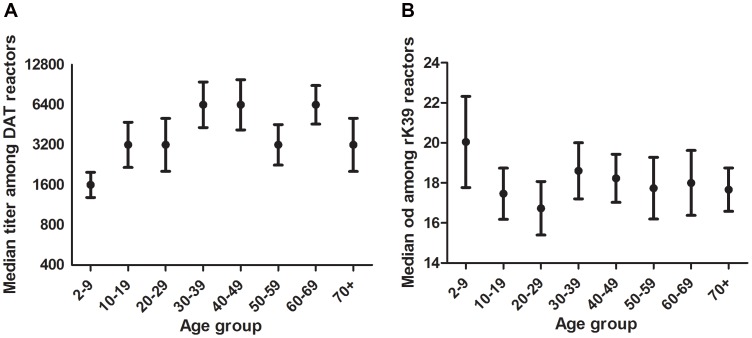
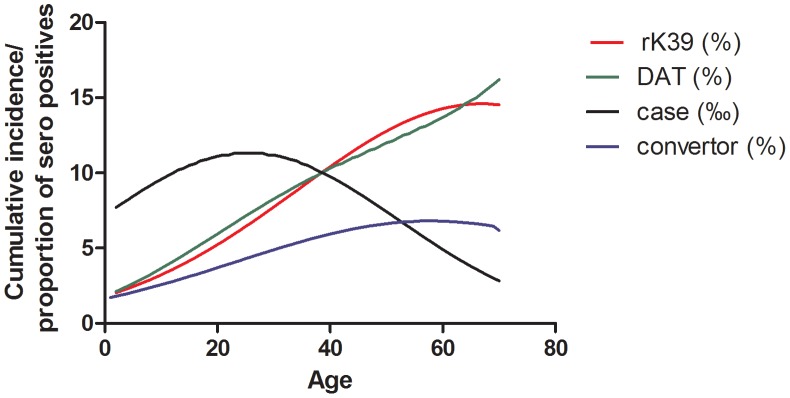
Results: We enrolled 13,163 persons; 6.2% were reactive to DAT and 5.9% to rK39. Agreement between the tests was weak (kappa = 0.30). Among those who were negative on both tests at baseline, 3.6% had converted to sero-positive on either of the two tests one year later. Proportions of sero-positives and sero-converters increased steadily with age. Clinical VL occurred mainly among children and young adults (median age 19 years).
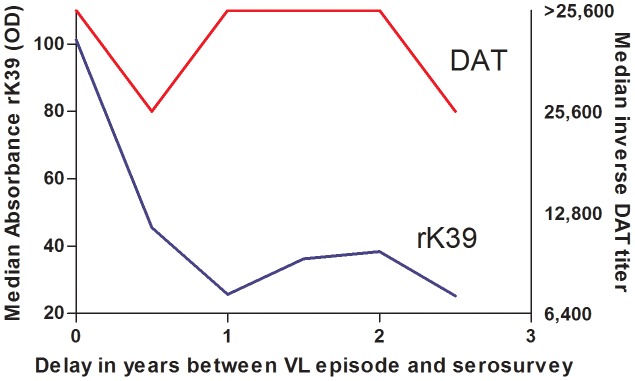
Discussion: Although infection with L. donovani is assumed to be permanent, serological markers revert to negative. Most VL cases occur at younger ages, yet we observed a steady increase with age in the frequency of sero-positivity and sero-conversion. Our findings can be explained by a boosting effect upon repeated exposure to the parasite or by intermittent release of parasites in infected subjects from safe target cells. A certain proportion of sero-negative subjects could have been infected but below the threshold of antibody abundance for our serologic testing.
Conflict of interest statement
The authors have declared that no competing interests exist.
Figures
References
-
- World Health Organization Control of the leishmaniasis: report of a meeting of the WHO Expert Committee on the Control of Leishmaniases, Geneva, 22–26 March 2010. WHO technical report series; no. 949.
-
- Ranjan A, Sur D, Singh VP, Siddique NA, Manna B, et al. (2005) Risk factors for Indian kala-azar. Am J Trop Med Hyg 73: 74–78. - PubMed
-
- Elnaiem DA, Hassan MM, Maingon R, Nureldin GH, Mekawi AM, et al. (2001) The Egyptian mongoose, Herpestes ichneumon, is a possible reservoir host of visceral leishmaniasis in eastern Sudan. Parasitology 122: 531–536. - PubMed
-
- Stauch A, Sarkar RR, Picado A, Ostyn B, Sundar S, et al. (2011) Visceral leishmaniasis in the Indian subcontinent: modelling epidemiology and control. PLoS Negl Trop Dis 5: e1405 10.1371/journal.pntd.0001405 [doi];PNTD-D-11-00419 [pii]. - DOI - PMC - PubMed
Publication types
MeSH terms
Substances
Grants and funding
LinkOut - more resources
Full Text Sources
Other Literature Sources