


Who Do You Think Is in Control in Addiction? A Pilot Study on Drug-related Locus of Control Beliefs
- PMID: 23459679
- PMCID: PMC3586285
- DOI: 10.1097/ADT.0b013e31823da151
Who Do You Think Is in Control in Addiction? A Pilot Study on Drug-related Locus of Control Beliefs
Abstract
Objectives: The drug-related locus of control scale (DR-LOC) is a new instrument for assessing a person's belief of "being in control" in situations involving drug abuse. It consists of 16-item pairs presented in a forced-choice format, based on the conceptual model outlined by Rotter. The model characterizes the extent to which a person believes that the outcome of an event is under their personal control (internal locus of control) or the influence of external circumstances (external locus of control).
Methods: A total of 592 volunteers completed the DR-LOC and the Rotter's I-E scale. Approximately half of the respondents were enrolled in a drug treatment program for opiates, stimulants and/or alcohol dependence (n = 282), and the remainder (n = 310) had no history of drug dependence.
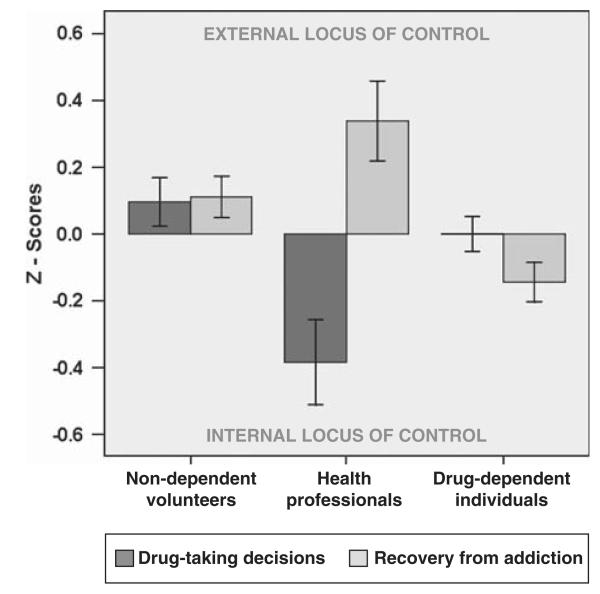
Results: Factor analysis of DR-LOC items revealed 2 factors reflecting control beliefs regarding (i) the successful recovery from addiction, and (ii) decisions to use drugs. The extent to which a person attributes control in drug-related situations is significantly influenced by their personal or professional experiences with drug addiction. Drug-dependent individuals have a greater internal sense of control with regard to addiction recovery or drug-taking behaviors than health professionals and/or non-dependent control volunteers.
Conclusions: The DR-LOC has shown to effectively translate generalized expectancies of control into a measure of control expectancies for drug-related situations, making it more sensitive for drug-dependent individuals than Rotter's I-E scale. Further research is needed to demonstrate its performance at discriminating between heterogeneous clinical groups such as between treatment-seeking versus non-treatment-seeking drug users.
Keywords: addiction recovery; drug-taking; health professionals; self-report measure; substance abuse.
Figures
References
-
- American Psychiatric Association . Diagnostic and Statistical Manual of Mental Disorders. 4th ed, Text Revision American Psychiatric Association; Washington, DC: 2000.
-
- Jentsch JD, Taylor JR. Impulsivity resulting from frontostriatal dysfunction in drug abuse: implications for the control of behavior by reward- related stimuli. Psychopharmacology. 1999;146:373–390. - PubMed
-
- Garavan H, Hester R. The role of cognitive control in cocaine dependence. Neuropsychol Rev. 2007;17:337–345. - PubMed
-
- Fillmore MT, Rush CR. Impaired inhibitory control of behavior in chronic cocaine users. Drug Alcohol Depend. 2002;66:265–273. - PubMed
Grants and funding
LinkOut - more resources
Full Text Sources