. 2013 Jul 1;22(13):2603-11.
doi: 10.1093/hmg/ddt108. Epub 2013 Mar 3.

Trans-splicing correction of tau isoform imbalance in a mouse model of tau mis-splicing

Affiliations

Trans-splicing correction of tau isoform imbalance in a mouse model of tau mis-splicing

María Elena Avale et al. Hum Mol Genet. .

Abstract

Abnormal metabolism of the tau protein is central to the pathogenesis of a number of dementias, including Alzheimer's disease. Aberrant alternative splicing of exon 10 in the tau pre-mRNA resulting in an imbalance of tau isoforms is one of the molecular causes of the inherited tauopathy, FTDP-17. We showed previously in heterologous systems that exon 10 inclusion in tau mRNA could be modulated by spliceosome-mediated RNA trans-splicing (SMaRT). Here, we evaluated the potential of trans-splicing RNA reprogramming to correct tau mis-splicing in differentiated neurons in a mouse model of tau mis-splicing, the htau transgenic mouse line, expressing the human MAPT gene in a null mouse Mapt background. Trans-splicing molecules designed to increase exon 10 inclusion were delivered to neurons using lentiviral vectors. We demonstrate reprogramming of tau transcripts at the RNA level after transduction of cultured neurons or after direct delivery and long-term expression of viral vectors into the brain of htau mice in vivo. Tau RNA trans-splicing resulted in an increase in exon 10 inclusion in the mature tau mRNA. Importantly, we also show that the trans-spliced product is translated into a full-length chimeric tau protein. These results validate the potential of SMaRT to correct tau mis-splicing and provide a framework for its therapeutic application to neurodegenerative conditions linked to aberrant RNA processing.


Figures
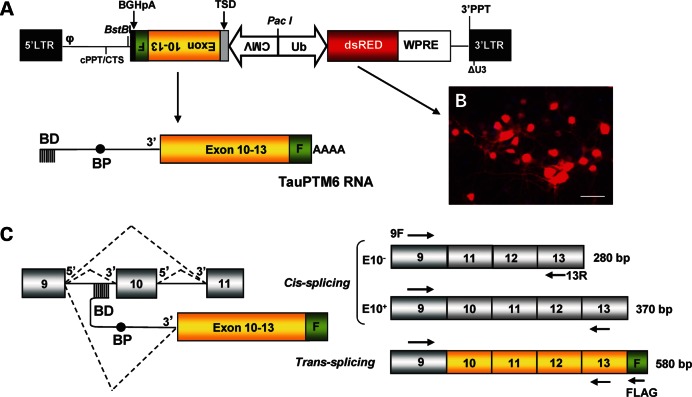
Figure 1.
Figure 1.
Trans-splicing strategy for lentiviral delivery of TauPTM6. (A) Map of the LV designed for simultaneous delivery of TauPTM6 and DsRed. The viral backbone comprises: LTR, long-terminal repeat; φ, HIV encapsidation sequence; cPPT, central polypurine tract; CTS, central termination sequence; 3′PPT, 3′polypurine tract; ΔU3, deletion of the U3 portion of 3′LTR. The DsRed reporter cassette consists of DsRed under the human ubiquitin promoter (in the 5′–3′ direction) followed by the WPRE sequence. In the 3′–5′ direction, under the CMV promoter, the TauPTM6 sequence consists of a trans-splicing domain (TSD) comprising a 125 nt binding domain (BD) complementary to the 3′ end of tau intron 9, a branch point (BP) and the 3′AG splice acceptor site followed by tau exons 10–13, the FLAG epitope sequence (F) and the bovine growth hormone (BGH) polyadenylation signal. (B) DsRed expression in mouse cortical neurons transduced with LV-TauPTM6. Scale bar: 100 μm. (C) RT–PCR strategy to detect cis- and trans-splicing products. Schematic representation of cis- and trans-splicing events from tau pre-RNA (left) and the corresponding mRNA products (right). Arrows indicate the position of forward (9F) or reverse (13R, FLAGR) PCR primers. The expected size of PCR products is indicated for each splicing product.
Figure 2.
Figure 2.
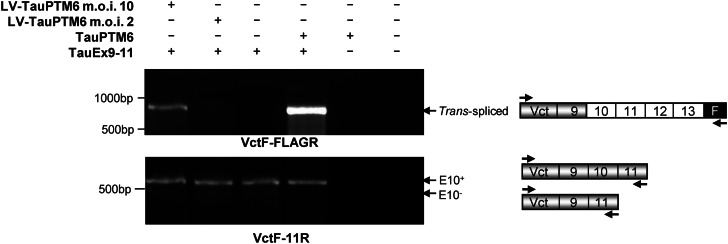
Trans-splicing modulation of E10 inclusion in tau transcripts. HeLa cells were transduced with LV-TauPTM6 and 2 to 3 days later were transfected with the TauEx9-11 minigene consisting of tau exons 9-10-11 and 498 bp 5′ and 264 bp 3′ of intronic sequences flanking E10. HeLa cells co-transfected with TauEx9-11 and TauPTM6 in pcDNA3 were used as a positive control. RT–PCR analysis with the forward primer VctF, specific for the target minigene and the PTM-specific reverse primer FLAGR, complementary to the FLAG epitope sequence, demonstrate trans-splicing between minigene transcripts and TauPTM6 (top panel). Both cis- and trans-spliced products were detected by RT–PCR with the forward primer VctF and the reverse primer 11R, corresponding to an exon 11 sequence; transduction with LV-TauPTM6 resulted in an increase in E10 inclusion (bottom panel).
Figure 3.
Figure 3.
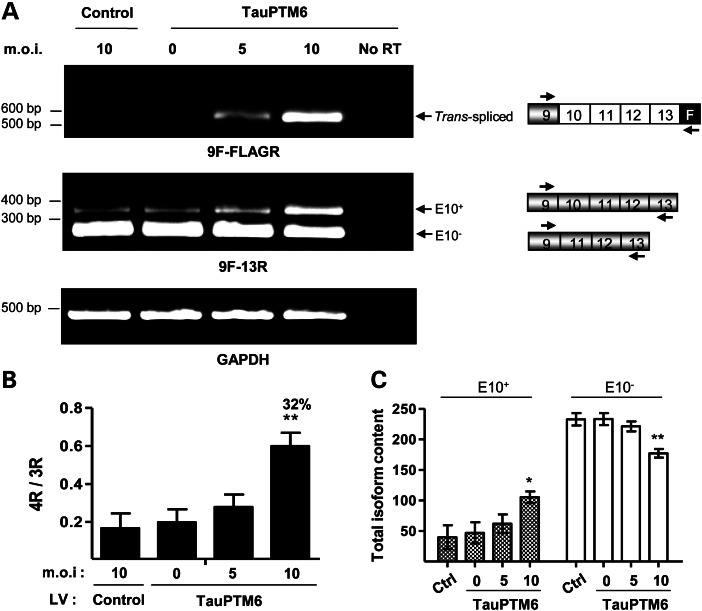
Trans-splicing reprogramming of endogenous tau RNA in SH-SY5Y cells after lentivirus-mediated PTM delivery. Human neuroblastoma SH-SY5Y cells were transduced with LV-TauPTM6 at the indicated m.o.i., or with a control LV at m.o.i. = 10. Total RNA was extracted 7 days after transduction and reverse-transcribed. (A) PCR analysis of reverse-transcribed RNA from transduced cells. Top panel: PCR analysis with 9F-FLAGR primers detects a product of 580 bp only in cells transduced with LV-TauPTM6. Middle panel: 3R and 4R tau isoforms were detected with primers 9F and 13R. An increase in 4R tau RNA was observed in LV-TauPTM6-transduced cells. GAPDH mRNA was used for normalization (bottom panel). No RT: PCR with no RT using RNA from cells transduced with LV-TauPTM6 at m.o.i. = 10. (B) Quantitative analysis of 4R/3R tau RNA ratio. The 4R/3R ratios are expressed as mean ± SEM (*P < 0.05, **P < 0.01, n = 3). The percentage of isoform conversion is indicated above the respective bars. (C) Individual values of 4R and 3R tau RNA content for each condition. Values are expressed in arbitrary units as mean ± SEM (*P < 0.05, **P < 0.025, n = 3).
Figure 4.
Figure 4.
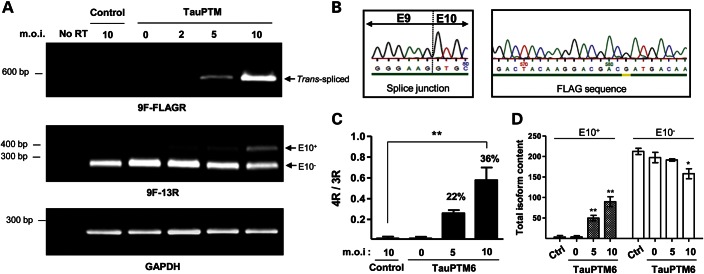
Correction of tau mis-splicing in cultured cortical neurons from htau mouse after lentivirus-mediated PTM delivery. Cultured cortical neurons from htau mice were transduced at DIV3 with LV-TauPTM6 at the indicated m.o.i., or with a control LV at m.o.i. = 10. Total RNA was extracted 7 days after transduction and reverse-transcribed. (A) PCR analysis of reverse-transcribed RNA from transduced neurons. Top panel: a 580 bp PCR product was detected with 9F-FLAGR primers only in neurons transduced with LV-TauPTM6 at m.o.i. = 5 and 10. Middle panel: 3R and 4R tau isoforms were detected with primers 9F and 13R. GAPDH mRNA was used for normalization (bottom panel). No RT: PCR with no RT using RNA from cells transduced with LV-TauPTM6 at m.o.i. = 10. (B) Details of the sequence of the 9F-FLAGR PCR product showing a correct splice junction between exons 9 and 10 and the presence of the FLAG epitope sequence at the 3′ end of the trans-spliced product. (C) Quantitative analysis of 4R/3R tau RNA ratios. 4R/3R ratios are expressed as mean ± SEM (**P < 0.01, n = 3). The percentage of isoform conversion is indicated above the respective bars. (D) Individual values of 4R and 3R tau RNA content. Values are expressed in arbitrary units as mean ± SEM (*P < 0.05, **P < 0.025, n = 2).
Figure 5.
Figure 5.
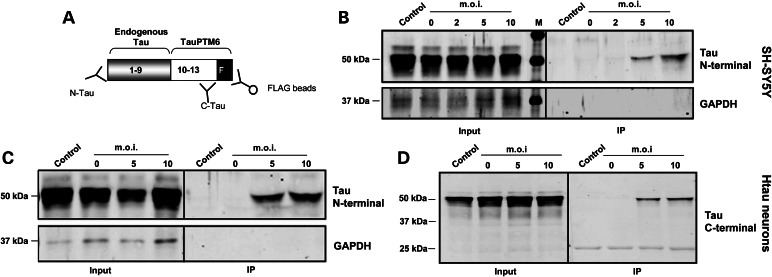
Translation of trans-spliced RNA into a chimeric protein. (A) Diagram of the strategy used for the detection of chimeric proteins by immunoprecipitation. An immobilized mouse monoclonal FLAG antibody was used to immunoprecipitate chimeric proteins. Immunoprecipitated proteins were analyzed by western blotting with N-terminal or C-terminal tau antibodies. The N-terminal part of the protein (grey box) corresponds to the part encoded by endogenous RNA (exons 1–9) and the C-terminal part (white box) corresponds to the part encoded by the PTM (exons 10–13 and FLAG epitope). (B–D) Immunoprecipitation analysis of FLAG-containing proteins from transduced cells. SH-SY5Y cells (B) or cortical neurons from htau mice at DIV3 (C and D) were transduced with LV-TauPTM6 at the indicated m.o.i. or with a control lentivirus (m.o.i. = 10). Transduced cells were lysed 14–16 days later and proteins immunoprecipitated with a FLAG antibody were analyzed by western blotting with an N-terminal tau antibody, a GAPDH antibody (B and C) or a C-terminal tau antibody (D) (input: 5 μl of cell lysate before immunoprecipitation). All samples had similar levels of tau before immunoprecipitation. No GAPDH immunoreactivity was detected in immunoprecipitates, ruling out non-specific precipitation by the FLAG antibody or by the affinity gel.
Figure 6.
Figure 6.
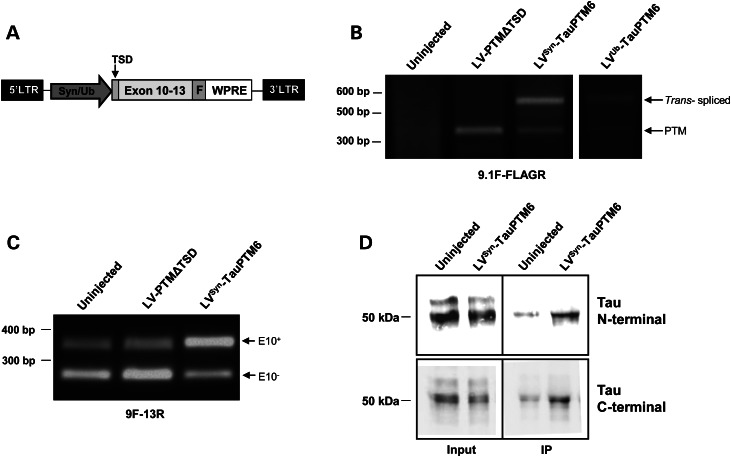
Correction of tau mis-splicing in vivo in adult htau mouse brain. (A) Map of LVSyn-TauPTM6/LVUb-TauPTM6 designed for TauPTM6 delivery in vivo. The viral backbone is the same as for LV-TauPTM6 (Fig. 1). TauPTM6 is under the control of the synapsin promoter or of the ubiquitin promoter and is followed by the WPRE sequence (TSD: trans-splicing domain; F: FLAG epitope sequence). LVSyn-TauPTM6 or LVUb-TauPTM6 was stereotaxically injected into the prefrontal cortex of 12–14-week-old htau mice; control mice were uninjected or injected with an LV expressing a PTM lacking the trans-splicing domain (LV-PTMΔTSD). RNA and protein were analyzed 8 months after injection. (B). RT–PCR analysis with the 9.1F-FLAGR primer combination. In addition to a 360 bp product, demonstrating PTM expression, a 550 bp trans-spliced product was detected after injection with LVSyn-TauPTM6 or LVUb-TauPTM6. (C) RT-PCR analysis with the 9F-13R primer combination, demonstrating an increase in 4R tau mRNA after injection with LVSyn-TauPTM6. (D) Immunoprecipitation analysis of FLAG-containing proteins using N- or C- terminal tau antibodies (Input: 5 μl of brain homogenate before immunoprecipitation). An increased signal was detected with both antibodies after injection with LVSyn-TauPTM6.

References

    1. Ballatore C., Lee V.M., Trojanowski J.Q. Tau-mediated neurodegeneration in Alzheimer's disease and related disorders. Nat. Rev. Neurosci. 2007;8:663–672. - PubMed
    1. Morris M., Maeda S., Vossel K., Mucke L. The many faces of tau. Neuron. 2011;70:410–426. - PMC - PubMed
    1. Gallo J.-M., Noble W., Rodriguez Martin T. RNA and protein-dependent mechanisms in tauopathies: consequences for therapeutic strategies. Cell. Mol. Life Sci. 2007;64:1701–1714. - PMC - PubMed
    1. Hutton M., Lendon C.L., Rizzu P., Baker M., Froelich S., Houlden H.H., Pickering Brown S., Chakraverty S., Isaacs A., Grover A., et al. Association of missense and 5′-splice-site mutations in tau with the inherited dementia FTDP-17. Nature. 1998;393:702–704. - PubMed
    1. Spillantini M.G., Murrell J.R., Goedert M., Farlow M.R., Klug A., Ghetti B. Mutation in the tau gene in familial multiple system tauopathy with presenile dementia. Proc. Natl Acad. Sci. USA. 1998;95:7737–7741. - PMC - PubMed

Publication types