. 2013 Jun 1;207(11):1694-702.
doi: 10.1093/infdis/jit086. Epub 2013 Mar 4.

Long-term reduction in peripheral blood HIV type 1 reservoirs following reduced-intensity conditioning allogeneic stem cell transplantation

Affiliations

Long-term reduction in peripheral blood HIV type 1 reservoirs following reduced-intensity conditioning allogeneic stem cell transplantation

Timothy J Henrich et al. J Infect Dis. .

Abstract

Background: The long-term impact of allogeneic hematopoietic stem cell transplantation (HSCT) on human immunodeficiency virus type 1 (HIV-1) reservoirs in patients receiving combination antiretroviral therapy (cART) is largely unknown.

Methods: We studied the effects of a reduced-intensity conditioning allogeneic HSCT from donors with wild-type-CCR5(+) cells on HIV-1 peripheral blood reservoirs in 2 patients heterozygous for the ccr5Δ32 mutation. In-depth analyses of the HIV-1 reservoir size in peripheral blood, coreceptor use, and specific antibody responses were performed on samples obtained before and up to 3.5 years after HSCT receipt.

Results: Although HIV-1 DNA was readily detected in peripheral blood mononuclear cells (PBMCs) before and 2-3 months after HSCT receipt, HIV-1 DNA and RNA were undetectable in PBMCs, CD4(+) T cells, or plasma up to 21 and 42 months after HSCT. The loss of detectable HIV-1 correlated temporally with full donor chimerism, development of graft-versus-host disease, and decreases in HIV-specific antibody levels.

Conclusions: The ability of donor cells to engraft without evidence of ongoing HIV-1 infection suggests that HIV-1 replication may be fully suppressed during cART and does not contribute to maintenance of viral reservoirs in peripheral blood in our patients. HSCTs with wild-type-CCR5(+) donor cells can lead to a sustained reduction in the size of the peripheral reservoir of HIV-1.


Figures
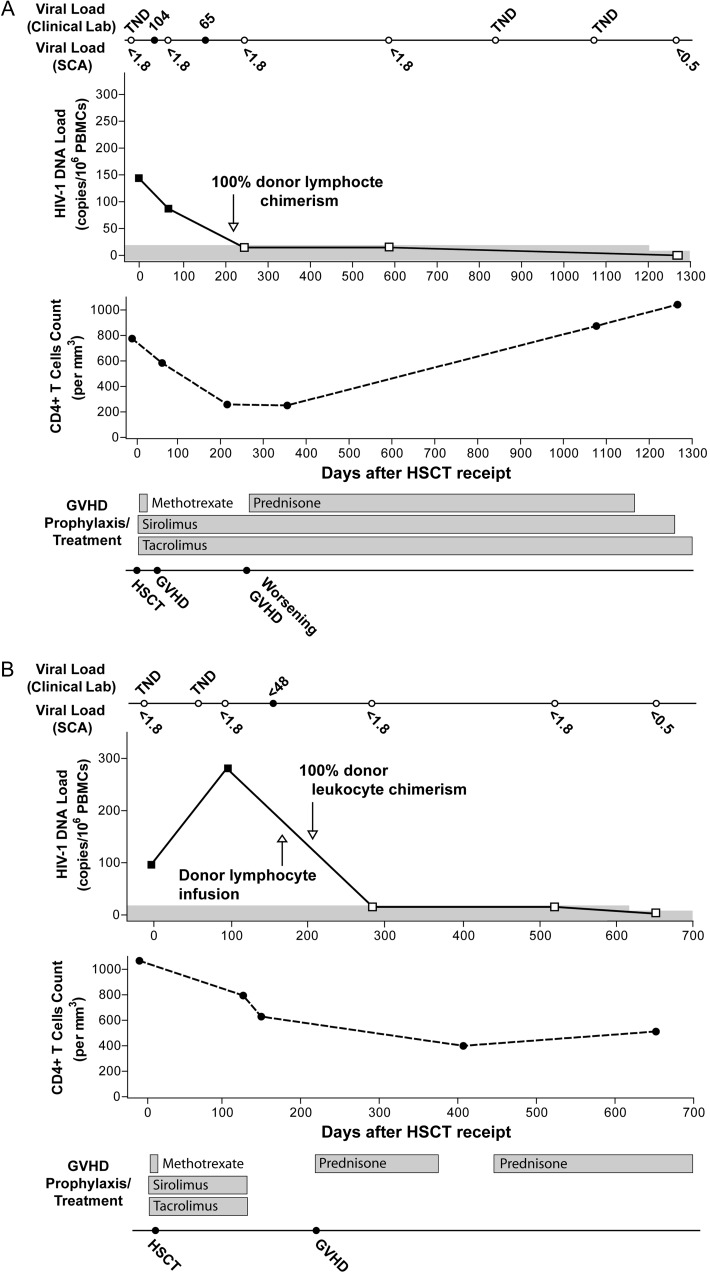
Figure 1.
Figure 1.
Clinical course after allogeneic hematopoietic stem cell transplant (HSCT) receipt, including longitudinal changes in plasma levels of human immunodeficiency virus type 1 (HIV-1), cell-associated HIV-1 DNA, absolute CD4+ T-cell counts, and graft-versus-host disease therapy for patient A (A) and patient B (B). Viral load measurements are shown above and below the solid line on top of each figure. Results from clinical viral load testing, using the Cobas Taqman real-time polymerase chain reaction (PCR) assay (v. 1), are shown above the line (solid circles represent time points when RNA target was detected, whereas open circles denote time points when no target was detected; <48, detectable virus load below the assay limit of quantification of 48 copies/mL). Numbers below the line represent the limit of detection of a highly sensitive, single-copy real-time PCR assay (SCA) in copies per milliliter; no RNA was detected by SCA at any time point. HIV-1 peripheral blood mononuclear cell (PBMC) DNA became undetectable in both patients after full donor chimerism, and no DNA was detected in purified CD4+ T cells from the last assay time point (days 1266 and 562 after transplantation for patients A and B, respectively). The approximate relative sensitivity for HIV-1 DNA is represented by the top of the gray line, and open symbols represent the assay detection threshold for negative results. Viral coculture of highly stimulated, purified CD4+ T cells obtained from the last time point yielded no detectable HIV-1 p24 antigen from assay supernatants. Loss of detectable HIV-1 DNA and RNA was associated with recovery or plateau of absolute CD4+ T-cell counts. Abbreviations: TND, target not detected; GVHD, graft-versus-host disease; Lab, laboratory.
Figure 2.
Figure 2.
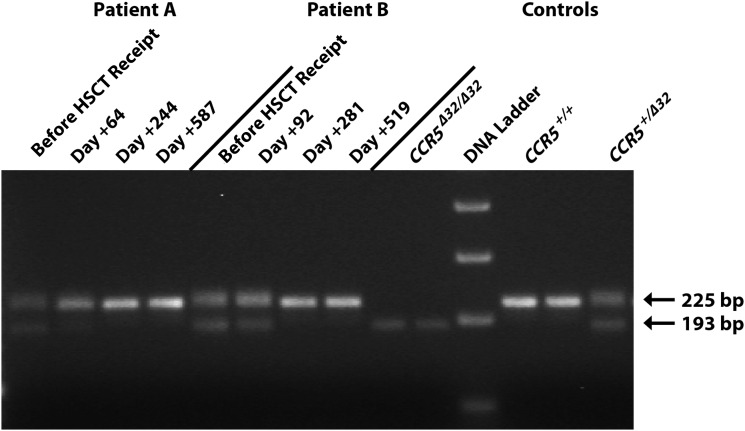
Agarose gel electrophoresis of peripheral blood mononuclear cell polymerase chain reaction DNA products from a 225-bp segment of the gene encoding human CCR5 before and after hematopoietic stem cell transplant (HSCT) receipt by patients A and B. Control patients with a known homozygous wild-type genotype (CCR5+/+), a heterozygous Δ32 genotype (CCR5+/Δ32), and a homozygous Δ32 genotype (CCR5Δ32/Δ32) are shown on the right for comparison. The 193-bp band represents the presence of a Δ32 mutant sequence. Both patients were CCR5+/Δ32 prior to HSCT receipt, but only the gene encoding wild-type CCR5 was detected by full-length CCR5 sequencing following donor cell chimerism. The image has been cropped and brightened, but the bands shown have not been individually modified or repositioned, and no nonlinear adjustments have been made.
Figure 3.
Figure 3.
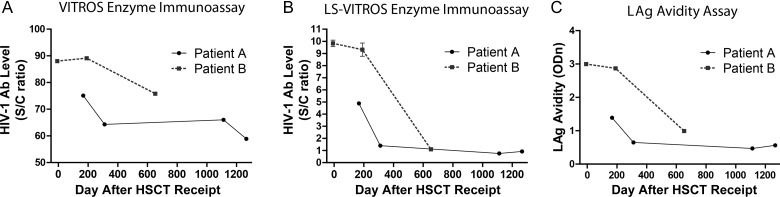
Human immunodeficiency virus type 1 (HIV-1)–specific antibody (Ab) levels and antigen avidity decreased following hematopoietic stem cell transplant receipt by patients A and B. A, Ab levels were measured using the VITROS Anti-HIV-1 + 2 enhanced chemiluminescence detection assay, as well as a less sensitive (LS) version with 1:400 diluted plasma (B). C, Avidity was measured using a limiting-antigen (LAg) avidity enzyme immunoassay. Abbreviations: ODn, normalized optical density; S/C, sign to cutoff.

References

    1. Margolis DM. Histone deacetylase inhibitors and HIV latency. Curr Opin HIV AIDS. 2011;6:25–9. - PMC - PubMed
    1. Siliciano RF. What do we need to do to cure HIV infection. Top HIV Med. 2010;18:104–8. - PubMed
    1. Allers K, Hutter G, Hofmann J, et al. Evidence for the cure of HIV infection by CCR5{Delta}32/{Delta}32 stem cell transplantation. Blood. 2010;117:2791–9. - PubMed
    1. Hutter G, Nowak D, Mossner M, et al. Long-term control of HIV by CCR5 Delta32/Delta32 stem-cell transplantation. N Engl J Med. 2009;360:692–8. - PubMed
    1. Yukl SA, Chun T, Strain MC, et al. Challenges inherent in detecting HIV persistence during potentially curative interventions. Antiviral Therapy. 2012;17:A47.

Publication types