


2012 Liver resections in the 21st century: we are far from zero mortality
- PMID: 23461811
- PMCID: PMC4503289
- DOI: 10.1111/hpb.12069
2012 Liver resections in the 21st century: we are far from zero mortality
Abstract
Objectives: Recent improvements in surgical technique have extended the indications for liver resection. The aims of this study were to assess whether this extension is associated with a changing patient profile and to evaluate how this potential shift has influenced mortality after liver resection in order to define standard expectations for hepatectomy.
Methods: The characteristics and postoperative outcomes of all patients undergoing elective hepatectomy from 2000 to 2009 were reviewed retrospectively. Multivariate analysis was conducted to determine the factors associated with mortality in the subgroup of patients with malignant disease.
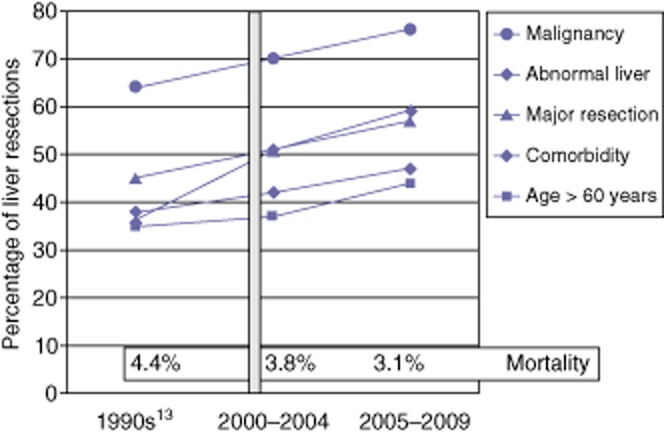
Results: Among the 2012 patients in whom hepatectomies were performed, the percentage of patients operated for malignancy increased from 66.4% in 2000 to 82.3% in 2009 (P < 0.001). These patients experienced higher mortality (4.5% versus 0.7%; P < 0.001), were significantly older, and displayed greater comorbidity and underlying parenchymal disease compared with those with benign lesions. Mortality over the entire study period was 3.5% and was fairly stable, dropping from 3.8% in 2000 to 3.1% in 2009 (P = 0.686). On multivariate analysis, age of >60 years, an American Society of Anesthesiologists score of ≥3, major resection, vascular procedure, severe fibrosis (F3-F4) and steatosis of >30% were associated with increased mortality in patients with malignant disease.
Conclusions: The profile of patients undergoing liver resection has changed and now includes more high-risk patients with diseased parenchyma undergoing major hepatectomy for malignancy. This change in patient profile is responsible for the stability in mortality rates over the years.
© 2013 International Hepato-Pancreato-Biliary Association.
Figures
References
-
- Imamura H, Seyama Y, Kokudo N, Maema A, Sugawara Y, Sano K, et al. One thousand fifty-six hepatectomies without mortality in 8 years. Arch Surg. 2003;138:1198–1206. - PubMed
-
- Kamiyama T, Nakanishi K, Yokoo H, Kamachi H, Tahara M, Yamashita K, et al. Perioperative management of hepatic resection toward zero mortality and morbidity: analysis of 793 consecutive cases in a single institution. J Am Coll Surg. 2010;211:443–449. - PubMed
MeSH terms
LinkOut - more resources
Full Text Sources
Other Literature Sources
Medical
Miscellaneous
