Review
. 2013:369:167-98.
doi: 10.1007/978-3-642-27340-7_7.

Hepatitis C virus RNA replication

Affiliations
Review

Hepatitis C virus RNA replication

Volker Lohmann. Curr Top Microbiol Immunol. 2013.

Abstract

Genome replication is a crucial step in the life cycle of any virus. HCV is a positive strand RNA virus and requires a set of nonstructural proteins (NS3, 4A, 4B, 5A, and 5B) as well as cis-acting replication elements at the genome termini for amplification of the viral RNA. All nonstructural proteins are tightly associated with membranes derived from the endoplasmic reticulum and induce vesicular membrane alterations designated the membranous web, harboring the viral replication sites. The viral RNA-dependent RNA polymerase NS5B is the key enzyme of RNA synthesis. Structural, biochemical, and reverse genetic studies have revealed important insights into the mode of action of NS5B and the mechanism governing RNA replication. Although a comprehensive understanding of the regulation of RNA synthesis is still missing, a number of important viral and host determinants have been defined. This chapter summarizes our current knowledge on the role of viral and host cell proteins as well as cis-acting replication elements involved in the biogenesis of the membranous web and in viral RNA synthesis.


Figures
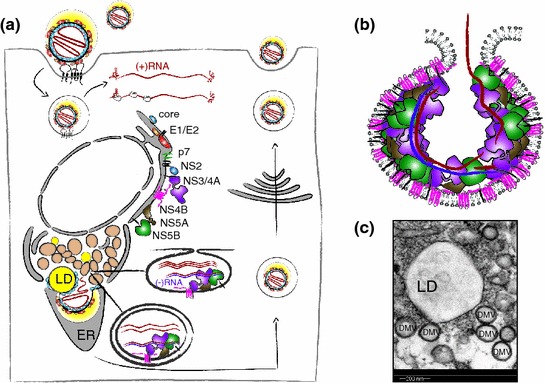
Fig. 1
Fig. 1
a Schematic representation of the HCV replication cycle. Different potential substructures harboring the replication sites based on biochemical evidence as shown in (b) and DMVs recently detected by EM (c) are indicated. b Model of the HCV replication complex based on biochemical evidence (Quinkert et al. 2005). Multiple copies of the nonstructural proteins serve as structural components of a vesicular structure, containing probably only one replication intermediate and several progeny positive strands. Only a minor subfraction of the nonstructural proteins is supposed to have a function in RNA synthesis. A pore should allow the access of nucleotides and the exit of RNA. c Electron micrograph of DMVs in HCV-infected cells 16 h after infection (provided by Inès Romero-Brey unpublished). LD lipid droplet, DMV double membrane vesicle
Fig. 2
Fig. 2
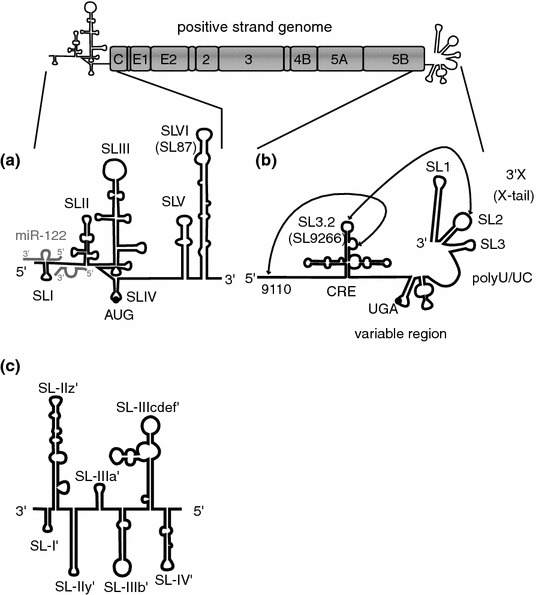
Schematic representation of cis-acting replication elements. a 5′ end of the viral positive strand (Honda et al. 1996). Two copies of miR-122 binding to the 5′NTR are shown in grey. b 3′end of the viral positive strand (Blight and Rice 1997). Long range interactions of SL3.2 with sequences around 9,110 (Tuplin et al. 2012) and with the loop region of SL2 (Friebe et al. 2005) are indicated by arrows. c 3′ end of the viral negative strand (Smith et al. ; McMullan et al. 2007). Alternative nomenclatures of some structures are given in brackets
Fig. 3
Fig. 3
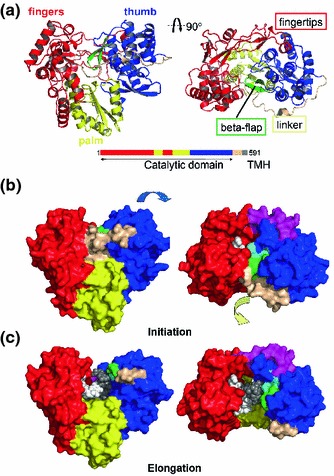
Structure of the HCV polymerase in front views (left panels) and top views (right panels) (Bressanelli et al. 1999). a Ribbon model of HCV NS5B indicating the fingers (red), thumb (blue), palm (yellow) and linker (wheat) subdomains. Note the contact of fingertips and thumb, resulting in a closed structure. The beta flap in the thumb domain is indicated by green color. b Space filling model of the same structures as in (a) with template RNA (light gray) modeled. This structure represents the closed conformation, capable of binding the single-stranded template RNA and the two initiating nucleotides. Structural movements of the thumb and linker domains required for the transition to elongation are indicated by a blue and wheat colored arrow, respectively. c Crystal structure of the elongation mode of NS5B in a complex with a double-stranded replication intermediate consisting of the template RNA (light gray) and newly synthesized RNA (dark gray)

References

    1. Ago H, Adachi T, Yoshida A, Yamamoto M, Habuka N, Yatsunami K, Miyano M. Crystal structure of the RNA-dependent RNA polymerase of hepatitis C virus. Structure. 1999;7:1417–1426. - PubMed
    1. Aizaki H, Lee KJ, Sung VM, Ishiko H, Lai MM. Characterization of the hepatitis C virus RNA replication complex associated with lipid rafts. Virology. 2004;324:450–461. - PubMed
    1. Al RH, Xie YP, Wang YH, Hagedorn CH. Expression of recombinant hepatitis C virus non-structural protein 5B in Escherichia coli. Virus Res. 1998;53:141–149. - PubMed
    1. Ali N, Tardif KD, Siddiqui A. Cell-free replication of the hepatitis C virus subgenomic replicon. J Virol. 2002;76:12001–12007. - PMC - PubMed
    1. Aligo J, Jia S, Manna D, Konan KV. Formation and function of hepatitis C virus replication complexes require residues in the carboxy-terminal domain of NS4B protein. Virology. 2009;393:68–83. - PMC - PubMed

Publication types

LinkOut - more resources