


Identification of ATP synthase as a lipid peroxide protein adduct in pancreatic islets from humans with and without type 2 diabetes mellitus
- PMID: 23463654
- PMCID: PMC3615212
- DOI: 10.1210/jc.2012-4203
Identification of ATP synthase as a lipid peroxide protein adduct in pancreatic islets from humans with and without type 2 diabetes mellitus
Abstract
Context: Most current knowledge of pancreatic islet pathophysiology in diabetes mellitus has come from animal models. Even though islets from humans are readily available, only a few come from diabetic donors. We had the uncommon opportunity to acquire islets from humans with type 2 diabetes and used it to perform a study not previously done with human or animal islets.
Objectives: Oxidative stress has been proposed as a mechanism for impaired β-cell function in type 2 diabetes. Lipid peroxides caused by reactive oxygen species are damaging to body tissues. The objective was to determine whether lipid peroxide-protein adducts occur in pancreatic islets of humans with type 2 diabetes.
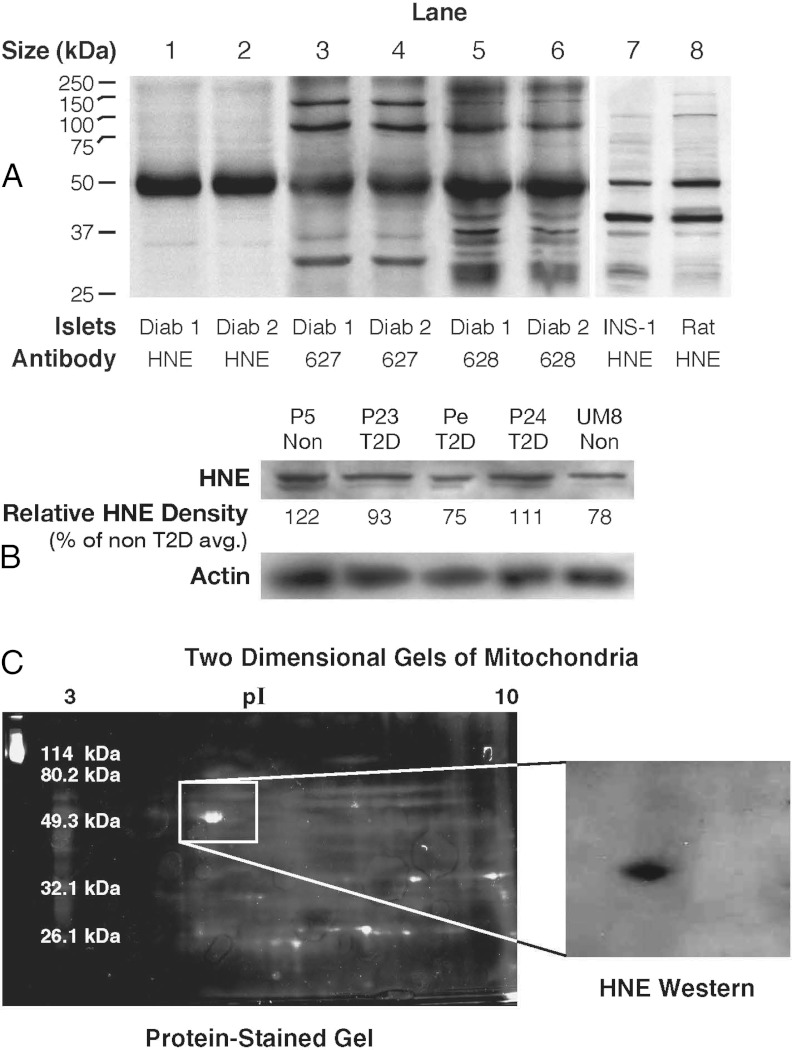
Design: Immunoblots with two antibodies to hydroxynonenal and 2 other antibodies we generated against reactive small aliphatic compounds were used to detect lipid peroxide-protein adducts in islets of patients with type 2 diabetes and controls.
Results: The antibodies reacted strongly to ≥5 islet proteins. The major hydroxynonenal adduct in the islets of type 2 diabetes patients was a 52-kDa protein seen with all 4 antibodies that was also seen in islets of nondiabetic humans, rat islets, and insulinoma cells and in mitochondria of various rat tissues. Nano-LC-MS/MS (liquid chromatography-tandem mass spectrometry) and MALDI-TOF (matrix-assisted laser desorption/ionization-time of flight) analysis identified the protein as the β-chain of the mitochondrial F-ATP synthase, an enzyme responsible for 95% of ATP formed in tissues.
Conclusions: Lipid peroxide-protein adducts occur in β-cells in the nondiabetic state and in diabetes. Lipid peroxidation is thought to be damaging to tissues. Analogous to various other unhealthy characteristics, the presence in nondiabetic individuals of lipid peroxide-protein adducts does not necessarily indicate they are not detrimental.
Figures
References
-
- Brissova M, Fowler MJ, Nicholson WE, et al. Assessment of human pancreatic islet architecture and comparison by laser scanning confocal microscopy. J Histochem Cytochem. 2005;53:1097–1097 - PubMed
-
- MacDonald MJ. Differences between mouse and rat pancreatic islets: succinate responsiveness, malic enzyme, and anaplerosis. Am J Physiol Endocrinol Metab. 2002;283:E302–E310 - PubMed
Publication types
MeSH terms
Substances
Grants and funding
LinkOut - more resources
Full Text Sources
Other Literature Sources
Medical
Miscellaneous
