


Challenges to the measurement of estradiol: an endocrine society position statement
- PMID: 23463657
- PMCID: PMC3615207
- DOI: 10.1210/jc.2012-3780
Challenges to the measurement of estradiol: an endocrine society position statement
Abstract
Objective: The objective of the study was to evaluate the current state of clinical assays for estradiol in the context of their applications.
Participants: The participants were appointed by the Council of The Endocrine Society and charged with attaining the objective using published data and expert opinion.
Evidence: Data were gathered from published sources via online databases (principally PubMed, Ovid MEDLINE, Google Scholar), and the clinical and laboratory experience of the participants.
Consensus process: The statement was an effort of the committee and was reviewed by each member. The Clinical Affairs Committee, the Council of The Endocrine Society, and JCEM reviewers reviewed the manuscript and made recommendations.
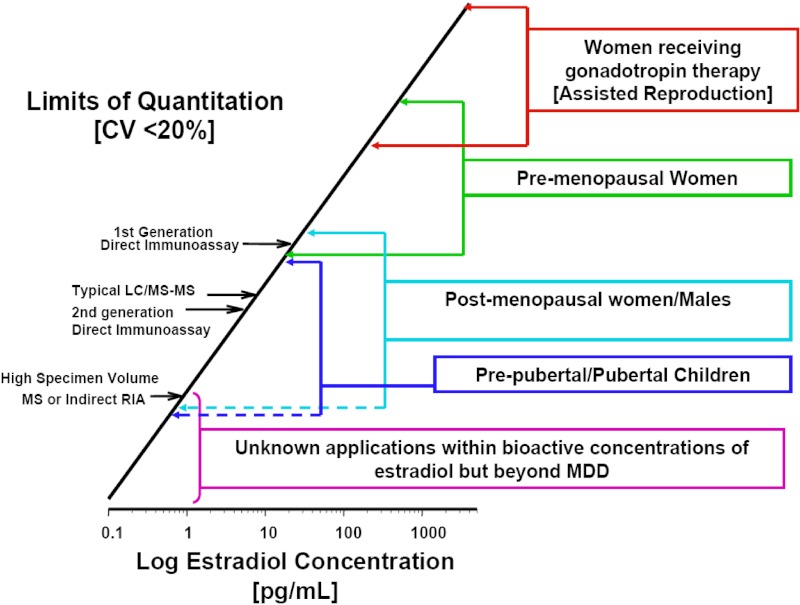
Conclusions: The measurement of estradiol in biological fluids is important in human biology from cradle to grave. In addition to its centrality in sexual development, it has significant effects on skin, blood vessels, bone, muscle, coagulation, hepatic cells, adipose tissue, the kidney, the gastrointestinal tract, brain, lung, and pancreas. Alterations in its plasma concentration have been implicated in coronary artery disease, stroke, and breast cancer. Although modern immunoassays and liquid chromatography/tandem mass spectrometry-based methods for estradiol are reasonably well suited to the diagnosis and management of infertility (nonetheless, imprecision and method-to-method differences remain problematic), the very low concentrations that appear to be crucial in nonreproductive tissues are a separate and more difficult issue. Such levels of estradiol are too low to be routinely measured accurately or precisely, and further evolution of analytical methods and the way in which estradiol is standardized is needed.
Figures
Comment in
-
Measurement of estradiol--challenges ahead.J Clin Endocrinol Metab. 2014 Jan;99(1):56-8. doi: 10.1210/jc.2013-2905. Epub 2013 Dec 20. J Clin Endocrinol Metab. 2014. PMID: 24178793 No abstract available.
References
-
- Rosner W, Auchus RJ, Azziz R, Sluss PM, Raff H. Position statement: utility, limitations, and pitfalls in measuring testosterone: an Endocrine Society position statement. J Clin Endocrinol Metab. 2007;92:405–413 - PubMed
-
- CDC workshop report improving steroid hormone measurements in patient care and research translation. Steroids. 2008;73:1285–1352 - PubMed
-
- Rosner W, Vesper H. Preface. CDC workshop report improving steroid hormone measurements in patient care and research translation. Steroids. 2008;73:1285. - PubMed
-
- Data replication and reproducibility. Science. 2011;334:1225–1233 - PubMed
-
- Abraham GE, Odell WD. Solid-phase immunoassay for estradiol 17-β: a semi-automated approach. In: Peron FG, Caldwell BV, eds. Immunologic methods in steroid determination. New York: Appelton-Century-Crofts; 1970;87–112
Publication types
MeSH terms
Substances
Grants and funding
LinkOut - more resources
Full Text Sources
Other Literature Sources
