Review
. 2013 Mar;193(3):651-69.
doi: 10.1534/genetics.112.146704.

Long noncoding RNAs: past, present, and future

Affiliations
Review

Long noncoding RNAs: past, present, and future

Johnny T Y Kung et al. Genetics. 2013 Mar.

Abstract

Long noncoding RNAs (lncRNAs) have gained widespread attention in recent years as a potentially new and crucial layer of biological regulation. lncRNAs of all kinds have been implicated in a range of developmental processes and diseases, but knowledge of the mechanisms by which they act is still surprisingly limited, and claims that almost the entirety of the mammalian genome is transcribed into functional noncoding transcripts remain controversial. At the same time, a small number of well-studied lncRNAs have given us important clues about the biology of these molecules, and a few key functional and mechanistic themes have begun to emerge, although the robustness of these models and classification schemes remains to be seen. Here, we review the current state of knowledge of the lncRNA field, discussing what is known about the genomic contexts, biological functions, and mechanisms of action of lncRNAs. We also reflect on how the recent interest in lncRNAs is deeply rooted in biology's longstanding concern with the evolution and function of genomes.


Figures

Figure 1
Figure 1
Genomic contexts of lncRNAs. lncRNAs may be stand-alone transcription units, or they may be transcribed from enhancers (eRNAs), promoters (TSSa-RNAs, uaRNAs, pasRNAs, and PROMPTs), or introns of other genes (in this case a protein-coding gene, with start codon ATG and stop codon TGA in white); from pseudogenes (shown here with a premature stop codon TGA in black); or antisense to other genes (NATs) with varying degrees of overlap, from none (divergent), to partial (terminal), to complete (nested). lncRNAs may also host one or more small RNAs (black hairpin) within their transcription units.
Figure 2
Figure 2
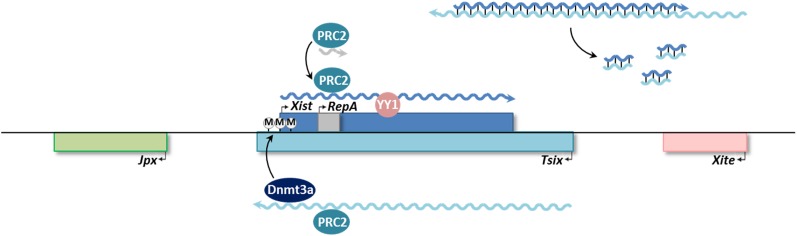
Noncoding loci at the Xic. On Xi, RepA is thought to recruit PRC2 to the Xist promoter to (paradoxically) upregulate transcription. PRC2 may then be loaded onto Xist, which remains tethered to its allele of origin via YY1 interactions with RNA and DNA. Meanwhile on Xa, Tsix expression is believed to repress Xist through a combination of several mechanisms: titrating away PRC2, preventing its proper docking onto RepA/Xist; recruiting Dnmt3a, laying down DNA methylation (Ⓜ) to silence the Xist promoter; and/or directly base pairing with Xist RNA, becoming a substrate for Dicer-dependent processing into small RNAs.
Figure 3
Figure 3
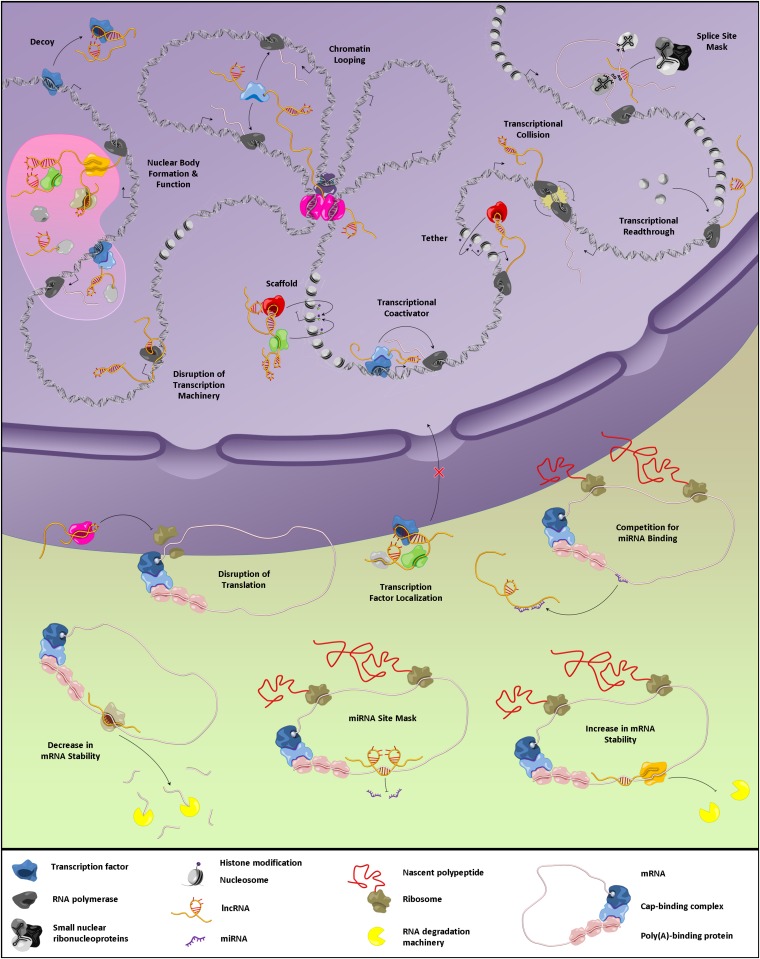
Mechanisms of lncRNA function. See text for detailed discussion.
Figure 4
Figure 4
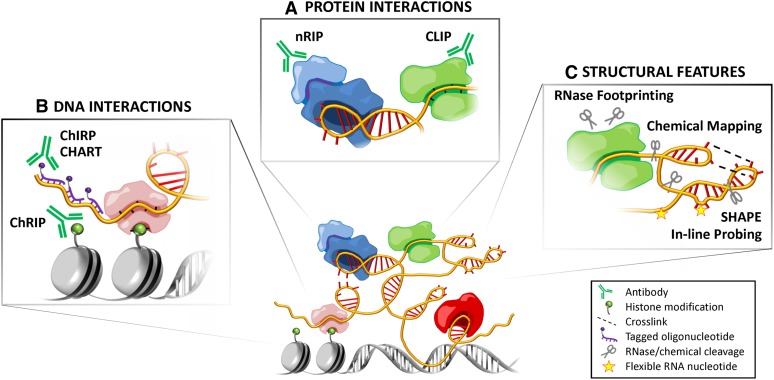
Methods for studying lncRNAs. (A) Protein interactions: Identifying protein partners of lncRNAs provides clues into their functional mechanisms and pathways. RNA-immunoprecipitation (RIP) techniques such as chemical-cross-linked RIP (Selth et al. 2009), native RIP (nRIP) (Zhao et al. 2008), and UV-crosslinked immunoprecipitation (CLIP) (Ule et al. 2005) use antibodies to pull down ribonucleoprotein complexes, from which the associated RNAs are isolated for analysis. Each variation has its own advantages and disadvantages: nRIP avoids cross-linking artifacts, whereas CLIP may be better at avoiding reassociation artifacts and can be used to identify protein-interacting regions (even nucleotides) of the RNA. These techniques are being combined with high-throughput sequencing (e.g., RIP-Seq, HITS-CLIP/CLIP-Seq) to identify lncRNA interactions with a whole host of protein factors (Licatalosi et al. 2008; Zhao et al. 2010), although further validation by mechanistic studies is required. (B) DNA interactions: Several techniques have been developed to identify the genomic targets of lncRNAs. Based on principles of both chromatin immunoprecipitation (ChIP) and RIP, chromatin RNA immunoprecipitation (ChRIP) can be used to identify RNAs associated with a particular chromatin mark (Pandey et al. 2008). On the other hand, techniques such as chromatin oligo-affinity precipitation (ChOP) (Mariner et al. 2008), chromatin isolation by RNA purification (ChIRP) (Chu et al. 2011), and capture hybridization of RNA targets (CHART) (Simon et al. 2011) use tagged complementary oligonucleotides to identify DNA loci that interact with an RNA of interest. (C) Structural features: ncRNAs form specific secondary (base pairing) and tertiary (three-dimensional) structures to carry out their functions. Such structures can be mapped using chemical reagents that cleave at specific nucleotides or attack solvent-exposed regions of the RNA backbone or by cross-linking three-dimensionally proximal regions of the RNA to reveal long-range intramolecular interactions (Weeks 2010). Ribonucleases with different cleavage specificities are also used to identify single- or double-stranded regions, as well as protein-protected regions (RNase footprinting). Other methods such as selective 2′-hydroxyl acylation analyzed by primer extension (SHAPE) (Wilkinson et al. 2006) and in-line probing (Regulski and Breaker 2008) assess local nucleotide flexibility. SHAPE has since been adapted for high-throughput analysis (SHAPE-Seq) (Lucks et al. 2011), joining other techniques that rely on RNase digestion such as fragmentation sequencing (FragSeq) (Underwood et al. 2010) and parallel analysis of RNA structure (PARS) (Kertesz et al. 2010).

References

    1. Agarwal A., Koppstein D., Razowsky J., Sboner A., Habegger L., et al. , 2010. Comparison and calibration of transcriptome data from RNA-Seq and tiling arrays. BMC Genomics 11: 383. - PMC - PubMed
    1. Annilo T., Kepp K., Laan M., 2009. Natural antisense transcript of natriuretic peptide precursor A (NPPA): structural organization and modulation of NPPA expression. BMC Mol. Biol. 10: 81. - PMC - PubMed
    1. Ashe H. L., Monks J., Wijgerde M., Fraser P., Proudfoot N. J., 1997. Intergenic transcription and transinduction of the human beta-globin locus. Genes Dev. 11: 2494–2509. - PMC - PubMed
    1. Au P. C., Zhu Q. H., Dennis E. S., Wang M. B., 2011. Long non-coding RNA-mediated mechanisms independent of the RNAi pathway in animals and plants. RNA Biol. 8: 404–414. - PubMed
    1. Bacher C. P., Guggiari M., Brors B., Augui S., Clerc P., et al. , 2006. Transient colocalization of X-inactivation centres accompanies the initiation of X inactivation. Nat. Cell Biol. 8: 293–299. - PubMed

Publication types

Substances