


Prevalence and patterns of polysubstance use in a nationally representative sample of 10th graders in the United States
- PMID: 23465320
- PMCID: PMC3746553
- DOI: 10.1016/j.jadohealth.2012.12.006
Prevalence and patterns of polysubstance use in a nationally representative sample of 10th graders in the United States
Abstract
Purpose: The current study examines the prevalence and demographic correlates of self-reported substance use and identifies subgroups of polysubstance users among a cohort of United States 10th-grade students.
Methods: A nationally representative school-based cohort of United States 10th-grade students completed the NEXT Generation Health Study baseline survey in spring 2010 (N = 2,524).
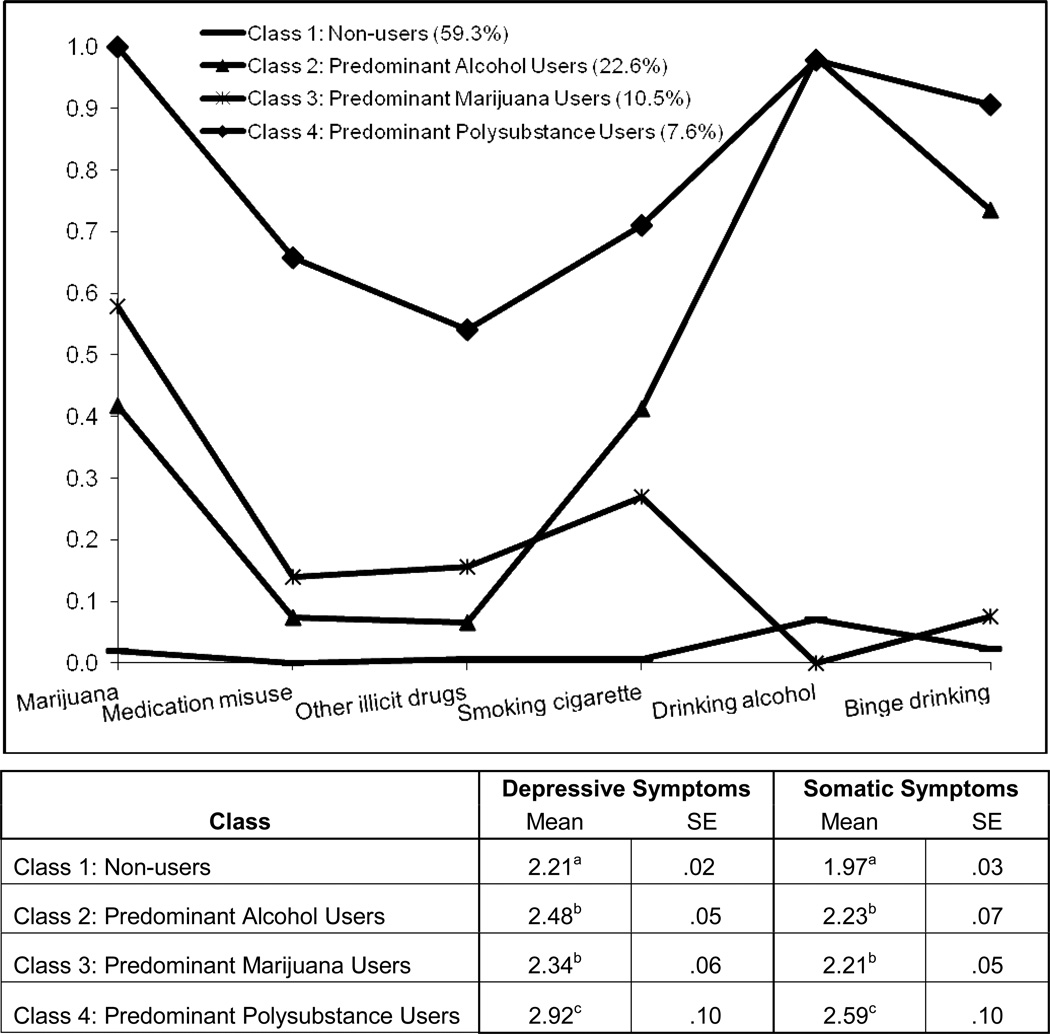
Results: Past-year use of marijuana was most common among illicit drugs (26%), followed by misuse of medication (9%) and use of other illicit drugs (8%). During the past month, alcohol use was reported by more than one third (35%), binge drinking by 27%, and cigarette smoking by 19%. Results further show that substance use varied somewhat by demographic characteristics. Results from the latent class analysis of polysubstance use indicated a four-class solution as the best-fitting model; class 1 (59%) included the nonuser group; class 2 (23%) comprised the predominant alcohol user group; class 3 (11%) formed the predominant marijuana user group; and class 4 (8%) was characterized as the predominant polysubstance user group. Somatic and depressive symptoms varied significantly by class membership, with predominant polysubstance users reporting elevated levels of somatic and depressive symptoms.
Conclusions: The findings from this national study of 10th-grade students indicate high rates of substance and polysubstance use. The high level of depressive and somatic symptoms among polysubstance users indicates the need for mental health screening and referral.
Published by Elsevier Inc.
Conflict of interest statement
Conflicts of Interest: No conflicts of interest are reported.
Figures
References
-
- Johnston LD, O’Malley PM, Bachman JG, Schulenberg JE. Ann Arbor, Institute for Social Research, The University of Michigan; 2012. Monitoring the Future national results on adolescent drug use: Overview of key findings, 2011.
-
- Mitchell CM, Plunkett M. The Latent Structure of Substance Use Among American Indian Adolescents: An Example Using Categorical Variables. American Journal of Community Psychology. 2000;28:105–125. - PubMed
-
- Whitesell NR, Beals J, Mitchell CM, Novins DK, Spicer P, Manson SM. Latent class analysis of substance use: comparison of two American Indian reservation populations and a national sample. J Stud Alcohol. 2006;67:32–43. - PubMed
-
- Dierker LC, Vesel F, Sledjeski EM, Costello D, Perrine N. Testing the dual pathway hypothesis to substance use in adolescence and young adulthood. Drug Alcohol Depend. 2007;87:83–93. - PubMed
Publication types
MeSH terms
Substances
Grants and funding
LinkOut - more resources
Full Text Sources
Other Literature Sources
Medical
Molecular Biology Databases
Miscellaneous
