


Induction of pathogenic TH17 cells by inducible salt-sensing kinase SGK1
- PMID: 23467085
- PMCID: PMC3637879
- DOI: 10.1038/nature11984
Induction of pathogenic TH17 cells by inducible salt-sensing kinase SGK1
Abstract
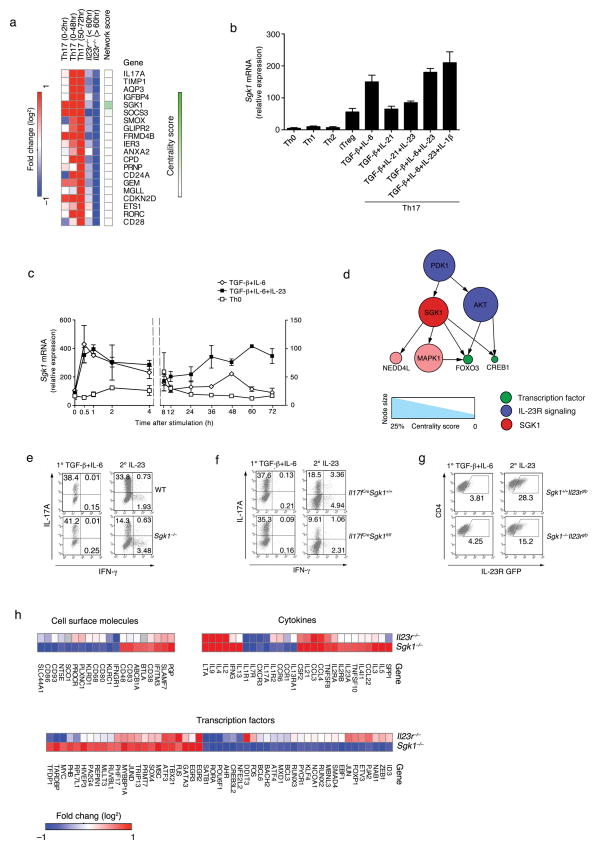
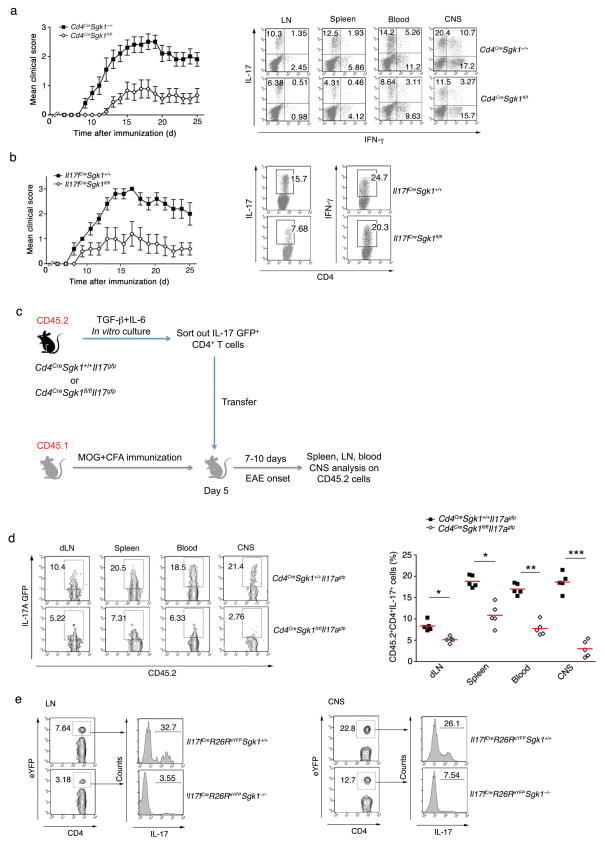
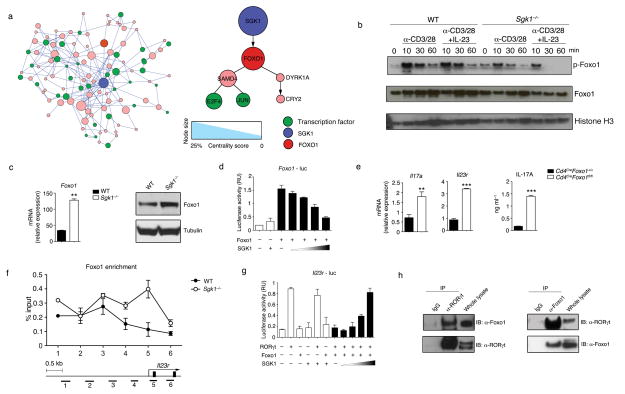
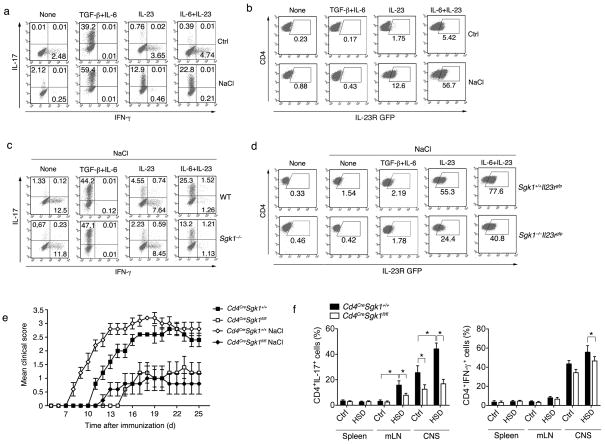
TH17 cells (interleukin-17 (IL-17)-producing helper T cells) are highly proinflammatory cells that are critical for clearing extracellular pathogens and for inducing multiple autoimmune diseases. IL-23 has a critical role in stabilizing and reinforcing the TH17 phenotype by increasing expression of IL-23 receptor (IL-23R) and endowing TH17 cells with pathogenic effector functions. However, the precise molecular mechanism by which IL-23 sustains the TH17 response and induces pathogenic effector functions has not been elucidated. Here we used transcriptional profiling of developing TH17 cells to construct a model of their signalling network and nominate major nodes that regulate TH17 development. We identified serum glucocorticoid kinase 1 (SGK1), a serine/threonine kinase, as an essential node downstream of IL-23 signalling. SGK1 is critical for regulating IL-23R expression and stabilizing the TH17 cell phenotype by deactivation of mouse Foxo1, a direct repressor of IL-23R expression. SGK1 has been shown to govern Na(+) transport and salt (NaCl) homeostasis in other cells. We show here that a modest increase in salt concentration induces SGK1 expression, promotes IL-23R expression and enhances TH17 cell differentiation in vitro and in vivo, accelerating the development of autoimmunity. Loss of SGK1 abrogated Na(+)-mediated TH17 differentiation in an IL-23-dependent manner. These data demonstrate that SGK1 has a critical role in the induction of pathogenic TH17 cells and provide a molecular insight into a mechanism by which an environmental factor such as a high salt diet triggers TH17 development and promotes tissue inflammation.
Comment in
-
Autoimmunity: Rubbing salt in the wound.Nature. 2013 Apr 25;496(7446):437-9. doi: 10.1038/nature11959. Epub 2013 Mar 6. Nature. 2013. PMID: 23467087 No abstract available.
-
T cells: Salt promotes pathogenic TH17 cells.Nat Rev Immunol. 2013 Apr;13(4):225. doi: 10.1038/nri3432. Epub 2013 Mar 15. Nat Rev Immunol. 2013. PMID: 23493117 No abstract available.
-
Does dietary salt induce autoimmunity?Cell Res. 2013 Jul;23(7):872-3. doi: 10.1038/cr.2013.65. Epub 2013 May 7. Cell Res. 2013. PMID: 23649312 Free PMC article.
-
PD research round-up: Sodium sensing: link to (auto)immunity.Perit Dial Int. 2013 Jul-Aug;33(4):348. doi: 10.3747/pdi.2013.00143. Perit Dial Int. 2013. PMID: 23843585 Free PMC article. No abstract available.
-
Salt, immune function, and the risk of autoimmune diseases.Circ Cardiovasc Genet. 2013 Dec;6(6):642-3. doi: 10.1161/CIRCGENETICS.113.000423. Circ Cardiovasc Genet. 2013. PMID: 24347621 No abstract available.
-
High sodium chloride consumption enhances the effects of smoking but does not interact with SGK1 polymorphisms in the development of ACPA-positive status in patients with RA.Ann Rheum Dis. 2016 May;75(5):943-6. doi: 10.1136/annrheumdis-2015-209009. Epub 2016 Feb 22. Ann Rheum Dis. 2016. PMID: 26903441 No abstract available.
References
-
- Korn T, Bettelli E, Oukka M, Kuchroo VK. IL-17 and Th17 Cells. Annu Rev Immunol. 2009;27:485–517. - PubMed
-
- Aggarwal S, Ghilardi N, Xie MH, de Sauvage FJ, Gurney AL. Interleukin-23 promotes a distinct CD4 T cell activation state characterized by the production of interleukin-17. J Biol Chem. 2003;278(3):1910–1914. - PubMed
-
- Zhou L, Ivanov II, Spolski R, Min R, Shenderov K, Egawa T, et al. IL-6 programs T(H)-17 cell differentiation by promoting sequential engagement of the IL-21 and IL-23 pathways. Nat Immunol. 2007;8(9):967–974. - PubMed
-
- Lang F, Bohmer C, Palmada M, Seebohm G, Strutz-Seebohm N, Vallon V. (Patho)physiological significance of the serum- and glucocorticoid-inducible kinase isoforms. Physiol Rev. 2006;86(4):1151–1178. - PubMed
Publication types
MeSH terms
Substances
Associated data
- Actions
- Actions
- Actions
Grants and funding
- R01 NS045937/NS/NINDS NIH HHS/United States
- K01DK090105/DK/NIDDK NIH HHS/United States
- DP1 CA174427/CA/NCI NIH HHS/United States
- HHMI/Howard Hughes Medical Institute/United States
- P01 AI045757/AI/NIAID NIH HHS/United States
- 1P50HG006193-01/HG/NHGRI NIH HHS/United States
- NS045937/NS/NINDS NIH HHS/United States
- P01 AI073748/AI/NIAID NIH HHS/United States
- R29 NS030843/NS/NINDS NIH HHS/United States
- P01 HG005062/HG/NHGRI NIH HHS/United States
- DP1 OD003958/OD/NIH HHS/United States
- R01 NS030843/NS/NINDS NIH HHS/United States
- NS030843/NS/NINDS NIH HHS/United States
- AI045757/AI/NIAID NIH HHS/United States
- DP1-OD003958-01/OD/NIH HHS/United States
- 1P01HG005062-01/HG/NHGRI NIH HHS/United States
- K01 DK090105/DK/NIDDK NIH HHS/United States
- R37 NS030843/NS/NINDS NIH HHS/United States
- P50 HG006193/HG/NHGRI NIH HHS/United States
- AI073748/AI/NIAID NIH HHS/United States
LinkOut - more resources
Full Text Sources
Other Literature Sources
Medical
Molecular Biology Databases
Research Materials
Miscellaneous
