. 2013 Mar 14;495(7440):223-6.
doi: 10.1038/nature11906. Epub 2013 Mar 6.

CALHM1 ion channel mediates purinergic neurotransmission of sweet, bitter and umami tastes

Affiliations

CALHM1 ion channel mediates purinergic neurotransmission of sweet, bitter and umami tastes

Akiyuki Taruno et al. Nature. .

Abstract

Recognition of sweet, bitter and umami tastes requires the non-vesicular release from taste bud cells of ATP, which acts as a neurotransmitter to activate afferent neural gustatory pathways. However, how ATP is released to fulfil this function is not fully understood. Here we show that calcium homeostasis modulator 1 (CALHM1), a voltage-gated ion channel, is indispensable for taste-stimuli-evoked ATP release from sweet-, bitter- and umami-sensing taste bud cells. Calhm1 knockout mice have severely impaired perceptions of sweet, bitter and umami compounds, whereas their recognition of sour and salty tastes remains mostly normal. Calhm1 deficiency affects taste perception without interfering with taste cell development or integrity. CALHM1 is expressed specifically in sweet/bitter/umami-sensing type II taste bud cells. Its heterologous expression induces a novel ATP permeability that releases ATP from cells in response to manipulations that activate the CALHM1 ion channel. Knockout of Calhm1 strongly reduces voltage-gated currents in type II cells and taste-evoked ATP release from taste buds without affecting the excitability of taste cells by taste stimuli. Thus, CALHM1 is a voltage-gated ATP-release channel required for sweet, bitter and umami taste perception.


Figures
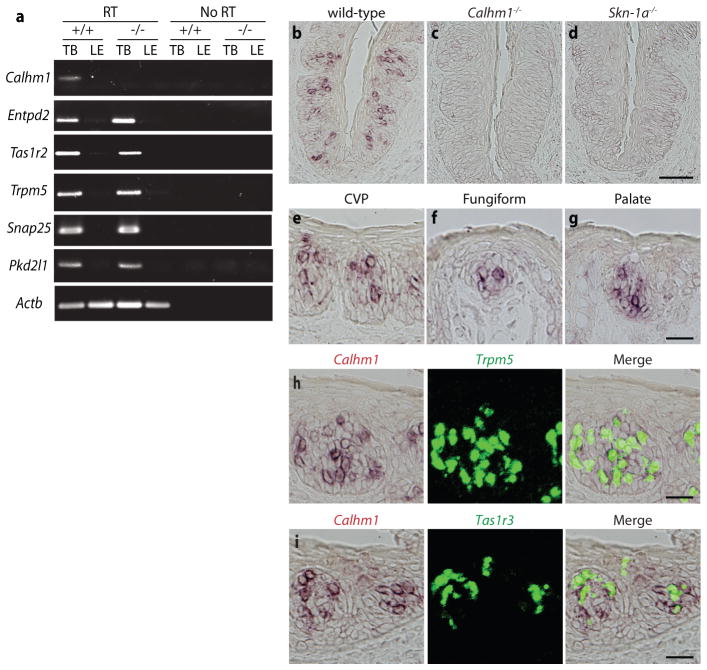
Figure 1
Figure 1. CALHM1 is selectively expressed in type II taste bud cells
(a) RT-PCR of mRNA of Calhm1, Actb (β-actin) and taste cell marker genes from laser micro-dissected circumvallate papillae (CVP) taste buds (TB) and lingual epithelium (LE) in wild-type (+/+) and Calhm1 knock-out (−/−) mouse tongues. RT, reverse transcriptase. (b–d) in situ hybridization of Calhm1 in CVP TB of WT (b), Calhm1−/− (c) and Skn-1a−/− (d) mice. Scale bar, 50 μm. Calhm1 is expressed in subsets of CVP (e), fungiform (f), and palate (g) TB cells. (h) Double-label in situ hybridization directly illustrates cellular co-expression of Calhm1 and Trpm5 in CVP TB. Most cells expressing Trpm5 also express Calhm1, with Calhm1 expression absent in Trpm5 negative cells. (i) CVP TB illustrating that Tas1r3 is expressed in a subset of Calhm1 positive cells. Scale bars for (e–i), 20 μm.
Figure 2
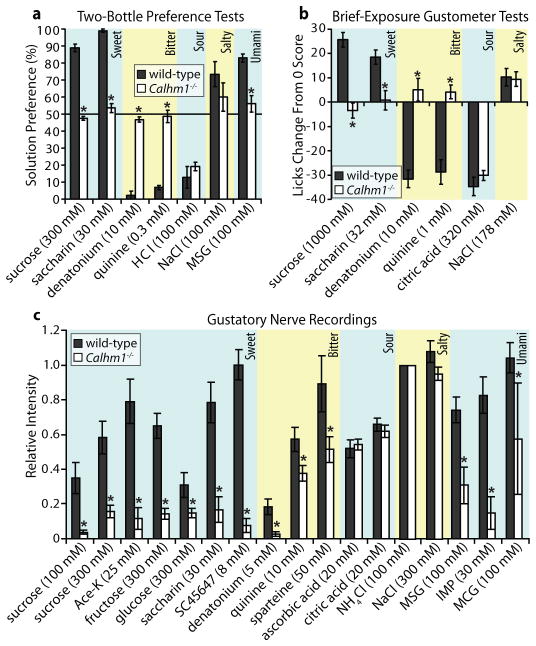
Figure 2. CALHM1 is essential for sweet, bitter and umami taste perception
(a) Mean preference % (taste compound vs. water) from 48 hr two-bottle preference tests and (b) brief-access lick scores to indicated compounds in Calhm1−/− mice and WT littermates. Error bars, s.e. (8–12 mice per group, 4–6 month-old); *P < 0.01 (post hoc Bonferroni’s test for (a) and Student’s t-test for (b)). (c) Summary of responses from whole-chorda tympani nerve recordings stimulated with indicated compounds and normalized to response to NH4Cl from WT (n = 7) and Calhm1−/− (n = 8) mice. MSG, monosodium glutamate; IMP, inosine 5′-monophosphate; MCG, monocalcium di-L-glutamate. Error bars, s.e.; *P < 0.05 (Student’s t-test).
Figure 3
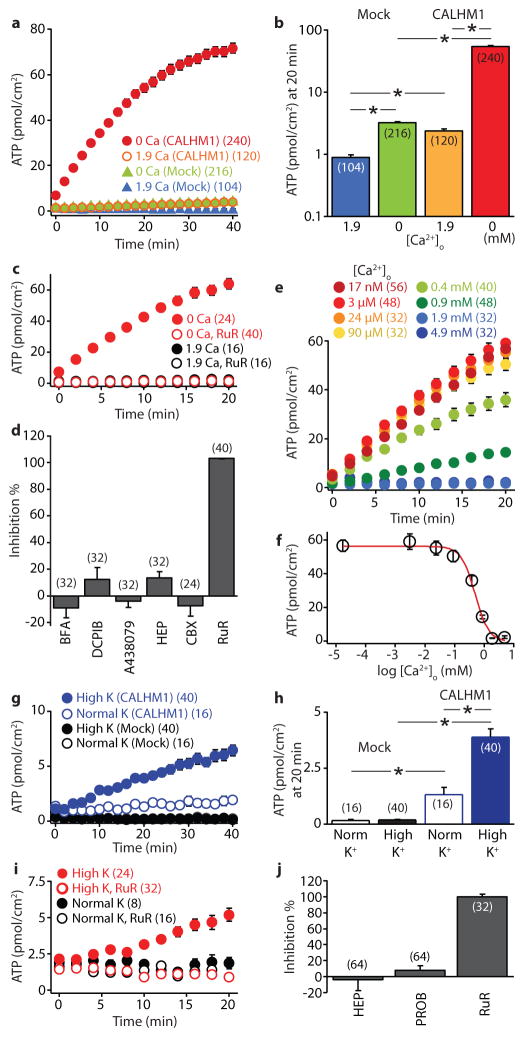
Figure 3. CALHM1 mediates ATP release
(a) Time courses of extracellular ATP levels due to release from mock- and hCALHM1-transfected HeLa cells exposed to normal (1.9 mM) or zero (17 nM) [Ca2+]o. Error bars mostly hidden behind symbols. (b) Summary of extracellular ATP levels at 20 min in (a). (c) Low [Ca2+]o-induced ATP release in CALHM1-expressing cells is abolished by ruthenium red (RuR). (d) Effects on low [Ca2+]o-stimulated ATP release from hCALHM1 cells of 0.5 μg/ml brefeldin A (BFA); 10 μM DCPIB; 3 μM A438079; 1 mM 1-heptanol (HEP); 30 μM carbenoxolone (CBX); 20 μM RuR. (e) Time courses of ATP release from hCALHM1 cells induced by various [Ca2+]o. (f) ATP levels at 20 min in (e) plotted against [Ca2+]o and fitted to a Hill equation. (g) Depolarization by high [K+]o (117.5 mM K+) induces ATP release specifically from hCALHM1 cells. (h) ATP levels at 20 min in (g). (i) Depolarization-induced ATP release from CALHM1-expressing cells is abolished by RuR. (j) Pharmacological sensitivities of depolarization-induced ATP release from hCALHM1 cells. 1 mM HEP, 1 mM probenecid (PROB); 20 μM RuR. Number of wells in parentheses throughout. Error bars, s.e.; *P < 0.01 (Student’s t-test).
Figure 4
Figure 4. CALHM1 is required for taste-evoked ATP release from taste cells
(ac) Electrophysiological phenotypes of types I, II and III cells identified in WT (red) and Calhm1−/− (blue) taste cells. Cells held at −70 mV and pulsed from −80 to +80 mV in 20 mV increments with 1 sec duration. INa (●), Islow at end of pulses (■), and Itail (▲) measured in (df) for type II (n = 9 WT, 10 Calhm1−/−), and (g) type III (n = 9 WT, 6 Calhm1−/−) cells. Type I current recorded from 16 WT, 9 Calhm1−/− cells. (h) Sensitivities of Islow in GFP-positive cells from TRPM5-GFP mice to Gd3+ (100 μM), probenecid (1 mM), 1-heptanol (1 mM) (n = 4). (i) [Ca2+]i in type II cells from WT (left, 9 cells) and Calhm1−/− (right, 12 cells) mice. Type II cells identified by robust [Ca2+]i response to a mix of sweet and bitter substances (gray bar). Basal (j) and taste-evoked responses (k) are comparable in WT and Calhm1−/− cells. (l) Taste-evoked ATP release from gustatory CVP tissue and non-gustatory LE. Bitter mix elicits considerable ATP release from CVP vs. LE in WT mice that is abolished in Calhm1−/− mice and by 1 μM tetrodotoxin (TTX). Error bars, s.e.; *P < 0.05; **P < 0.01. (Student’s t-test). (m) Schematic illustration of signal transduction cascade in type II taste receptor cells with CALHM1 as the ATP release pathway.

References

    1. Chaudhari N, Roper SD. The cell biology of taste. J Cell Biol. 2010;190:285–296. - PMC - PubMed
    1. Ma Z, et al. Calcium homeostasis modulator 1 (CALHM1) is the pore-forming subunit of an ion channel that mediates extracellular Ca2+ regulation of neuronal excitability. Proc Natl Acad Sci U S A. 2012;109:E1963–1971. - PMC - PubMed
    1. Siebert AP, et al. Structural and Functional Similarities of Calcium Homeostasis Modulator 1 (CALHM1) Ion Channel With Connexins, Pannexins and Innexins. J Biol Chem. 2013 - PMC - PubMed
    1. Chandrashekar J, Hoon MA, Ryba NJ, Zuker CS. The receptors and cells for mammalian taste. Nature. 2006;444:288–294. - PubMed
    1. Finger TE, et al. ATP signaling is crucial for communication from taste buds to gustatory nerves. Science. 2005;310:1495–1499. - PubMed

References for Methods

    1. Ohmoto M, Matsumoto I, Misaka T, Abe K. Taste receptor cells express voltage-dependent potassium channels in a cell age-specific manner. Chem Senses. 2006;31:739–746. - PubMed
    1. Dvoryanchikov G, Sinclair MS, Perea-Martinez I, Wang T, Chaudhari N. Inward rectifier channel, ROMK, is localized to the apical tips of glial-like cells in mouse taste buds. J Comp Neurol. 2009;517:1–14. - PMC - PubMed
    1. Sinclair MS, et al. Oxytocin signaling in mouse taste buds. PLoS One. 2010;5:e11980. - PMC - PubMed
    1. Tordoff MG, Bachmanov AA. Mouse taste preference tests: why only two bottles? Chem Senses. 2003;28:315–324. - PMC - PubMed
    1. Damak S, et al. Trpm5 null mice respond to bitter, sweet, and umami compounds. Chem Senses. 2006;31:253–264. - PubMed

Publication types

MeSH terms