


Three-year follow-up of visual outcome and quality of life in patients with age-related macular degeneration
- PMID: 23467557
- PMCID: PMC3589196
- DOI: 10.2147/OPTH.S41585
Three-year follow-up of visual outcome and quality of life in patients with age-related macular degeneration
Abstract
Background: The purpose of this study was to evaluate the visual outcome and self-reported vision-targeted health status in patients treated with intravitreal ranibizumab for wet age-related macular degeneration (AMD).
Methods: A total of 51 eyes from 50 patients aged 76 ± 7 years, with wet AMD not previously treated, were included in this prospective study. Best corrected visual acuity was examined using Early Treatment Diabetic Research Study charts and near vision reading. All patients underwent an ophthalmological examination, including fluorescein and indocyanine green angiography (occult cases) and optical coherence tomography. The Visual Function Questionnaire test was completed before and 37 ± 7 months after the start of intravitreal injections.
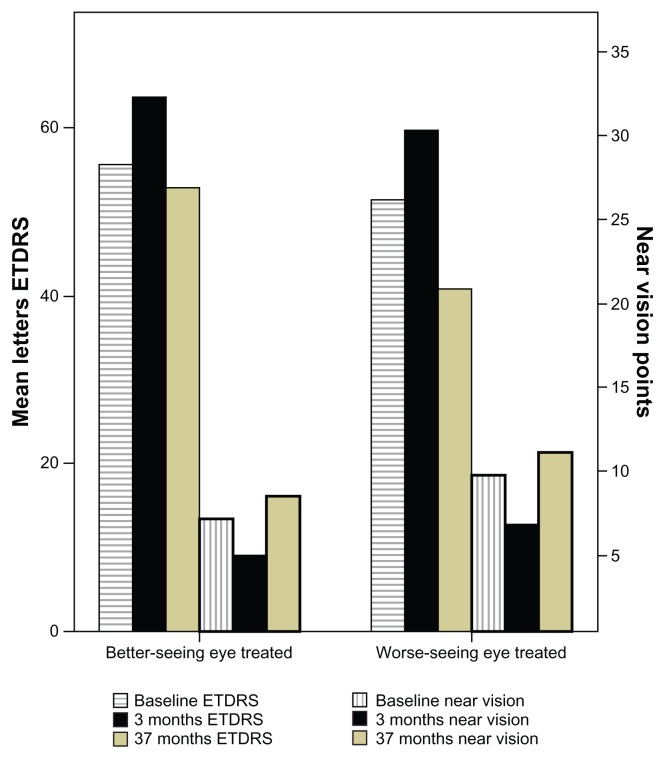
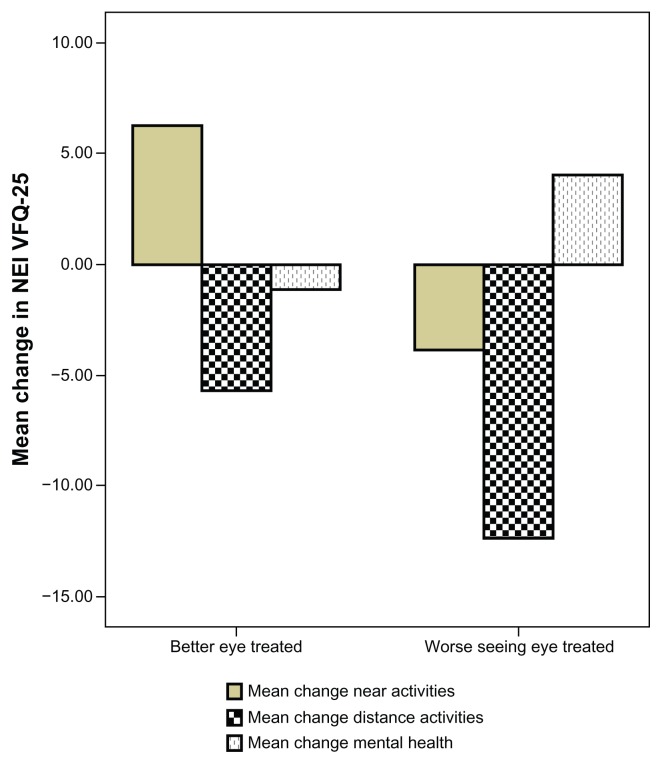
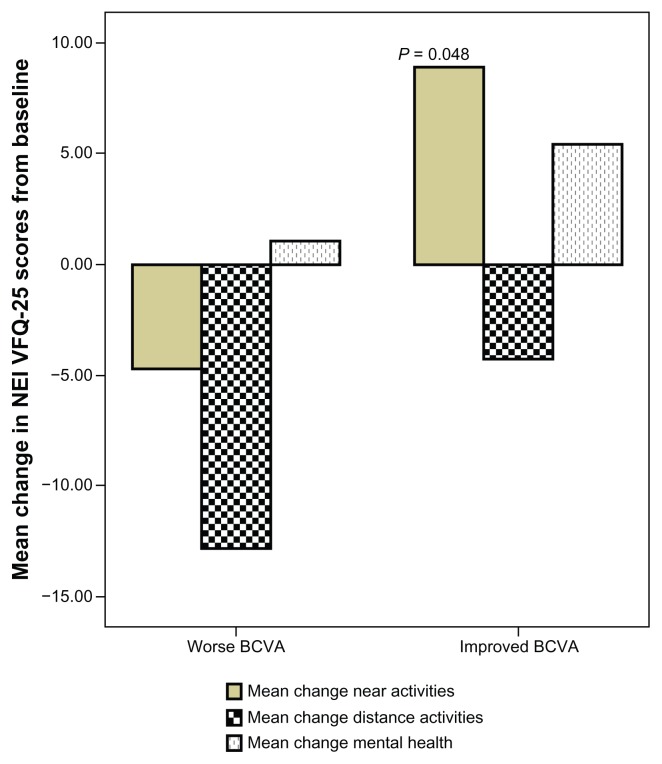
Results: The patients received a mean number of 7.8 ± 5.0 (range 2-22) injections. One month after the third intravitreal injection, significant improvement was seen in both visual acuity (53 ± 14 to 61 ± 14 letter, P = 0.001) and near vision (17 ± 9 to 11 ± 8 points, P = 0.001). During follow-up, mean visual acuity decreased from 53 ± 14 to 44 ± 24 letters (P = 0.011), and near vision decreased from 17 ± 9 to 20 ± 11 points (P = 0.048). Despite visual impairment, the quality of life test revealed no significant decrease in mental health (P = 0.529) or ability to read a newspaper (P = 0.21), but a decrease in distance activities (reading street signs, steps, going to the theater) from 57 ± 27 to 46 ± 31 points (P = 0.007) was documented.
Conclusion: Decreased visual acuity was related to a decrease in self-reported visual function for distance activities, while mental health items, such as worrying, were not influenced.
Keywords: age-related macular degeneration; quality of life; visual outcome.
Figures
Similar articles
-
Significant improvements in near vision, reading speed, central visual field and related quality of life after ranibizumab treatment of wet age-related macular degeneration.Acta Ophthalmol. 2010 Jun;88(4):420-5. doi: 10.1111/j.1755-3768.2009.01576.x. Epub 2009 Aug 12. Acta Ophthalmol. 2010. PMID: 19678811
-
Treatment of neovascular age-related macular degeneration with a variable ranibizumab dosing regimen and one-time reduced-fluence photodynamic therapy: the TORPEDO trial at 2 years.Graefes Arch Clin Exp Ophthalmol. 2010 Jul;248(7):943-56. doi: 10.1007/s00417-009-1256-6. Epub 2010 Mar 4. Graefes Arch Clin Exp Ophthalmol. 2010. PMID: 20204659 Clinical Trial.
-
One-year outcomes of less frequent bevacizumab in age-related macular degeneration.Retina. 2011 Apr;31(4):645-53. doi: 10.1097/IAE.0b013e3182012d18. Retina. 2011. PMID: 21358363
-
Intravitreal bevacizumab (Avastin) therapy for persistent diffuse diabetic macular edema.Retina. 2006 Nov-Dec;26(9):999-1005. doi: 10.1097/01.iae.0000247165.38655.bf. Retina. 2006. PMID: 17151486 Clinical Trial.
-
Intravitreal ranibizumab (Lucentis) for branch retinal vein occlusion-induced macular edema: nine-month results of a prospective study.Retina. 2010 Jun;30(6):893-902. doi: 10.1097/IAE.0b013e3181cd4894. Retina. 2010. PMID: 20531142
Cited by
-
Ranibizumab for the treatment of degenerative ocular conditions.Clin Ophthalmol. 2014 Jun 24;8:1187-98. doi: 10.2147/OPTH.S40350. eCollection 2014. Clin Ophthalmol. 2014. PMID: 25028531 Free PMC article. Review.
-
Contrast sensitivity and binocular reading speed best correlating with near distance vision-related quality of life in bilateral nAMD.Ophthalmic Physiol Opt. 2020 Nov;40(6):760-769. doi: 10.1111/opo.12736. Epub 2020 Sep 22. Ophthalmic Physiol Opt. 2020. PMID: 32959926 Free PMC article.
-
Hypomethylation of the IL17RC promoter in peripheral blood leukocytes is not a hallmark of age-related macular degeneration.Cell Rep. 2013 Dec 26;5(6):1527-35. doi: 10.1016/j.celrep.2013.11.042. Cell Rep. 2013. PMID: 24373284 Free PMC article.
-
No improvement in injection frequency or in visual outcome over time in two cohorts of patients from the same Swedish county treated for wet age-related macular degeneration.Clin Ophthalmol. 2017 Jun 9;11:1105-1111. doi: 10.2147/OPTH.S130182. eCollection 2017. Clin Ophthalmol. 2017. PMID: 28652696 Free PMC article.
-
The management of neovascular age-related macular degeneration: A systematic literature review of patient-reported outcomes, patient mental health and caregiver burden.Acta Ophthalmol. 2023 Feb;101(1):e26-e42. doi: 10.1111/aos.15201. Epub 2022 Jul 5. Acta Ophthalmol. 2023. PMID: 35790079 Free PMC article.
References
-
- Klaver CC, Wolfs RC, Vingerling JR, Hofman A, de Jong PT. Age specific prevalence and causes of blindness and visual impairment in an older population: the Rotterdam Study. Arch Ophthalmol. 1998;116(5):653–658. - PubMed
-
- Bressler NM. Age-related macular degeneration is the leading cause of blindness. JAMA. 2004;291(15):1900–1901. - PubMed
-
- Rosenfeld PJ, Brown DM, Heier JS, et al. for the MARINA Study Group. Ranibizumab for neovascular age-related macular degeneration. N Engl J Med. 2006;355(14):1419–1431. - PubMed
-
- Brown DM, Michels M, Kaiser PK, et al. Ranibizumab versus verteporfin photodynamic therapy for neovascular age-related macular degeneration: two-year results of the ANCHOR study. Ophthalmology. 2009;116(1):57–65. - PubMed
-
- Brown DM, Kaiser PK, Michels M, et al. Ranibizumab versus verteporfin for neovascular age-related macular degeneration. N Engl J Med. 2006;355(14):1432–1444. - PubMed
LinkOut - more resources
Full Text Sources
Other Literature Sources
