


Review
doi: 10.1021/ac303053e.
Epub 2013 Mar 21.
Metaproteomics: harnessing the power of high performance mass spectrometry to identify the suite of proteins that control metabolic activities in microbial communities
Affiliations
- PMID: 23469896
- PMCID: PMC3696428
- DOI: 10.1021/ac303053e
Item in Clipboard
Review
Metaproteomics: harnessing the power of high performance mass spectrometry to identify the suite of proteins that control metabolic activities in microbial communities
Anal Chem.
.
Abstract
The availability of extensive genome information for many different microbes, including unculturable species in mixed communities from environmental samples, has enabled systems-biology interrogation by providing a means to access genomic, transcriptomic, and proteomic information. To this end, metaproteomics exploits the power of high-performance mass spectrometry for extensive characterization of the complete suite of proteins expressed by a microbial community in an environmental sample.
Figures
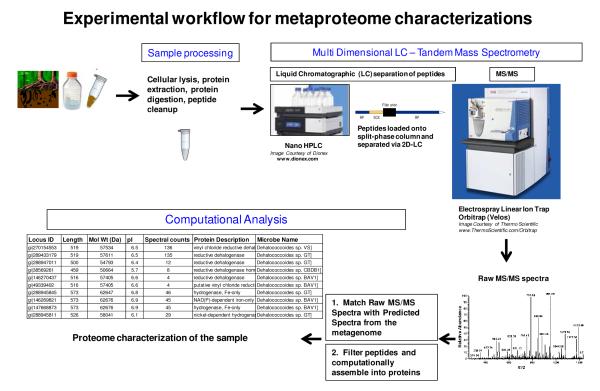
Experimental flowchart for sample preparation and measurement in a metaproteomic experiment. Sample collection and processing steps must be optimized to match the nature of the material to be analyzed, in terms of biomass amount and complexity, matrix composition, sample heterogeneity, etc. The resulting proteome sample is digested with trypsin and loaded onto a bi-phasic HPLC column for concomitant 2D-separation and MS analysis via nanoelectrospray-based ionization of eluting peptides. Acquisition of parent peptide ion (MS1) mass and fragmentation (MS/MS or MS2) information provides an experimental dataset containing hundreds of thousands of spectra that can be computationally matched to the predicted proteome obtained from the metagenome information.
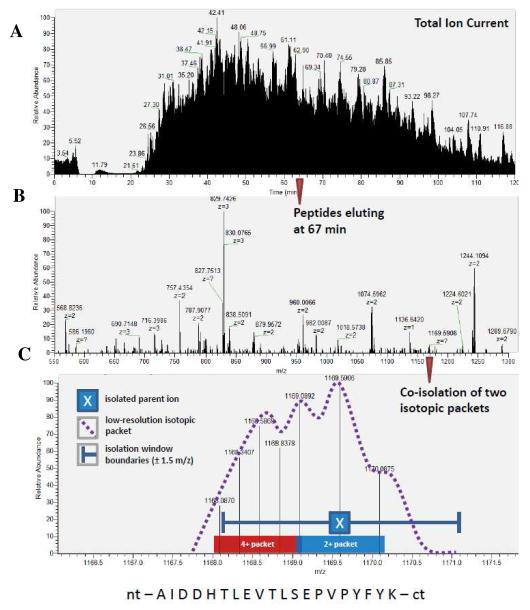
Experimental data from 2D-LC-MS/MS of a simulated microbial consortium consisting of Rhodopseudomonas palustris, Escherichia coli, Ignicoccus hospitalis, and Nanoarchaeum equitans. A) total ion chromatogram of the 2-hour reverse phase measurement of salt pulse #2; B) parent ion mass spectrum (MS1) of the peptides eluting at 67.0 min from the chromatogram in ‘A’ above. All the ions are recorded with mass resolutions of 30,000 and mass accuracies of < 5 ppm. The charge state of each peptide is denoted by ‘z’. Undeciphered charge states, represented by ‘?’, occur when the instrument cannot fully distinguish overlapping isotopic packets; C) zoom expansion of isobaric ion region at nominal m/z 1169, revealing two isotopic packets (manually verified as overlapping 2+ and 4+ ions). Note that a low resolution measurement would not have distinguished the presence of two distinct ions here. The resulting MS/MS measurement revealed the sequence identity (listed below) of the 2+ ion, without confusing it with the co-eluting 4+ ion, even though both isotopic packets we co-isolated and fragmented creating a hybrid MS/MS spectrum.
References
-
- Lander ES, et al. Nature. 2001;409:860–921. - PubMed
-
- Venter JC, et al. Science. 2001;291:1304–1351. - PubMed
-
- Singh J, Behal A, Singla N, Joshi A, Birbian N, Singh S, Bali V, Batra N. Biotechnol J. 2009;4:480–494. - PubMed
-
- Banfield JF, VerBerkmoes NC, Hettich RL, Thelen MP. Omics. 2005;9:301–333. - PubMed
-
- Wilmes P, Bond PL. Environ. Microbiol. 2004;6:911–920. - PubMed
Publication types
MeSH terms
Substances
Grants and funding
LinkOut - more resources
Full Text Sources
Other Literature Sources
Molecular Biology Databases
