


Associations of blood and urinary mercury with hypertension in U.S. adults: the NHANES 2003-2006
- PMID: 23472608
- PMCID: PMC3644317
- DOI: 10.1016/j.envres.2013.02.003
Associations of blood and urinary mercury with hypertension in U.S. adults: the NHANES 2003-2006
Abstract
Background: Few studies have examined the association between hypertension and mercury exposure in the general population. We examined cross-sectional associations between blood (mainly methylmercury) or urinary mercury (mainly inorganic mercury) and hypertension in representative U.S. adults and effect modifications by dietary omega-3 fatty acids and serum selenium.
Methods: We examined 6607 adults aged 20 years or older, using the National Health and Nutrition Examination Survey (NHANES) from 2003/2004 to 2005/2006 (2201 adults were available for urinary mercury from NHANES 2003-2006; 2117 available for serum selenium from NHANES 2003-2004 aged 40 years or older). The average of omega-3 fatty acids from two 24-h recalls was calculated.
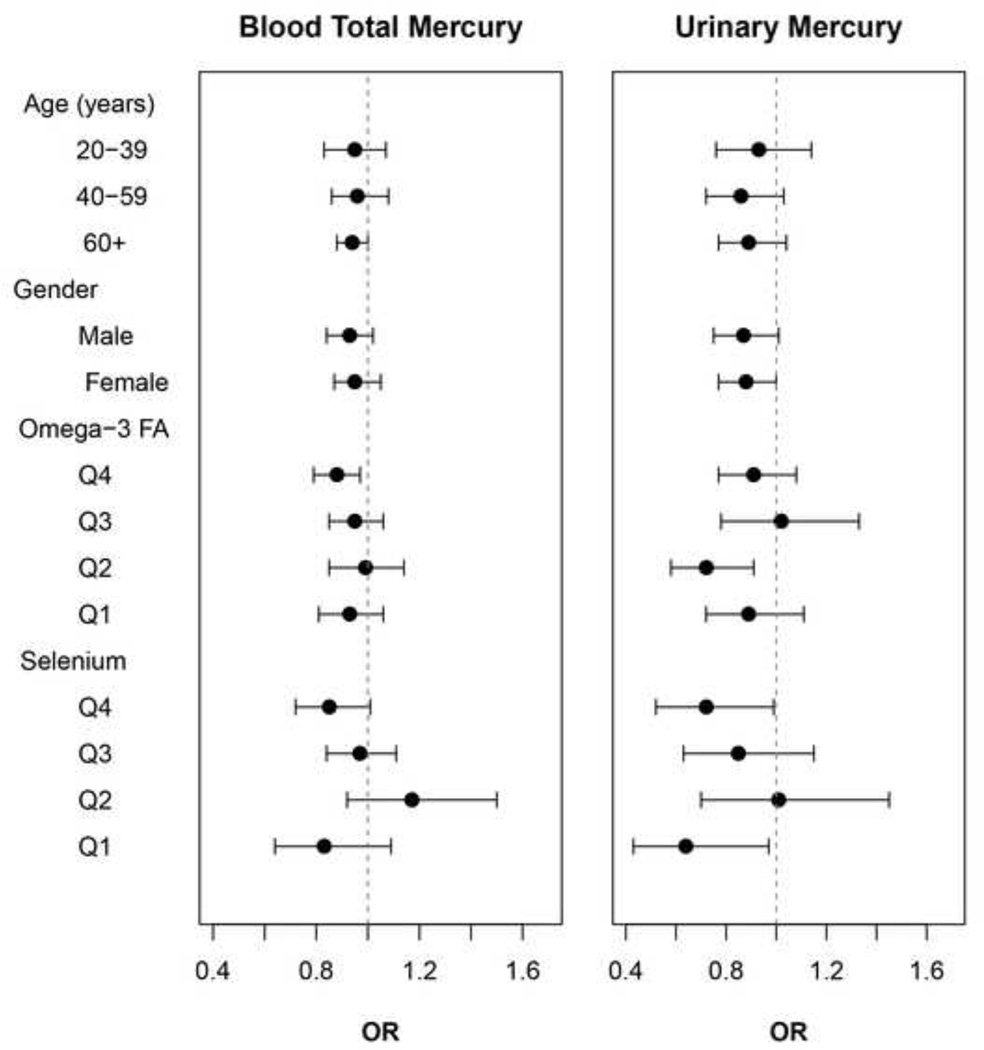
Results: The weighted prevalence of hypertension was 32.2%. The geometric means (95% confidence intervals) of blood total and urinary mercury were 1.03 (0.95, 1.11)μg/L and 0.51 (0.47, 0.54)μg/L, respectively. The adjusted odds ratios for a doubling increase in blood mercury and urinary mercury were 0.94 (0.87 to 1.01) and 0.87 (0.78 to 0.99), respectively, after adjusting for potential confounders. The associations remained similar, even after adjusting for either omega-3 fatty acids or selenium or both. No significant effect modification by either omega-3 fatty acids or selenium was observed.
Conclusions: In this cross-sectional study of the U.S. general population, we found no association of hypertension with blood mercury but a suggestive inverse association with urinary mercury. Future prospective studies are warranted to confirm these findings.
Copyright © 2013 Elsevier Inc. All rights reserved.
Figures
References
-
- Appel LJ, Miller ER, 3rd, Seidler AJ, Whelton PK. Does supplementation of diet with 'fish oil' reduce blood pressure? A meta-analysis of controlled clinical trials. Arch Int Med. 1993;153:1429–1438. - PubMed
-
- Aschner M, Aschner JL. Mercury neurotoxicity: mechanisms of blood-brain barrier transport. Neurosci Biobehav Rev. 1990;14:169–176. - PubMed
-
- Clarkson TW, Magos L, Myers GJ. The toxicology of mercury--current exposures and clinical manifestations. New Eng J Med. 2003;349:1731–1737. - PubMed
Publication types
MeSH terms
Substances
Grants and funding
LinkOut - more resources
Full Text Sources
Other Literature Sources
Medical
Molecular Biology Databases
