


Longterm survival after pancreaticoduodenectomy for periampullary adenocarcinomas
- PMID: 23472708
- PMCID: PMC3843613
- DOI: 10.1111/hpb.12071
Longterm survival after pancreaticoduodenectomy for periampullary adenocarcinomas
Abstract
Objectives: The aim of this study was to identify predictors for longterm survival following pancreaticoduodenectomy (PD) for pancreatic and other periampullary adenocarcinomas.
Methods: Clinicopathological factors were compared between short-term (<5 years) and longterm (≥ 5 years) survival groups. Rates of actual 5-year and actuarial 10-year survival were determined.
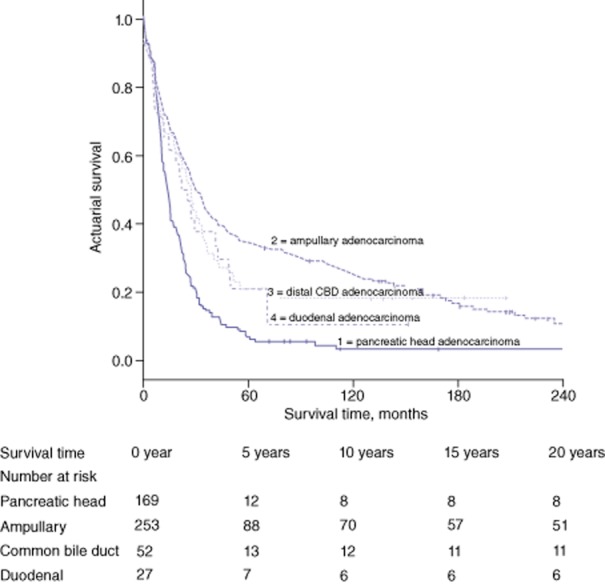
Results: There were 109 (21.8%) longterm survivors among a sample of 501 patients. Patients with ampullary adenocarcinoma represented 76.1% of the longterm survivors. Favourable factors for longterm survival included female gender, lack of jaundice, lower blood loss, classical PD, absence of postoperative bleeding or intra-abdominal abscess, non-pancreatic primary cancer, earlier tumour stage, smaller tumour size (≤ 2 cm), curative resection, negative lymph node involvement, well-differentiated tumours, and absence of perineural invasion. Independent factors associated with longterm survival were diagnosis of primary tumour, jaundice, intra-abdominal abscess, tumour stage, tumour size, radicality, lymph node status and cell differentiation. The prognosis was best for ampullary adenocarcinoma, for which the rate of actual 5-year survival was 32.8%, and poorest for pancreatic head adenocarcinoma, for which actual 5-year survival was only 6.5%.
Conclusions: The majority of longterm survivors after PD for periampullary adenocarcinomas are patients with ampullary adenocarcinoma. The longterm prognosis in pancreatic head adenocarcinoma remains dismal.
© 2013 International Hepato-Pancreato-Biliary Association.
Figures
References
-
- Bottger TC, Junginger T. Factors influencing morbidity and mortality after pancreaticoduodenectomy: critical analysis of 221 resections. World J Surg. 1999;23:164–172. - PubMed
-
- Castillo CFD, Rattner DW, Warshaw AL. Standards for pancreatic resection in the 1990s. Arch Surg. 1995;130:295–300. - PubMed
Publication types
MeSH terms
LinkOut - more resources
Full Text Sources
Other Literature Sources
Medical
