


Risk of zoonotic transmission of HEV from rabbits
- PMID: 23474012
- PMCID: PMC7172140
- DOI: 10.1016/j.jcv.2013.02.006
Risk of zoonotic transmission of HEV from rabbits
Abstract
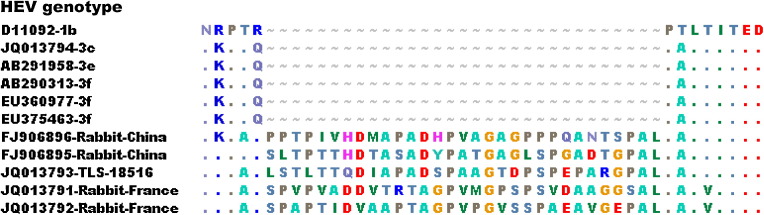
Hepatitis E virus strains from rabbits indicate that these mammals may be a reservoir for HEVs that cause infection in humans. Further issues remain to be clarified, including whether the genotype of rabbit HEV differs from human and swine HEV genotype 3 and whether rabbit HEV can infect human and other animals. HEV was found in farmed rabbits in several geographic areas of China, in USA and more recently in France. The prevalence of antibodies against HEV was 36%, 57% and 55% in rabbits from Virginia (USA), Gansu Province and Beijing (China), respectively. HEV RNA was detected in 16.5% of serum samples from farmed rabbits in Virginia, 7.5% in Gansu Province and 7.0% in Beijing. HEV RNA was detected in 7% of bile samples from farmed rabbits and in 23% of liver samples from wild rabbits in France. The full-length genomic sequences analysis indicates that all the rabbit strains belong to the same clade. Nucleotide sequences were 72.2-78.2% identical to HEV genotypes 1-4. Comparison with HEV sequences of human strains circulating in France and reference sequences identified a human strain closely related to rabbit HEV. A 93-nucleotide insertion in the X domain of the ORF1 of the human strain and in all the rabbit HEV strains was found. Moreover, the ability of rabbit HEV to cause cross-species infection in a pig model has recently been demonstrated. Rabbit HEV can replicate efficiently in human cell lines. Collectively, these data support the possibility of zoonotic transmission of HEV from rabbits.
Keywords: HEV; Hepatitis E virus; Rabbit; Zoonosis; hepatitis E virus.
Copyright © 2013. Published by Elsevier B.V.
Figures


References
-
- Purcell R.H., Emerson S.U. Hepatitis E: an emerging awareness of an old disease. J Hepatol. 2008;48:494–503. - PubMed
-
- Kamar N., Bendall R., Legrand-Abravanel F., Xia N.S., Ijaz S., Izopet J. Hepatitis E. Lancet. 2012;379:2477–2488. - PubMed
-
- Hoofnagle J.H., Nelson K.E., Purcell R.H., Hepatitis E. New Engl J Med. 2012;367:1237–1244. - PubMed
Publication types
MeSH terms
LinkOut - more resources
Full Text Sources
Other Literature Sources
Medical
