. 2013 Jul;62(7):2249-58.
doi: 10.2337/db12-1146. Epub 2013 Mar 8.

Moderate GLUT4 overexpression improves insulin sensitivity and fasting triglyceridemia in high-fat diet-fed transgenic mice

Affiliations

Moderate GLUT4 overexpression improves insulin sensitivity and fasting triglyceridemia in high-fat diet-fed transgenic mice

Brittanie J Atkinson et al. Diabetes. 2013 Jul.

Abstract

The GLUT4 facilitative glucose transporter mediates insulin-dependent glucose uptake. We tested the hypothesis that moderate overexpression of human GLUT4 in mice, under the regulation of the human GLUT4 promoter, can prevent the hyperinsulinemia that results from obesity. Transgenic mice engineered to express the human GLUT4 gene and promoter (hGLUT4 TG) and their nontransgenic counterparts (NT) were fed either a control diet (CD) or a high-fat diet (HFD) for up to 10 weeks. Homeostasis model assessment of insulin resistance scores revealed that hGLUT4 TG mice fed an HFD remained highly insulin sensitive. The presence of the GLUT4 transgene did not completely prevent the metabolic adaptations to HFD. For example, HFD resulted in loss of dynamic regulation of the expression of several metabolic genes in the livers of fasted and refed NT and hGLUT4 TG mice. The hGLUT4 TG mice fed a CD showed no feeding-dependent regulation of SREBP-1c and fatty acid synthase (FAS) mRNA expression in the transition from the fasted to the fed state. Similarly, HFD altered the response of SREBP-1c and FAS mRNA expression to feeding in both strains. These changes in hepatic gene expression were accompanied by increased nuclear phospho-CREB in refed mice. Taken together, a moderate increase in expression of GLUT4 is a good target for treatment of insulin resistance.


Figures
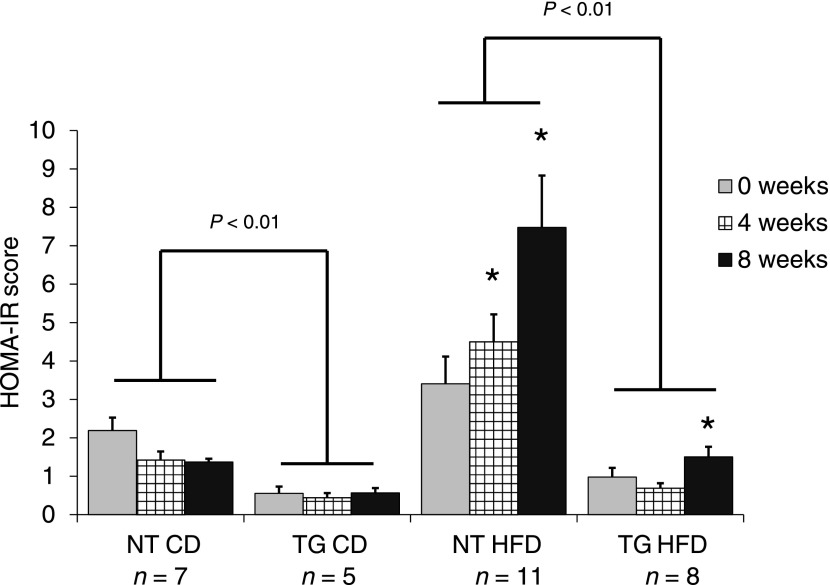
FIG. 1.
FIG. 1.
HOMA-IR scores from NT and hGLUT4 TG mice fed CD or HFD. HOMA-IR scores were calculated from recorded fasting blood glucose and plasma insulin levels at the time indicated. The following equation was used: fasting blood glucose (mg/dL) × fasting insulin (µU/mL)/405. Analysis was by two-way repeated-measures ANOVA. *Significant difference compared with week 0 within the same strain. Differences between strains fed the same diet are shown. There were no interactions between strain and diet.
FIG. 2.
FIG. 2.
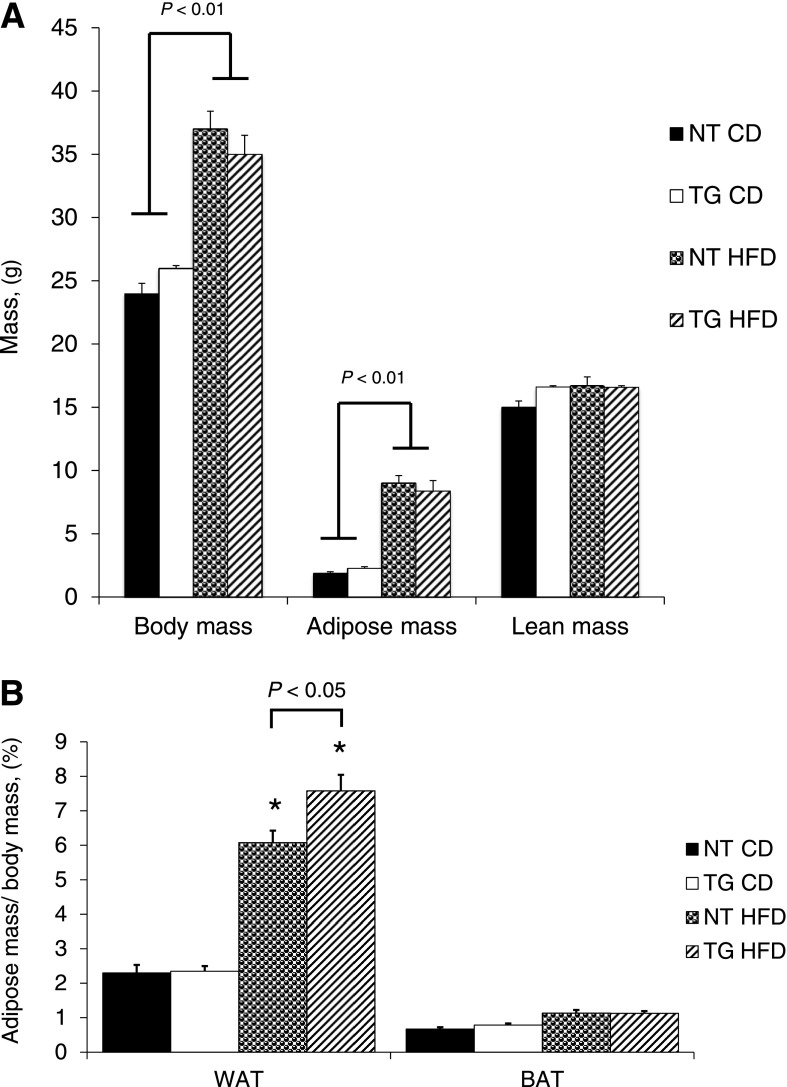
Body composition and adipose pad weight from NT and hGLUT4 TG mice fed CD or HFD for up to 8 weeks (n = 5–8 per group). A nuclear magnetic resonance method was used to measure body composition as described in research design and methods. A: Body weight, adipose mass, and lean body mass were measured. B: Wet weights for epididymal WAT and BAT are reported as a percentage of body mass. Data were analyzed by two-way ANOVA. *Significant difference between diets for the same strain. Differences between strains fed the same diet are shown.
FIG. 3.
FIG. 3.
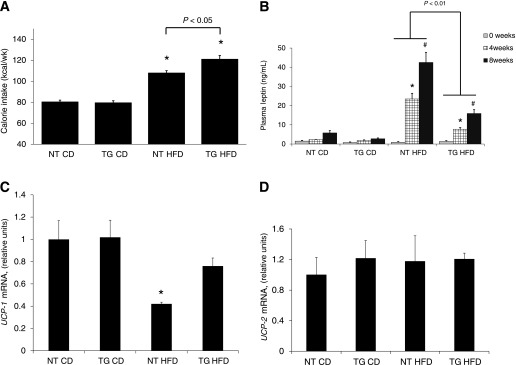
Average energy intake per week and plasma leptin levels from NT and hGLUT4 TG mice fed CD or HFD (n = 5–8 per group). A: Energy intake (kilocalorie equivalent of diet) was averaged over the 8-week feeding period. *Significant difference between diets. Differences between strains are shown. B: Fasting plasma leptin level was measured after 0, 4, and 8 weeks on diet. A strain-specific significant difference is indicated. *Significant difference between 4 and 0 weeks within a strain and diet, and #significant difference between 8 and 4 weeks within a strain and diet. Data were analyzed by one-way ANOVA. UCP-1 (C) and UCP-2 (D) mRNA were measured using qPCR and normalized to TBP mRNA (n = 4 mice per group). *Significant difference by one-way ANOVA.
FIG. 4.
FIG. 4.
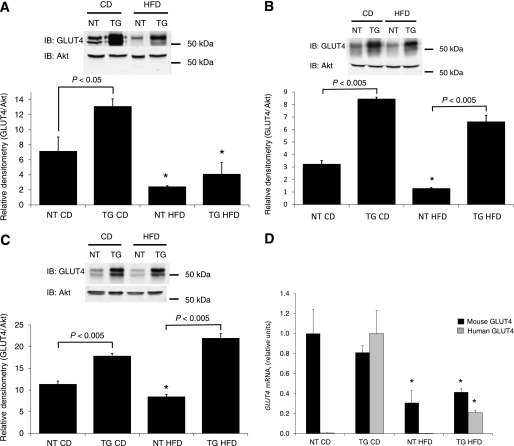
GLUT4 protein expression in perigonadal WAT (A), subscapular BAT (B), and hindquarter skeletal muscle (C) from NT and hGLUT4 TG mice fed CD or HFD for 8 weeks. A representative Western blot is shown. The histograms represent quantification of three independent experiments. Densitometry is normalized to Akt expression in each tissue. Mouse and transgenic human GLUT4 mRNA expression in perigonadal WAT (D) is the mean of three independent experiments. Data were analyzed by one-way ANOVA. *Difference between diets for the same strain. Differences between strains fed the same diet are shown. IB, immunoblot.
FIG. 5.
FIG. 5.
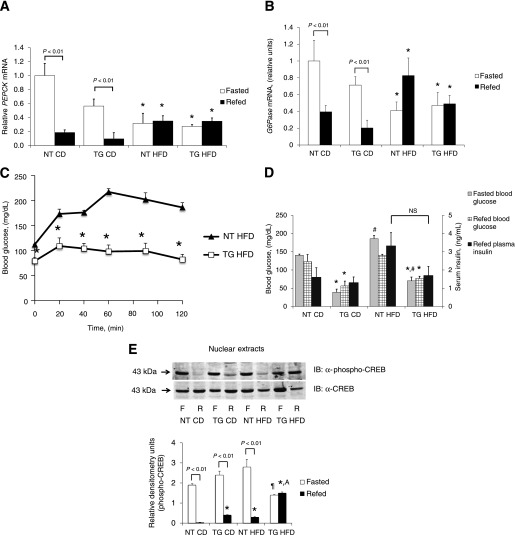
Hepatic gluconeogenic gene expression during fasting and refeeding from NT and hGLUT4 TG mice fed CD or HFD for 8 weeks (n = 3–5 per group). Livers were removed from mice fasted for 17 h (Fasted) or fasted mice refed for 4 h (Refed). Hepatic mRNA was isolated and analyzed for PEPCK mRNA (A) and G6Pase mRNA (B). Data were analyzed by two-way ANOVA. Significant differences between fasted and fasted and refed are shown. C: Pyruvate tolerance test for NT and hGLUT4 TG mice fed HFD for 8 weeks (n = 5 animals per group). *Significant difference between strains at individual time points by two-tailed Student t test. D: In the fasted and refed group, plasma glucose levels were measured before and after refeeding. Plasma insulin level was measured after refeeding. Data were analyzed by two-way repeated-measures ANOVA. *Significant differences for different strains within the same diet, and #significant differences between same strain on different diets. E: Phospho-CREB and total CREB immunolabeling of fasted and refed liver nuclear extracts. The histogram represents three independent experiments. Data were analyzed by two-way ANOVA. Differences between fasted and refed animals are shown. ¶Significant difference compared with all refed animals, *significant between all refed animals compared with NT mice fed CD, and Asignificant difference between hGLUT4 TG fed HFD and all other fasted mice. F, fasted; IB, immunoblot; NS, not significant; R, refed.
FIG. 6.
FIG. 6.
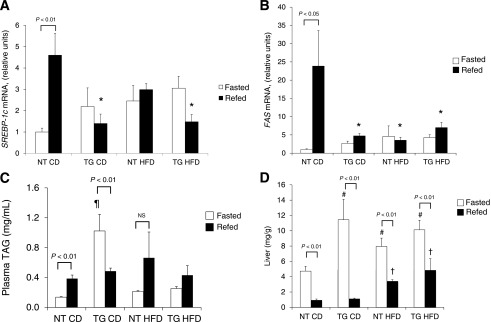
Hepatic lipid metabolism during fasting and refeeding from NT and hGLUT4 TG mice fed CD or HFD for 8 weeks. Livers were removed from mice fasted for 17 h (Fasted) or fasted mice refed for 4 h (Refed) after 8 weeks on the diet. Hepatic mRNA was isolated and analyzed for SREBP-1c mRNA (A) and FAS mRNA (B) (four independent experiments). Lipid-soluble material was isolated from blood plasma (n = 5 per group) (C) and liver homogenates (D) and assayed for total TAG level (n = 5 per group). Statistical differences between fasted and refed mice are indicated. *Significant difference in refed mice between strains and diets, ¶significant difference in fasted animals when comparing both strains and diets, #significant difference in fasted animals when comparing the same diet in different strains, and †significant difference in refed animals when comparing the same strain. NS, not significant.

References

    1. Ikemoto S, Thompson KS, Itakura H, Lane MD, Ezaki O. Expression of an insulin-responsive glucose transporter (GLUT4) minigene in transgenic mice: effect of exercise and role in glucose homeostasis. Proc Natl Acad Sci U S A 1995;92:865–869 - PMC - PubMed
    1. Ivy JL, Kuo CH. Regulation of GLUT4 protein and glycogen synthase during muscle glycogen synthesis after exercise. Acta Physiol Scand 1998;162:295–304 - PubMed
    1. Deems RO, Evans JL, Deacon RW, et al. Expression of human GLUT4 in mice results in increased insulin action. Diabetologia 1994;37:1097–1104 - PubMed
    1. Liu M-L, Gibbs EM, McCoid SC, et al. Transgenic mice expressing the human GLUT4/muscle-fat facilitative glucose transporter protein exhibit efficient glycemic control. Proc Natl Acad Sci U S A 1993;90:11346–11350 - PMC - PubMed
    1. Ranalletta M, Du XQ, Seki Y, et al. Hepatic response to restoration of GLUT4 in skeletal muscle of GLUT4 null mice. Am J Physiol Endocrinol Metab 2007;293:E1178–E1187 - PubMed

Publication types

MeSH terms