Changes in insulin resistance and HbA1c are related to exercise-mediated changes in body composition in older adults with type 2 diabetes: interim outcomes from the GREAT2DO trial
- PMID: 23474589
- PMCID: PMC3714491
- DOI: 10.2337/dc12-2196
Changes in insulin resistance and HbA1c are related to exercise-mediated changes in body composition in older adults with type 2 diabetes: interim outcomes from the GREAT2DO trial
Abstract
Objective: To investigate changes in body composition after 12 months of high-intensity progressive resistance training (PRT) in relation to changes in insulin resistance (IR) or glucose homeostasis in older adults with type 2 diabetes.
Research design and methods: One-hundred three participants were randomized to receive either PRT or sham exercise 3 days per week for 12 months. Homeostasis model assessment 2 of insulin resistance (HOMA2-IR) and glycosylated hemoglobin (HbA1c) were used as indices of IR and glucose homeostasis. Skeletal muscle mass (SkMM) and total fat mass were assessed using bioelectrical impedance. Visceral adipose tissue, mid-thigh cross-sectional area, and mid-thigh muscle attenuation were quantified using computed tomography.
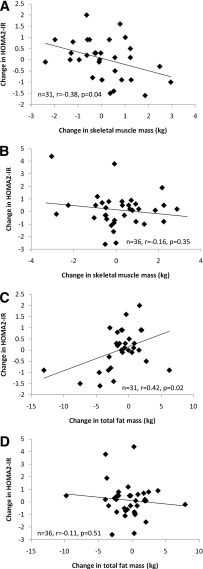
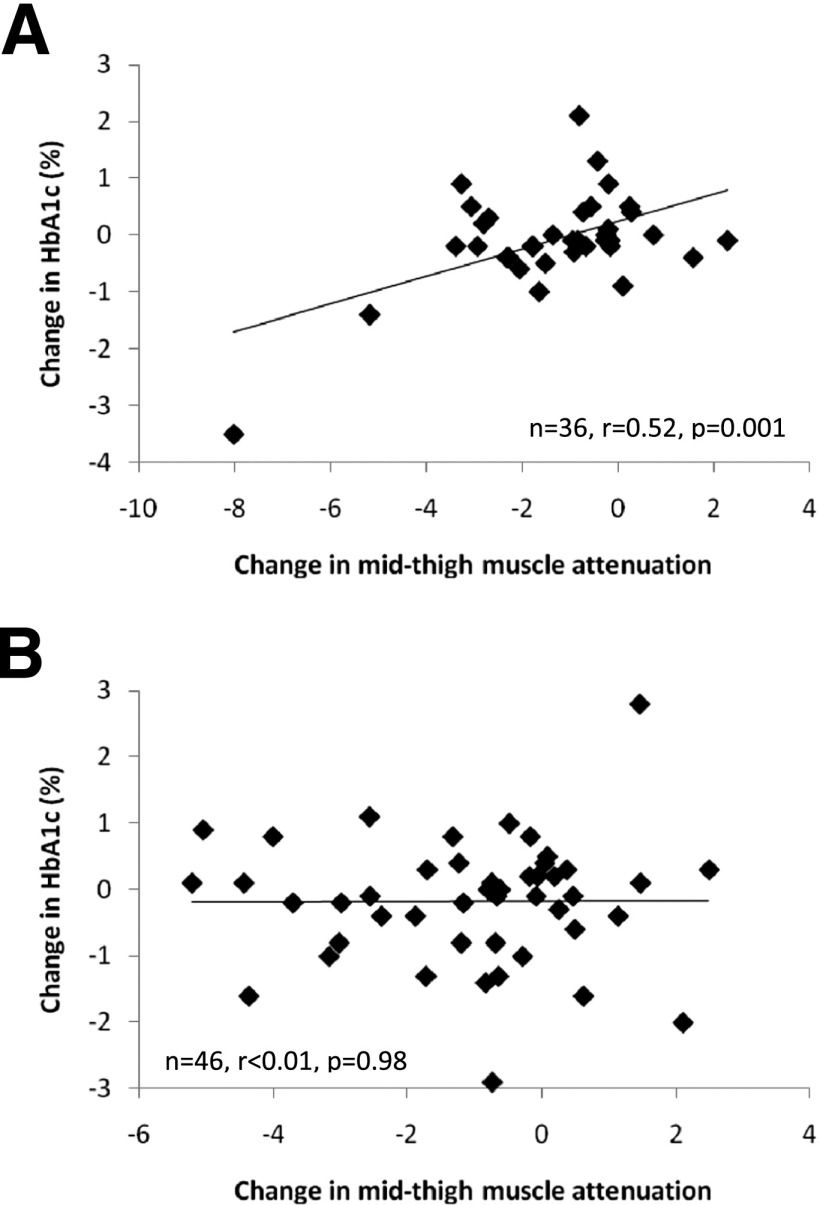
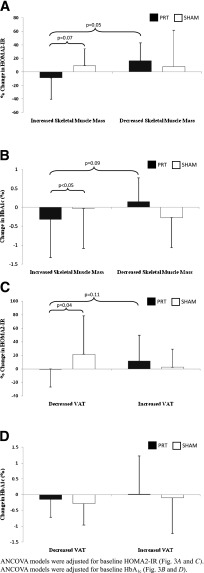
Results: Within the PRT group, changes in HOMA2-IR were associated with changes in SkMM (r = -0.38; P = 0.04) and fat mass (r = 0.42; P = 0.02). Changes in visceral adipose tissue tended to be related to changes in HOMA2-IR (r = 0.35; P = 0.07). Changes in HbA1c were related to changes in mid-thigh muscle attenuation (r = 0.52; P = 0.001). None of these relationships were present in the sham group (P > 0.05). Using ANCOVA models, participants in the PRT group who had increased SkMM had decreased HOMA2-IR (P = 0.05) and HbA1c (P = 0.09) compared with those in the PRT group who lost SkMM. Increases in SkMM in the PRT group decreased HOMA2-IR (P = 0.07) and HbA1c (P < 0.05) compared with those who had increased SkMM in the sham group.
Conclusions: Improvements in metabolic health in older adults with type 2 diabetes were mediated through improvements in body composition only if they were achieved through high-intensity PRT.
Figures
References
-
- Shaw JE, Sicree RA, Zimmet PZ. Global estimates of the prevalence of diabetes for 2010 and 2030. Diabetes Res Clin Pract 2010;87:4–14 - PubMed
-
- Castaneda C, Layne JE, Munoz-Orians L, et al. A randomized controlled trial of resistance exercise training to improve glycemic control in older adults with type 2 diabetes. Diabetes Care 2002;25:2335–2341 - PubMed
-
- Dunstan DW, Daly RM, Owen N, et al. High-intensity resistance training improves glycemic control in older patients with type 2 diabetes. Diabetes Care 2002;25:1729–1736 - PubMed
-
- Cuff DJ, Meneilly GS, Martin A, Ignaszewski A, Tildesley HD, Frohlich JJ. Effective exercise modality to reduce insulin resistance in women with type 2 diabetes. Diabetes Care 2003;26:2977–2982 - PubMed
Publication types
MeSH terms
Substances
LinkOut - more resources
Full Text Sources
Other Literature Sources
Medical