


Comment
doi: 10.1038/emboj.2013.48.
Epub 2013 Mar 8.
Oct4 shuffles Sox partners to direct cell fate
Affiliations
- PMID: 23474893
- PMCID: PMC3616291
- DOI: 10.1038/emboj.2013.48
Item in Clipboard
Comment
Oct4 shuffles Sox partners to direct cell fate
EMBO J.
.
Abstract
EMBO J (2013) 32: 938–953 doi:; DOI: 10.1038/emboj.2013.31; published online March 08 2013
The transcription factor Oct4 plays a crucial role in the maintenance of the embryonic pluripotent state, but can also regulate early lineage commitment. In this issue of The EMBO Journal, Aksoy et al (2013) lend critical mechanistic insights into the ability of Oct4 to regulate and specify the primitive endodermal lineage. These regulatory actions are governed by alternative direct partnering of Oct4 with Sox17, instead of Sox2, that leads to global reprogramming of enhancer occupancy by Oct4 during primitive endoderm differentiation.
Conflict of interest statement
The authors declare that they have no conflict of interest.
Figures
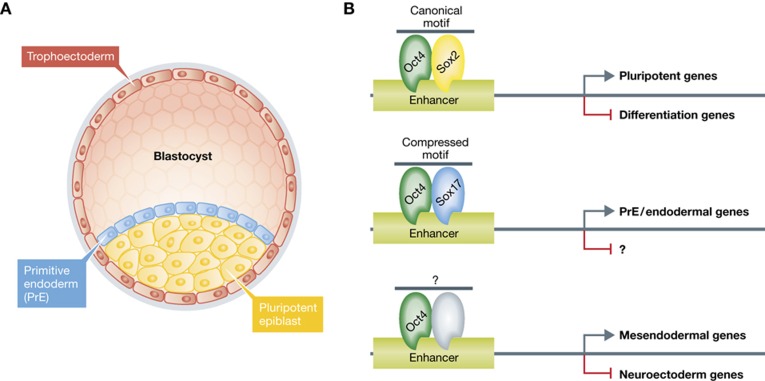
Oct4 regulates pluripotency and early development. (A) During early development the mouse late blastocyst comprises three distinct lineages: (1) the epiblast, which gives rise to the embryo proper, (2) primitive endoderm and (3) trophectoderm giving rise to extraembryonic cell types of placenta and yolk sac. (B) Model for cooperative action of Oct4 and Sox transcription factors in pluripotency and during lineage fate choice based on this study. In epiblast and ESCs, the cooperative binding of Oct4/Sox2 complex to canonical motif-containing enhancers facilitates pluripotency maintenance by up- and downregulation of pro-pluripotent and differentiation factors, respectively. Upon induction of PrE, Sox17 levels increase and directly recruit oct4 to compressed motif-containing enhancers, which positively regulate a set of PrE-specification genes (this study), and likely negatively regulate other yet to be defined genes. Notably, Oct4 can also drive commitment into the mesendodermal cell fate and repress neuroectodermal lineage by an undefined partner (Thomson et al, 2011).
Comment on
-
Oct4 switches partnering from Sox2 to Sox17 to reinterpret the enhancer code and specify endoderm.EMBO J. 2013 Apr 3;32(7):938-53. doi: 10.1038/emboj.2013.31. Epub 2013 Mar 8. EMBO J. 2013. PMID: 23474895 Free PMC article.
References
-
- Niakan KK, Ji H, Maehr R, Vokes SA, Rodolfa KT, Sherwood RI, Yamaki M, Dimos JT, Chen AE, Melton DA, McMahon AP, Eggan K (2010) Sox17 promotes differentiation in mouse embryonic stem cells by directly regulating extraembryonic gene expression and indirectly antagonizing self-renewal. Genes Dev 24: 312–326 - PMC - PubMed
-
- Niwa H (2007) How is pluripotency determined and maintained? Development 134: 635–646 - PubMed
Publication types
MeSH terms
Substances
LinkOut - more resources
Full Text Sources
Other Literature Sources
Miscellaneous
