


Sedentary behavior, physical activity, and markers of health in older adults
- PMID: 23475142
- PMCID: PMC5764165
- DOI: 10.1249/MSS.0b013e318288a1e5
Sedentary behavior, physical activity, and markers of health in older adults
Abstract
Introduction: The purpose of this study was to examine the association between sedentary behavior (SB), cardiometabolic risk factors, and self-reported physical function by level of moderate-vigorous physical activity (MVPA).
Methods: Cross-sectional analysis was completed on 1914 older adults age ≥ 65 yr from the 2003-2006 U.S. National Health and Nutrition Examination Survey. MVPA and SB were derived from ActiGraph accelerometers worn for 1 wk. MVPA was categorized as sufficient to meet the current U.S. guidelines (≥ 150 min · wk(-1)) or not; SB was split into quartiles. Various biomarkers were examined in laboratory analyses and physical exams, and the number of functional limitations was self-reported. Statistical interaction between SB and MVPA on the biomarker associations was the primary analysis, followed by an examination of their independent associations with relevant covariate adjustment.
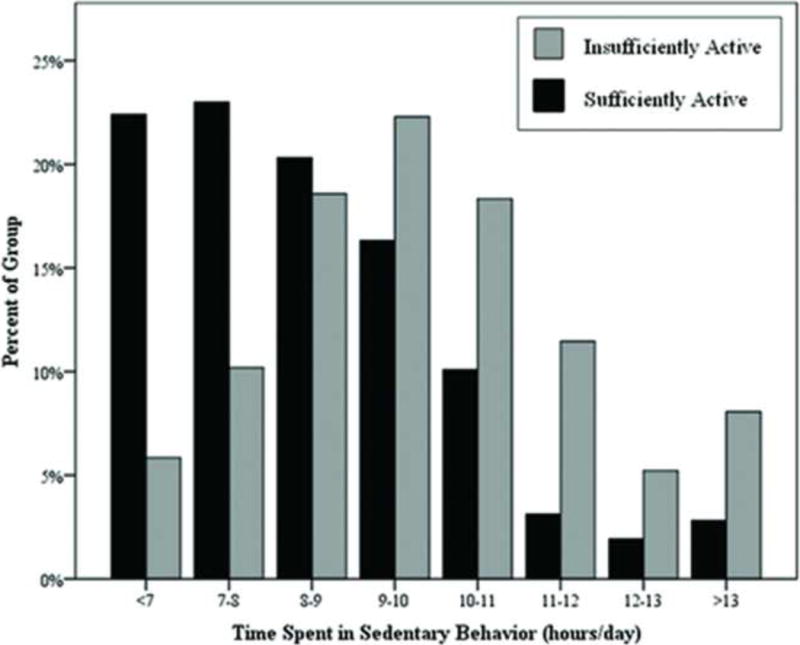
Results: Average SB was 9.4 ± 2.3 h · d(-1) (mean ± SD), and approximately 35% were classified as sufficiently active. Overall, no significant meaningful statistical interactions were found between SB and MVPA for any of the outcomes; however, strong independent positive associations were found between SB and weight (P < 0.01), body mass index (P < 0.01), waist circumference (P < 0.01), C-reactive protein (P < 0.01), plasma glucose (P = 0.04), and number of functional limitations (P < 0.01) after adjustment for MVPA. Similarly, MVPA was negatively associated with weight (P = 0.01), body mass index (P < 0.01), waist circumference (P < 0.01), diastolic blood pressure (P = 0.04), C-reactive protein (P < 0.01), and number of functional limitations (P < 0.01) after adjustment for SB.
Conclusions: The results suggest that sufficient MVPA did not ameliorate the negative associations between SB and cardiometabolic risk factors or functional limitations in the current sample and that there was independence on a multiplicative scale in their associations with the outcomes examined. Thus, older adults may benefit from the joint prescription to accumulate adequate MVPA and avoid prolonged sitting.
Conflict of interest statement
The authors have no conflict of interest to declare
Figures

References
-
- Centers for Disease Control and Prevention (CDC), and National Center for Health Statistics (NCHS) National Health and Nutrition Examination Survey Data [Internet] Hyattsville, MD: U.S. Department of Health and Human Services, Centers for Disease Control and Prevention; [cited 2012 Jul 21]. Available from: http://www.cdc.gov/nhcs/nhanes.htm/.
-
- Centers for Disease Control and Prevention (CDC), and National Center for Health Statistics (NCHS) National Health and Nutrition Examination Survey Examination Protocol [Internet] Hyattsville, MD: U.S. Department of Health and Human Services, Centers for Disease Control and Prevention; [cited 2012 Jul 21]. Available from: http://www.cdc.gov/nchs/data/nhanes/nhanes_05_06/PE.pdf.
-
- Centers for Disease Control and Prevention (CDC), and National Center for Health Statistics (NCHS) National Health and Nutrition Examination Survey Laboratory Protocol [Internet] Hyattsville, MD: U.S. Department of Health and Human Services, Centers for Disease Control and Prevention; [cited 2012 Jul 21]. Available from: http://cdc.gov/nchs/nhanes/nhanes2005-2006/lab_methods_05_06.htm.
-
- Centers for Disease Control and Prevention (CDC), and National Center for Health Statistics (NCHS) National Health and Nutrition Examination Survey Questionnaires, Examination Components and Laboratory Components 2005–2006 [Internet] Hyattsville, MD: U.S. Department of Health and Human Services, Centers for Disease Control and Prevention; [cited 2012 Jul 21]. Available from: http://www.cdc.gov/nchs/nhanes/nhanes2005-2006/questexam05_06.htm.
MeSH terms
Substances
Grants and funding
LinkOut - more resources
Full Text Sources
Other Literature Sources
Medical
Research Materials
