


Risk factors for failure of outpatient parenteral antibiotic therapy (OPAT) in infective endocarditis
- PMID: 23475647
- PMCID: PMC3682687
- DOI: 10.1093/jac/dkt046
Risk factors for failure of outpatient parenteral antibiotic therapy (OPAT) in infective endocarditis
Abstract
Objectives: To identify risk factors for failure of outpatient antibiotic therapy (OPAT) in infective endocarditis (IE).
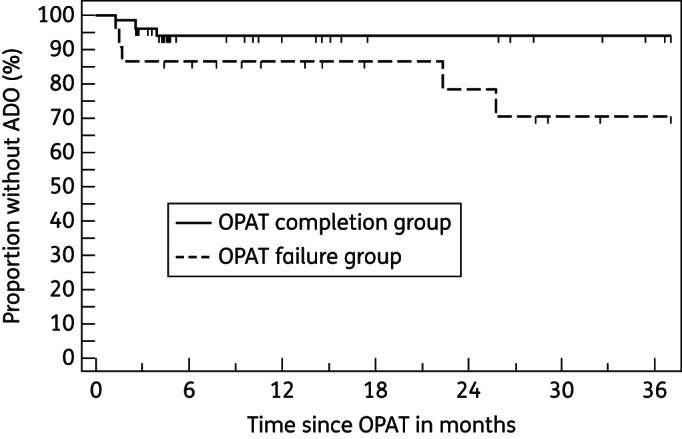
Patients and methods: We identified IE cases managed at a single centre over 12 years from a prospectively maintained database. 'OPAT failure' was defined as unplanned readmission or antibiotic switch due to adverse drug reaction or antibiotic resistance. We analysed patient and disease-related risk factors for OPAT failure by univariate and multivariate logistic regression. We also retrospectively collected follow-up data on adverse disease outcome (defined as IE-related death or relapse) and performed Kaplan-Meier survival analysis up to 36 months following OPAT.
Results: We identified 80 episodes of OPAT in IE. Failure occurred in 25/80 episodes (31.3%). On multivariate analysis, cardiac or renal failure [pooled OR 7.39 (95% CI 1.84-29.66), P=0.005] and teicoplanin therapy [OR 8.69 (95% CI 2.01-37.47), P=0.004] were independently associated with increased OPAT failure. OPAT failure with teicoplanin occurred despite therapeutic plasma levels. OPAT failure predicted adverse disease outcome up to 36 months (P=0.016 log-rank test).
Conclusions: These data caution against selecting patients with endocarditis for OPAT in the presence of cardiac or renal failure and suggest teicoplanin therapy may be associated with suboptimal OPAT outcomes. Alternative regimens to teicoplanin in the OPAT setting should be further investigated.
Keywords: ceftriaxone; glycopeptides; native valve endocarditis; outcomes; prosthetic valve endocarditis; teicoplanin.
Figures
References
-
- Andrews MM, von Reyn CF. Patient selection criteria and management guidelines for outpatient parenteral antibiotic therapy for native valve infective endocarditis. Clin Infect Dis. 2001;33:203–9. - PubMed
-
- Habib G, Hoen B, Tornos P, et al. Guidelines on the prevention, diagnosis, and treatment of infective endocarditis (new version 2009): the Task Force on the Prevention, Diagnosis, and Treatment of Infective Endocarditis of the European Society of Cardiology (ESC). Endorsed by the European Society of Clinical Microbiology and Infectious Diseases (ESCMID) and the International Society of Chemotherapy (ISC) for Infection and Cancer. Eur Heart J. 2009;30:2369–413. - PubMed
-
- Partridge DG, O'Brien E, Chapman AL. Outpatient parenteral antibiotic therapy for infective endocarditis: a review of 4 years' experience at a UK centre. Postgrad Med J. 2012;88:377–81. - PubMed
-
- Cervera C, del Rio A, Garcia L, et al. Efficacy and safety of outpatient parenteral antibiotic therapy for infective endocarditis: a ten-year prospective study. Enferm Infecc Microbiol Clin. 2011;29:587–92. - PubMed
-
- Rehm S, Campion M, Katz DE, et al. Community-based outpatient parenteral antimicrobial therapy (CoPAT) for Staphylococcus aureus bacteraemia with or without infective endocarditis: analysis of the randomized trial comparing daptomycin with standard therapy. J Antimicrob Chemother. 2009;63:1034–42. - PMC - PubMed
Publication types
MeSH terms
Substances
Grants and funding
LinkOut - more resources
Full Text Sources
Other Literature Sources
Medical
