. 2013 May 17;8(5):923-9.
doi: 10.1021/cb300653v. Epub 2013 Mar 25.

Discovery of small-molecule enhancers of reactive oxygen species that are nontoxic or cause genotype-selective cell death

Affiliations

Discovery of small-molecule enhancers of reactive oxygen species that are nontoxic or cause genotype-selective cell death

Drew J Adams et al. ACS Chem Biol. .

Abstract

Elevation of reactive oxygen species (ROS) levels has been observed in many cancer cells relative to nontransformed cells, and recent reports have suggested that small-molecule enhancers of ROS may selectively kill cancer cells in various in vitro and in vivo models. We used a high-throughput screening approach to identify several hundred small-molecule enhancers of ROS in a human osteosarcoma cell line. A minority of these compounds diminished the viability of cancer cell lines, indicating that ROS elevation by small molecules is insufficient to induce death of cancer cell lines. Three chemical probes (BRD5459, BRD56491, BRD9092) are highlighted that most strongly elevate markers of oxidative stress without causing cell death and may be of use in a variety of cellular settings. For example, combining nontoxic ROS-enhancing probes with nontoxic doses of L-buthionine sulfoximine, an inhibitor of glutathione synthesis previously studied in cancer patients, led to potent cell death in more than 20 cases, suggesting that even nontoxic ROS-enhancing treatments may warrant exploration in combination strategies. Additionally, a few ROS-enhancing compounds that contain sites of electrophilicity, including piperlongumine, show selective toxicity for transformed cells over nontransformed cells in an engineered cell-line model of tumorigenesis. These studies suggest that cancer cell lines are more resilient to chemically induced increases in ROS levels than previously thought and highlight electrophilicity as a property that may be more closely associated with cancer-selective cell death than ROS elevation.


Figures
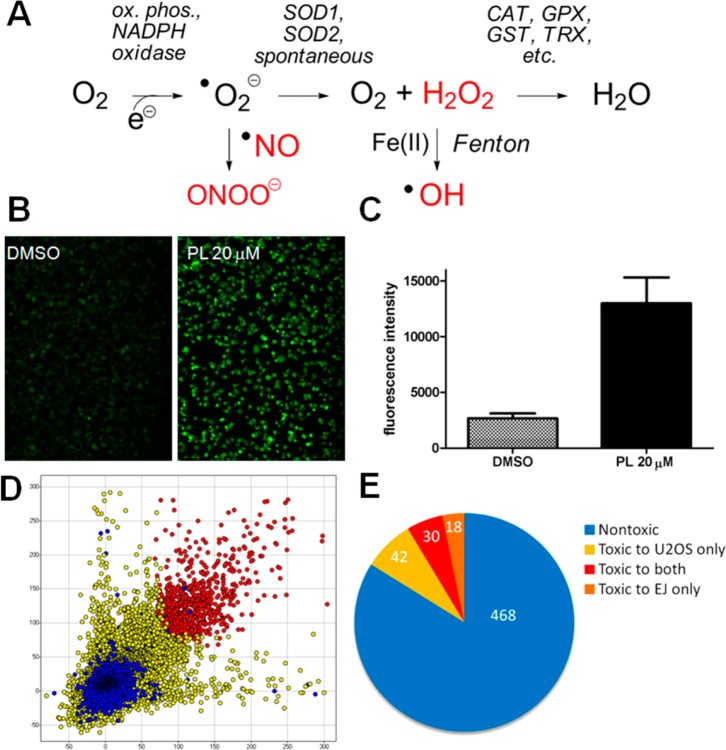
Figure 1
Figure 1
Identification of small-molecule enhancers of ROS and evaluation of toxicity in cancer cell lines. (A) Common pathways for the generation and metabolism of ROS. (B) U2OS cells were treated with either DMSO or 20 μM piperlongumine (PL) for 1 h, and ROS were measured using CM-H2DCF-DA and automated fluorescence microscopy. (C) Quantification of fluorescence levels following PL treatment. Mean and standard deviation from a representative experiment are shown. (D) Summary of high-throughput screening results. Blue, negative control (DMSO); yellow, test compounds; red, “hit” compounds (903); positive control (PL), not shown. Each assay plate was normalized to DMSO = 0, PL = 100. Compounds scoring >75 in both replicates were considered “hits”. (E) Occurrence of toxicity (>50% reduction in ATP at ≥20 μM after 48-h treatment) in U2OS and EJ cell lines.
Figure 2
Figure 2
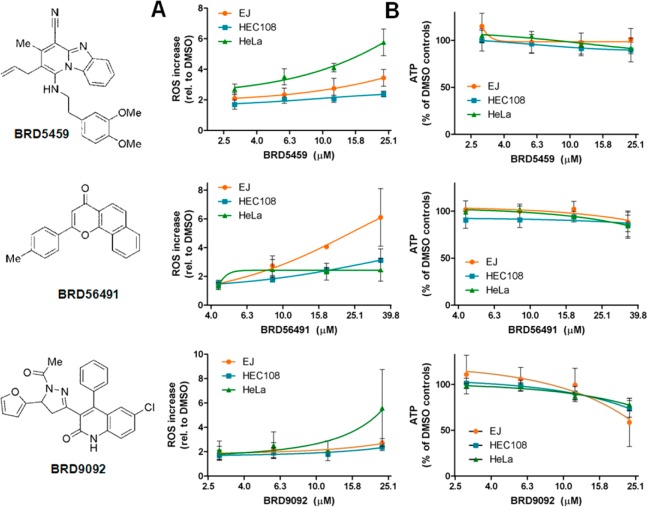
ROS-enhancing, nontoxic compounds. (A) Elevation of ROS for the indicated concentrations of each compound after 1-h treatment in three cell lines. (B) ATP levels after 48-h treatment in the same cell line panel. All data are expressed as mean ± SD, n = 3.
Figure 3
Figure 3
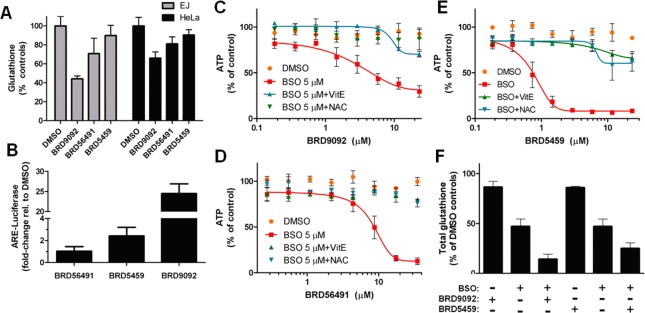
Cellular effects of ROS-enhancing, nontoxic compounds. (A) Total cellular glutathione after treatment with the indicated compounds (BRD9092, 23.2 μM; BRD56491, 35 μM; BRD5459, 11.7 μM) was measured in EJ and HeLa cells. (B) BRD9092 and BRD5459, but not BRD56491, elevate antioxidant response element (ARE) promoter transcription in a luciferase-based reporter-gene assay in IMR-32 cells. Data are expressed as mean ± SD, n = 3 (ARE reporter assay, n = 4). (C–E) Three ROS-enhancing nontoxic compounds were tested for viability in the presence of a nontoxic dose (5 μM) of BSO (a glutathione synthesis inhibitor), 200 μM vitamin E, or 5 mM N-acetyl cysteine (NAC) in EJ cells. ATP values were calculated relative to control wells lacking the indicated BRD compound but containing BSO and antioxidant when applicable. All treatments were nontoxic individually (Supporting Figure 4). (F) Pairing of BRD5459 (2.9 μM) or BRD9092 (11.6 μM) with BSO (5 μM) leads to enhanced depletion of glutathione. All data are expressed as mean ± SD, n = 3.
Figure 4
Figure 4
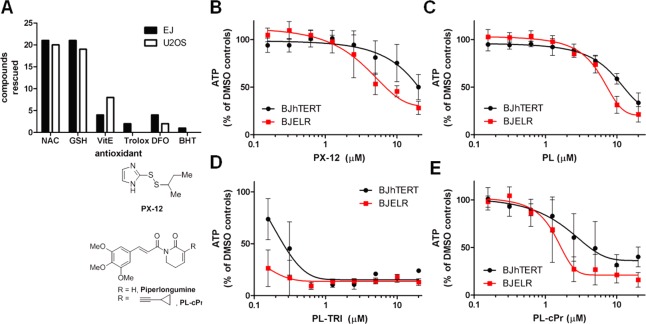
ROS-enhancing compounds show varying selectivity in isogenic models of tumorigenesis. (A) Prevention of compound-induced toxicity using antioxidants. We defined “rescue” as >30% increase in ATP levels at any compound dose following antioxidant co-treatment. No prevention of toxicity was observed using ascorbic acid, uric acid, or β-carotene (not shown). (B–E) Measurement of ATP levels in BJhTERT and BJELR after 48-h treatment with PX-12 (B), piperlongumine (C), and two synthetic piperlongumine analogues including a piperlongumine trimer (D, E). All data are expressed as mean ± SD, n = 3.
Figure 5
Figure 5
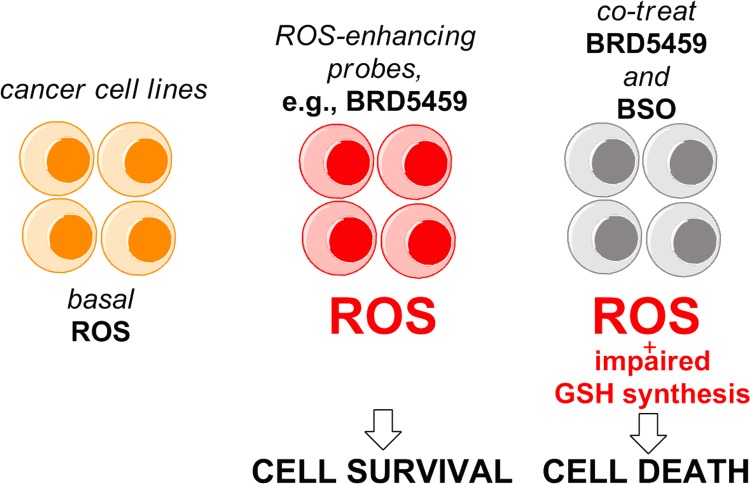
ROS-enhancing chemical probes frequently create a more oxidizing cell state without overt toxicity to cancer cell lines. Glutathione synthesis can be a dependency of cells treated with such probes, as co-treatment with the glutathione synthesis inhibitor BSO often leads to potent cell death.

References

    1. Trachootham D.; Alexandre J.; Huang P. (2009) Targeting cancer cells by ROS-mediated mechanisms: a radical therapeutic approach?. Nat. Rev. Drug Discovery 8, 579–591. - PubMed
    1. Winterbourn C. C.; Hampton M. B. (2008) Thiol chemistry and specificity in redox signaling. Free Radical Biol. Med. 45, 549–561. - PubMed
    1. Murphy M. P.; Holmgren A.; Larsson N. G.; Halliwell B.; Chang C. J.; Kalyanaraman B.; Rhee S. G.; Thornalley P. J.; Partridge L.; Gems D.; Nystrom T.; Belousov V.; Schumacker P. T.; Winterbourn C. C. (2011) Unraveling the biological roles of reactive oxygen species. Cell Metab. 13, 361–366. - PMC - PubMed
    1. Baird L.; Dinkova-Kostova A. T. (2011) The cytoprotective role of the Keap1-Nrf2 pathway. Arch. Toxicol. 85, 241–272. - PubMed
    1. Ma Z. A. (2012) The role of peroxidation of mitochondrial membrane phospholipids in pancreatic beta-cell failure. Curr. Diabetes Rev. 8, 69–75. - PMC - PubMed

Publication types

MeSH terms