


Early school engagement and late elementary outcomes for maltreated children in foster care
- PMID: 23477532
- PMCID: PMC3735813
- DOI: 10.1037/a0032218
Early school engagement and late elementary outcomes for maltreated children in foster care
Abstract
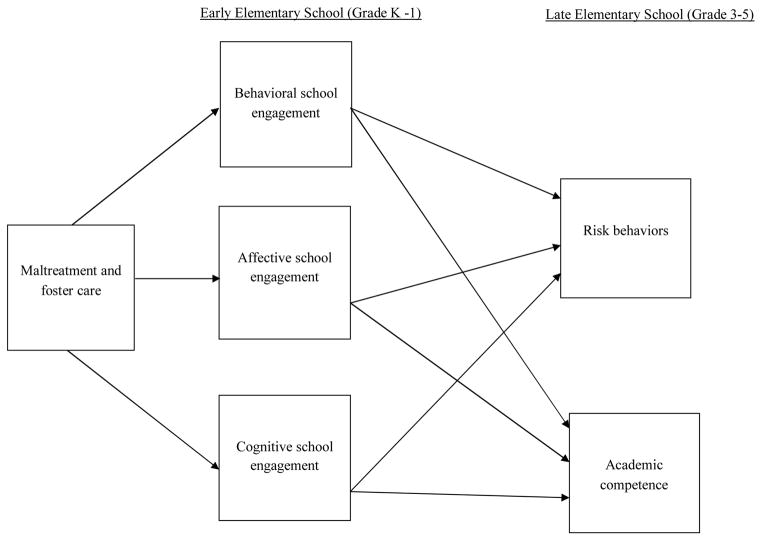
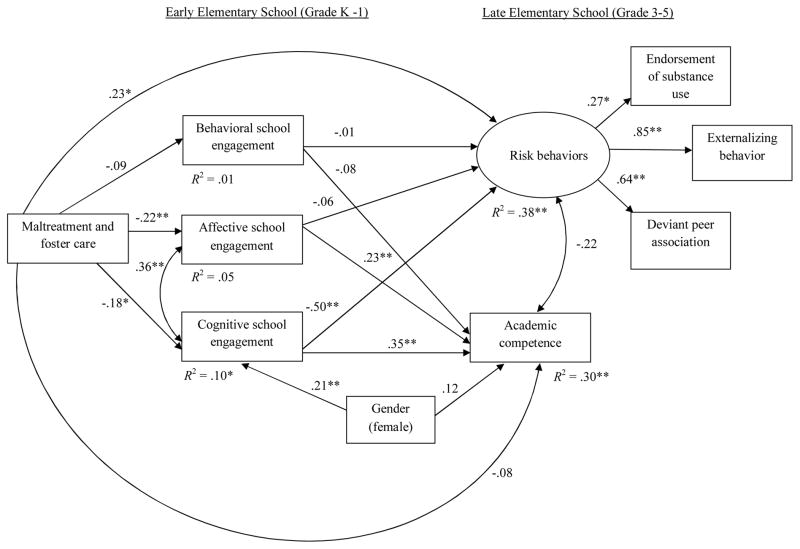
Children with a history of maltreatment and placement into foster care face elevated risks of poor psychosocial outcomes including school failure, substance use, externalizing, and deviant peer association. For children in the general population, school engagement appears to be a promotive factor in preventing negative outcomes. In this study, differences in 3 dimensions of school engagement (behavioral, affective, and cognitive) in early elementary school were explored in maltreated children in foster care (n = 93) and a community comparison group of low-socioeconomic status, nonmaltreated children (n = 54). It was also hypothesized that these 3 dimensions of school engagement would mediate the association between being maltreated and in foster care and several outcomes in late elementary school (Grades 3-5): academic competence, endorsement of substance use, externalizing behaviors, and deviant peer association. Measures were multimethod and multi-informant. Results showed that the children in foster care had lower affective and cognitive school engagement than children in the community comparison group. Structural equation modeling revealed that both affective and cognitive school engagement mediated the association between group status and academic competence in late elementary school. Cognitive engagement also mediated the association between group status and engagement in risk behaviors. The identification of dimensions of early school engagement that predict later outcomes suggests potential points of intervention to change trajectories of academic and behavioral adjustment for maltreated children in foster care.
PsycINFO Database Record (c) 2013 APA, all rights reserved.
Figures
References
-
- Achenbach TM. Manual for the Child Behavior Checklist/4–18 and 1991 Profile. Burlington, VT: University of Vermont; 1991a.
-
- Achenbach TM. Manual for the Teacher’s Report Form and 1991 profile. Burlington, VT: University of Vermont Department of Psychiatry; 1991b.
-
- Alexander KL, Entwisle DR, Kabbani NS. The dropout process in life course perspective: Early risk factors at home and school. Teachers College Record. 2001;103(5):760–822. doi: 10.1111/0161-4681.00134. - DOI
-
- Appleton JJ, Christenson SL, Kim D, Reschly AL. Measuring cognitive and psychological engagement: Validation of the Student Engagement Instrument. Journal of School Psychology. 2006;44(5):427–445. doi: 10.1016/j.jsp.2006.04.002. - DOI
-
- Arbuckle JL. Full information estimation in the presence of incomplete data. In: Marcoulides GA, Schumaker RE, editors. Advanced structural equation modeling: Issues and techniques. Mahwah, NJ: Lawrence Earlbaum Associates; 1996. pp. 243–277.
Publication types
MeSH terms
Grants and funding
LinkOut - more resources
Full Text Sources
Other Literature Sources
Medical
