Review
. 2013 Mar;13(2):151-65.
doi: 10.1586/erm.13.4.

Next-generation sequencing: a powerful tool for the discovery of molecular markers in breast ductal carcinoma in situ

Affiliations
Review

Next-generation sequencing: a powerful tool for the discovery of molecular markers in breast ductal carcinoma in situ

Hitchintan Kaur et al. Expert Rev Mol Diagn. 2013 Mar.

Abstract

Mammographic screening leads to frequent biopsies and concomitant overdiagnosis of breast cancer, particularly ductal carcinoma in situ (DCIS). Some DCIS lesions rapidly progress to invasive carcinoma, whereas others remain indolent. Because we cannot yet predict which lesions will not progress, all DCIS is regarded as malignant, and many women are overtreated. Thus, there is a pressing need for a panel of molecular markers in addition to the current clinical and pathological factors to provide prognostic information. Genomic technologies such as microarrays have made major contributions to defining subtypes of breast cancer. Next-generation sequencing (NGS) modalities offer unprecedented depth of expression analysis through revealing transcriptional boundaries, mutations, rare transcripts and alternative splice variants. NGS approaches are just beginning to be applied to DCIS. Here, the authors review the applications and challenges of NGS in discovering novel potential therapeutic targets and candidate biomarkers in the premalignant progression of breast cancer.


Conflict of interest statement

Financial Disclosure

The authors have no relevant affiliations or financial involvement with any organization or entity with a financial interest in or financial conflict with the subject matter or materials discussed in the manuscript. This includes employment, consultancies, honoraria, stock ownership or options, expert testimony, grants or patents received or pending, or royalties. This review was written solely by the authors without any additional writing assistance.

Figures
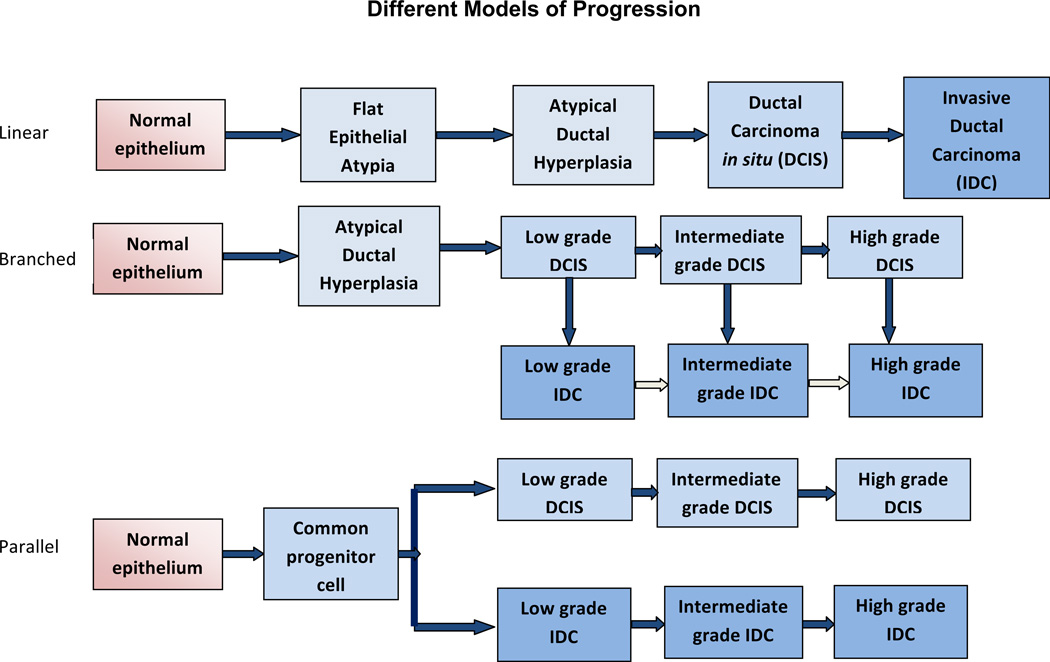
Figure 1
Figure 1. Models of Malignant Progression of Normal Breast Epithelium to Carcinoma
Evidence from epidemiological, morphological and immunohistochemical studies has been used to develop several models to describe the progression from non-invasive DCIS to IDC. (Top) A linear model of progression that in sequential stages from normal epithelium to invasive carcinoma via hyperplasia and in situ carcinoma. The postulates of this hypothesis include that DCIS is a direct precursor of IDC and that atypical ductal hyperplasia is a direct precursor to low grade DCIS. In “non-linear” or “branched” models (Middle) DCIS is a progenitor of IDC, yet different grades of DCIS progress to corresponding grades of IDC. The low, intermediate and high grades can also be termed grades I, II, and III, respectively. There may also be further progression of IDC (pale arrows). The “parallel” model of progression (Bottom) hypothesizes that DCIS and IDC diverge from a common progenitor cell and progress independently through different grades in parallel.
Figure 2
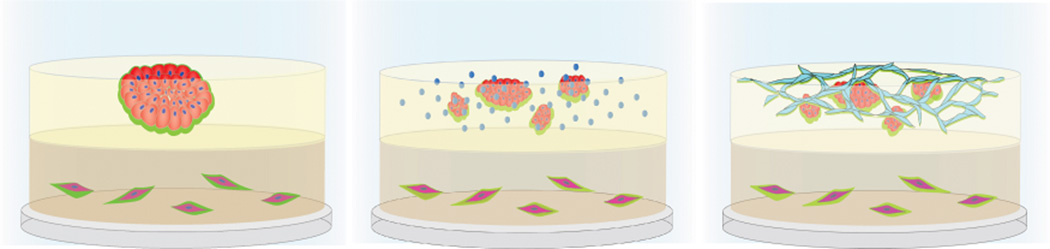
Figure 2. Mammary Architecture and Microenvironment (MAME) Models for functional, live-cell imaging of DCIS-stromal interactions
Left: MCF10.DCIS human DCIS cells in an upper layer of reconstituted basement membrane (rBM) + 2% rBM overlay form dysplastic structures. CAFs are in a lower layer of collagen I. Middle: Human macrophages are added to the rBM layer. Right: Human microvascular endothelial cells are added to the rBM layer.
Figure 3
Figure 3
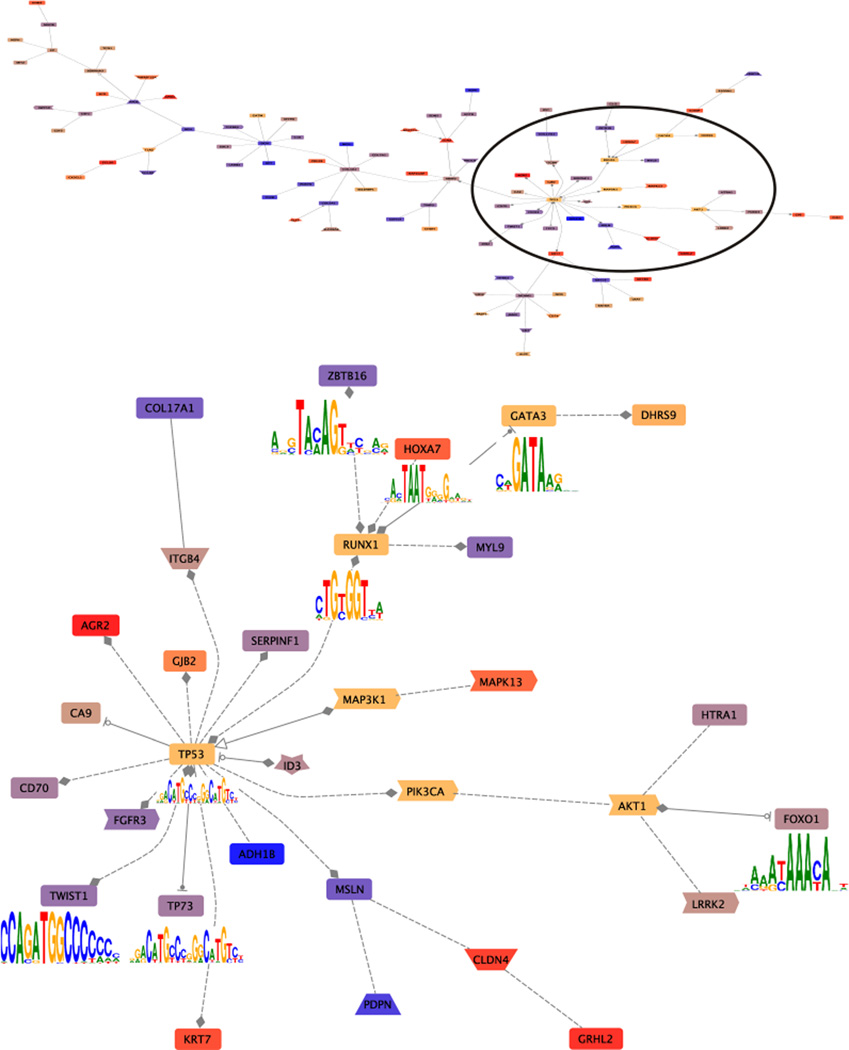
Co-citation interaction networks among the DCIS genes observed in NGS analysis of DCIS models [43]. The co-citation networks among 295 differentially expressed genes and PIK3CA TP53 AKT1 GATA3 MAP3K1 CBFB and RUNX1 7 were constructed using GePS with default parameters (Genomatix). The gene connections are based on previous published literature, i.e., the co-citations between two genes in the previous published literature that have been hand-curated. This network indicates the co-citations of the input genes. The up-regulated genes are shaded in warm colors (red, orange). The down-regulated genes are shaded cooler colors (blue, purple). CBFB does not appear in the network. PIK3CA TP53 AKT1 GATA3 MAP3K1, and RUNX17 are shaded yellow-brown. Of these TP53, GATA3, and RUNX1 encode transcription factors with the motif indicated. The upper panel shows the entire network formed. The circle indicates the region expanded in the lower panel. Note the number of genes which share transcription factor binding sites as indicated by the filled line terminators: diamonds indicate that gene A modulates gene B; arrowheads indicate that gene A activates gene B, and stopped circles that gene A inhibits gene B. This overview provides the opportunity to selectively evaluate the veracity of the resulting pathway.
Figure 4
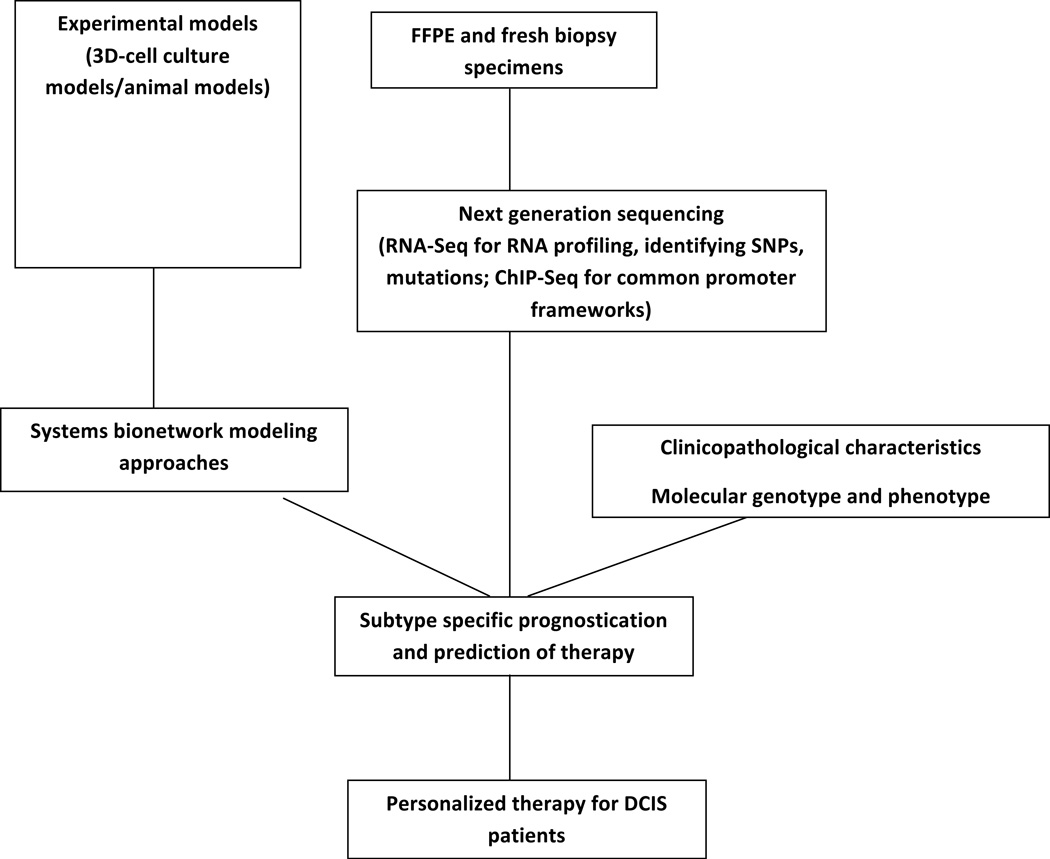
Figure 4. Integrative flow chart for discovery of knowledge to personalize DCIS treatment therapy
The DCIS samples for NGS may come from experimental models or clinical samples (FFPE or fresh biopsy). Genes with similar expression patterns could be identified by RNA-Seq and the common promoter frameworks verified by ChIP-Seq. Combining systems bionetwork modeling approaches with clinicopathological characteristics, molecular genotype and phenotype, NGS results will help to discover / predict personalized therapy for DCIS patients.

References

    1. Siegel R, Naishadham D, Jemal A. Cancer statistics, 2012. CA: a cancer journal for clinicians. 2012;62(1):10–29. - PubMed
    1. Puliti D, Zappa M. Breast cancer screening: are we seeing the benefit? BMC Med. 2012;10:106. - PMC - PubMed
    1. Tabar L, Vitak B, Chen HH, Yen MF, Duffy SW, Smith RA. Beyond randomized controlled trials: organized mammographic screening substantially reduces breast carcinoma mortality. Cancer. 2001;91(9):1724–1731. - PubMed
    1. Kopans DB. Just the facts: mammography saves lives with little if any radiation risk to the mature breast. Health Phys. 2011;101(5):578–582. - PubMed
    1. Peto R, Davies C, Godwin J, et al. Comparisons between different polychemotherapy regimens for early breast cancer: meta-analyses of long-term outcome among 100,000 women in 123 randomised trials. Lancet. 2012;379(9814):432–444. - PMC - PubMed

Publication types

Substances