


Primary ciliary dyskinesia-causing mutations in Amish and Mennonite communities
- PMID: 23477994
- PMCID: PMC3725203
- DOI: 10.1016/j.jpeds.2013.01.061
Primary ciliary dyskinesia-causing mutations in Amish and Mennonite communities
Abstract
Objective: To determine whether individuals with primary ciliary dyskinesia (PCD) from unrelated Amish and Mennonite families harbor a single and unique founder mutation.
Study design: Subjects from Amish and Mennonite communities in several states were enrolled in the study. All subjects were clinically characterized, and nasal nitric oxide levels were measured. Nasal epithelial scrapings were collected from several subjects for ciliary ultrastructural analyses. DNA was isolated from patients with PCD and their unaffected first- and second-degree relatives. Genome-wide homozygosity mapping, linkage analyses, targeted mutation analyses, and exome sequencing were performed.
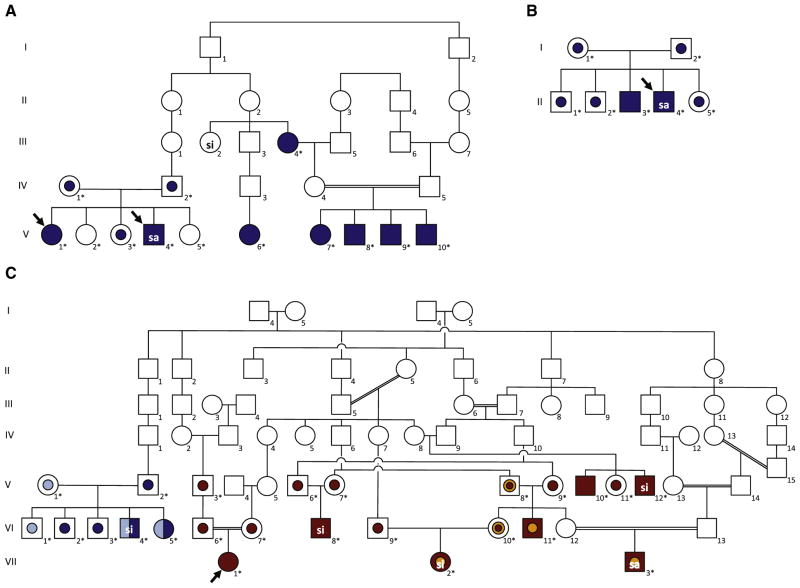
Results: All subjects from Old-Order Amish communities from Pennsylvania were homozygous for a nonsense mutant DNAH5 allele, c.4348C>T (p.Q1450X). Two affected siblings from an unrelated Mennonite family in Arkansas were homozygous for the same nonsense DNAH5 mutation. Children with PCD from an Amish family from Wisconsin had biallelic DNAH5 mutations, c.4348C>T (p.Q1450X) and c.10815delT (p.P3606HfsX23), and mutations in other genes associated with PCD were also identified in this community.
Conclusion: The Amish and Mennonite subjects from geographically dispersed and socially isolated communities had the same founder DNAH5 mutation, owing to the common heritage of these populations. However, disease-causing mutations in other PCD-associated genes were also found in affected individuals in these communities, illustrating the genetic heterogeneity in this consanguineous population.
Keywords: NO; Nitric oxide; PCD; Primary ciliary dyskinesia.
Copyright © 2013 Mosby, Inc. All rights reserved.
Conflict of interest statement
The authors declare no conflicts of interest.
Figures
References
Publication types
MeSH terms
Grants and funding
LinkOut - more resources
Full Text Sources
Other Literature Sources
Medical
Molecular Biology Databases
