


doi: 10.3390/ijms14035608.
Structure-based search for new inhibitors of cholinesterases
Affiliations
- PMID: 23478436
- PMCID: PMC3634507
- DOI: 10.3390/ijms14035608
Item in Clipboard
Structure-based search for new inhibitors of cholinesterases
Int J Mol Sci.
.
Abstract
Cholinesterases are important biological targets responsible for regulation of cholinergic transmission, and their inhibitors are used for the treatment of Alzheimer's disease. To design new cholinesterase inhibitors, of different structure-based design strategies was followed, including the modification of compounds from a previously developed library and a fragment-based design approach. This led to the selection of heterodimeric structures as potential inhibitors. Synthesis and biological evaluation of selected candidates confirmed that the designed compounds were acetylcholinesterase inhibitors with IC50 values in the mid-nanomolar to low micromolar range, and some of them were also butyrylcholinesterase inhibitors.
Figures
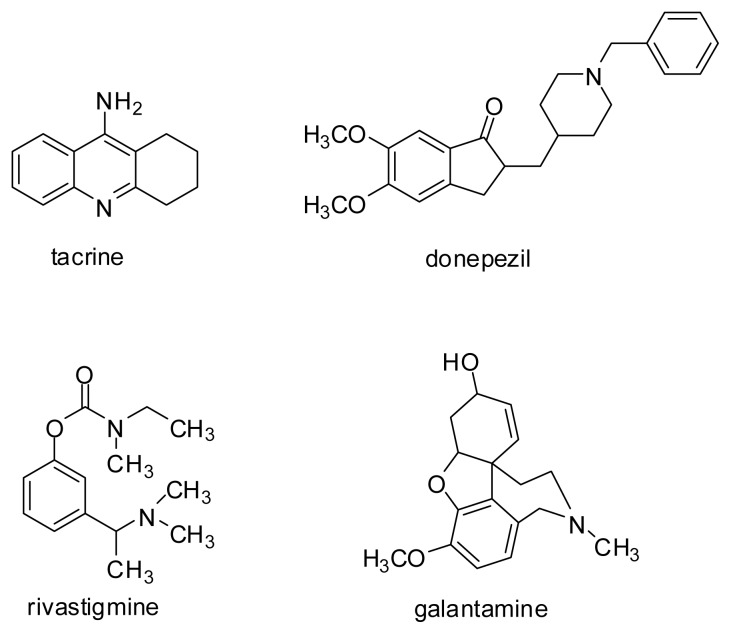
Cholinesterases inhibitors used in Alzheimer’s disease (AD) treatment. Tacrine was withdrawn, due to its hepatotoxicity, but it is still used in experiments as a reference inhibitor.
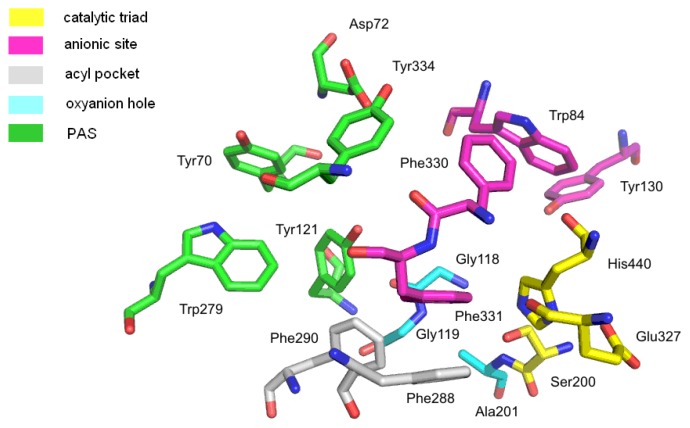
Active site of acetylcholinesterase (Torpedo californica acetylcholinesterase (TcAChE); Protein Database Bank (PDB): 1EVE).
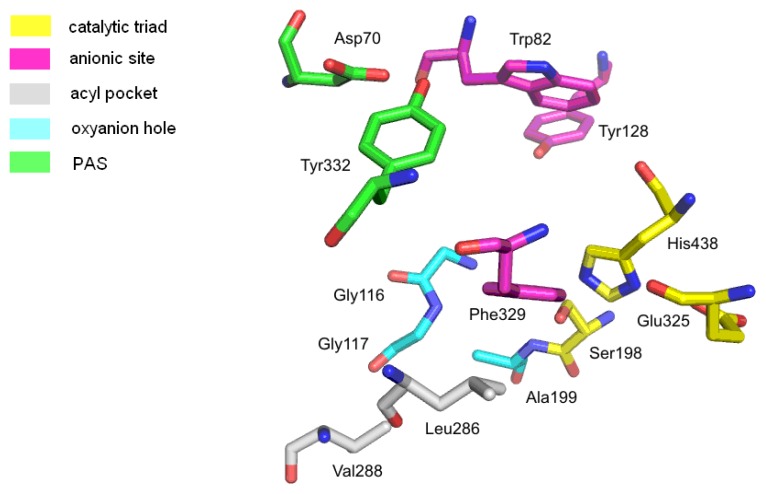
Active site of butyrylcholinesterase (human butyrylcholinesterase (hBuChE), PDB: 1P0I).
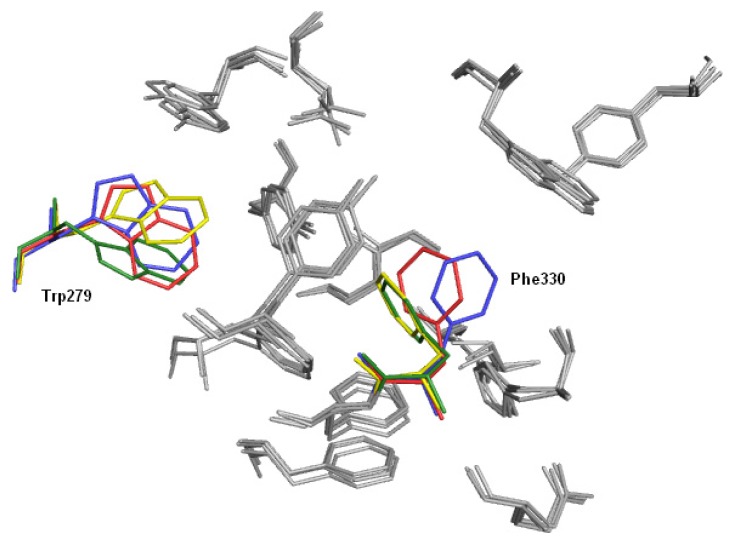
Superimposed amino acid residues from the AChE active site, derived from different crystal structures (1ACJ: yellow; 1EVE: blue; 2ACE: red; 2CKM: green).
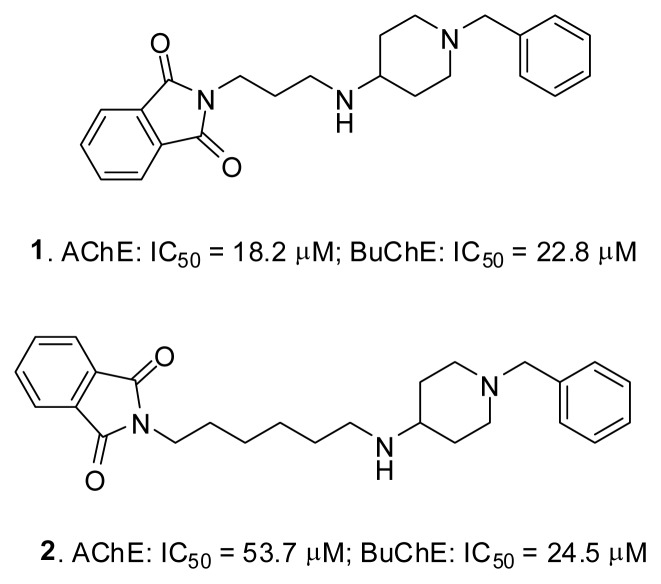
The starting point of our research—compounds 1 and 2. They are both acetyl- and butyryl-cholinesterase inhibitors with micromolar IC50 values [32].
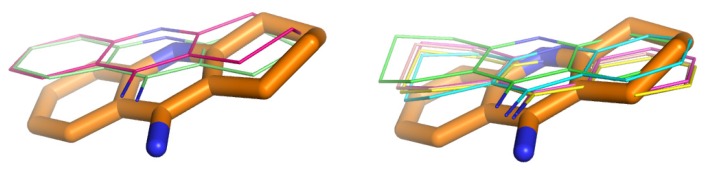
Tacrine clusters obtained in docking to BuChE. Results were compared with the arrangement of tacrine (orange) in the complex with acetylcholinesterase.
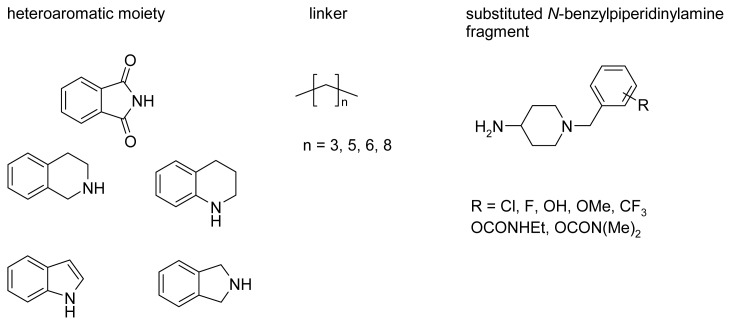
Modifications of heterodimeric compounds 1 and 2.
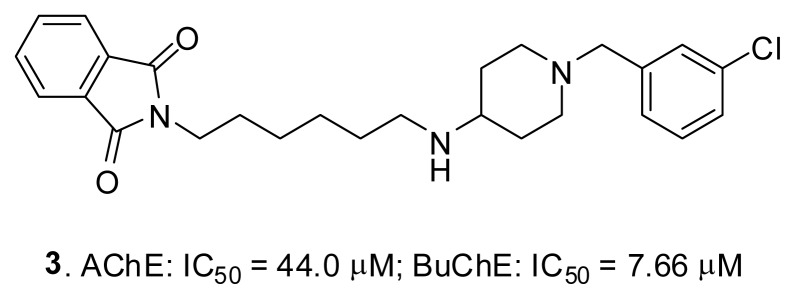
The obtained derivative 3, based on our library of compounds.
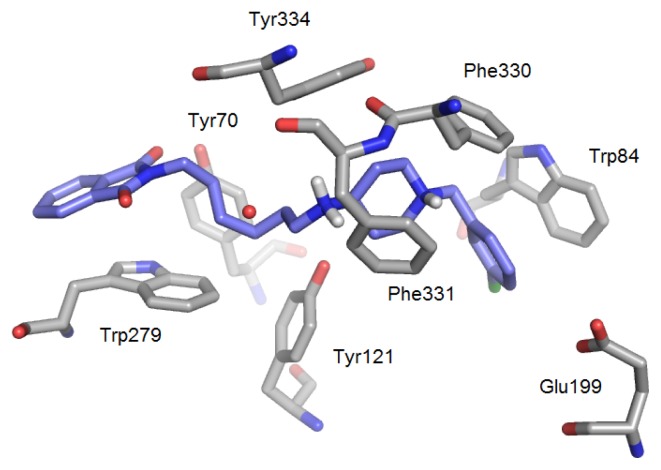
The obtained derivative 3, based on our library of compounds.
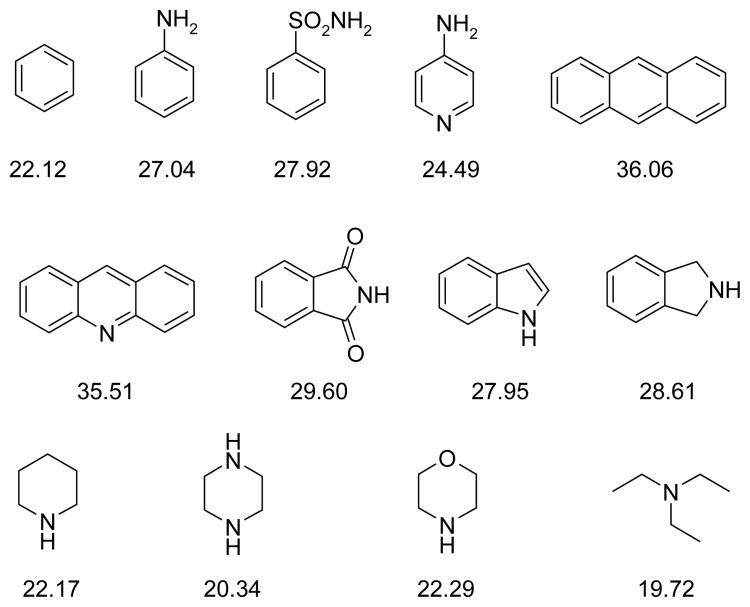
Structural fragments used for the fragment-based design of cholinesterase inhibitors. ChemScore values for binding with acetylcholinesterase are given for each fragment.
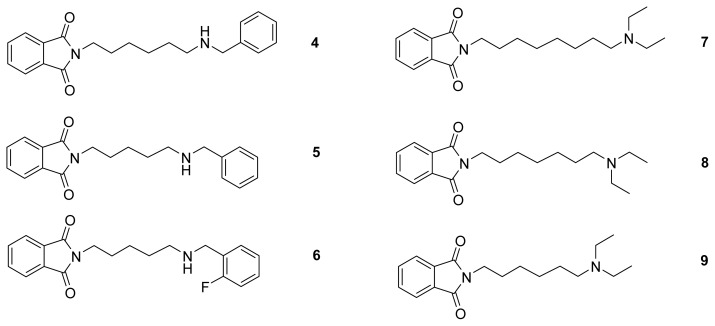
Structures of designed acetylcholinesterase inhibitors—newly synthesized (4–6) and currently described compounds (7–9).
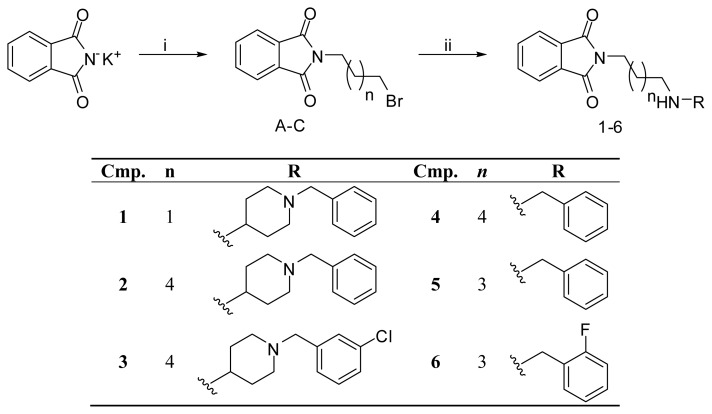
Reagents and conditions: i. dibromoalkane, tetra-n-butylammonium bromide (TBAB), MeCN, reflux, 20 h; ii. (a) 4-amino-1-benzylpiperidine, triethylamine (TEA), MeCN, reflux, 3 h (compound (cmp.) 1,2); (b) 1-(3-chlorobenzyl)piperidin-4-amine, TEA, MeCN, microwave (MW), 100 °C, 45 min. (cmp. 3); (c) benzylamine, K2CO3, MeCN, room temperature (RT), 48 h (cmp. 4,5); (d) 2-fluorobenzylamine, K2CO3, MeCN, RT, 48 h (cmp. 6).
References
-
- Giacobini E. Cholinesterase inhibitors: New roles and therapeutic alternatives. Pharmacol. Res. 2004;50:433–440. - PubMed
-
- Melnikova I. Therapies for Alzheimer’s disease. Nat. Rev. Drug Discov. 2007;6:341–342. - PubMed
-
- Ballenger J.F. Progress in the history of Alzheimer’s disease: The importance of context. J. Alzheimers Dis. 2006;9:5–13. - PubMed
LinkOut - more resources
Full Text Sources
Other Literature Sources
