Review
. 2013 Mar 11;5(3):806-23.
doi: 10.3390/v5030806.

Understanding bacteriophage specificity in natural microbial communities

Affiliations
Review

Understanding bacteriophage specificity in natural microbial communities

Britt Koskella et al. Viruses. .

Abstract

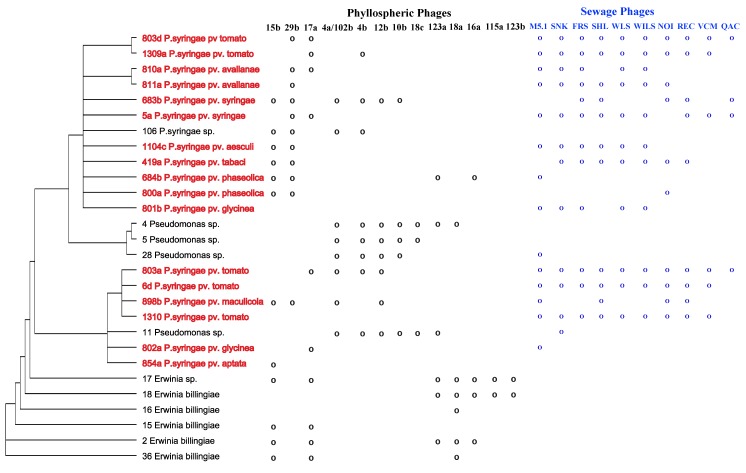
Studying the coevolutionary dynamics between bacteria and the bacteriophage viruses that infect them is critical to understanding both microbial diversity and ecosystem functioning. Phages can play a key role in shaping bacterial population dynamics and can significantly alter both intra- and inter-specific competition among bacterial hosts. Predicting how phages might influence community stability and apparent competition, however, requires an understanding of how bacteria-phage interaction networks evolve as a function of host diversity and community dynamics. Here, we first review the progress that has been made in understanding phage specificity, including the use of experimental evolution, we then introduce a new dataset on natural bacteriophages collected from the phyllosphere of horse chestnut trees, and finally we highlight that bacterial sensitivity to phage is rarely a binary trait and that this variation should be taken into account and reported. We emphasize that there is currently insufficient evidence to make broad generalizations about phage host range in natural populations, the limits of phage adaptation to novel hosts, or the implications of phage specificity in shaping microbial communities. However, the combination of experimental and genomic approaches with the study of natural communities will allow new insight to the evolution and impact of phage specificity within complex bacterial communities.


Figures
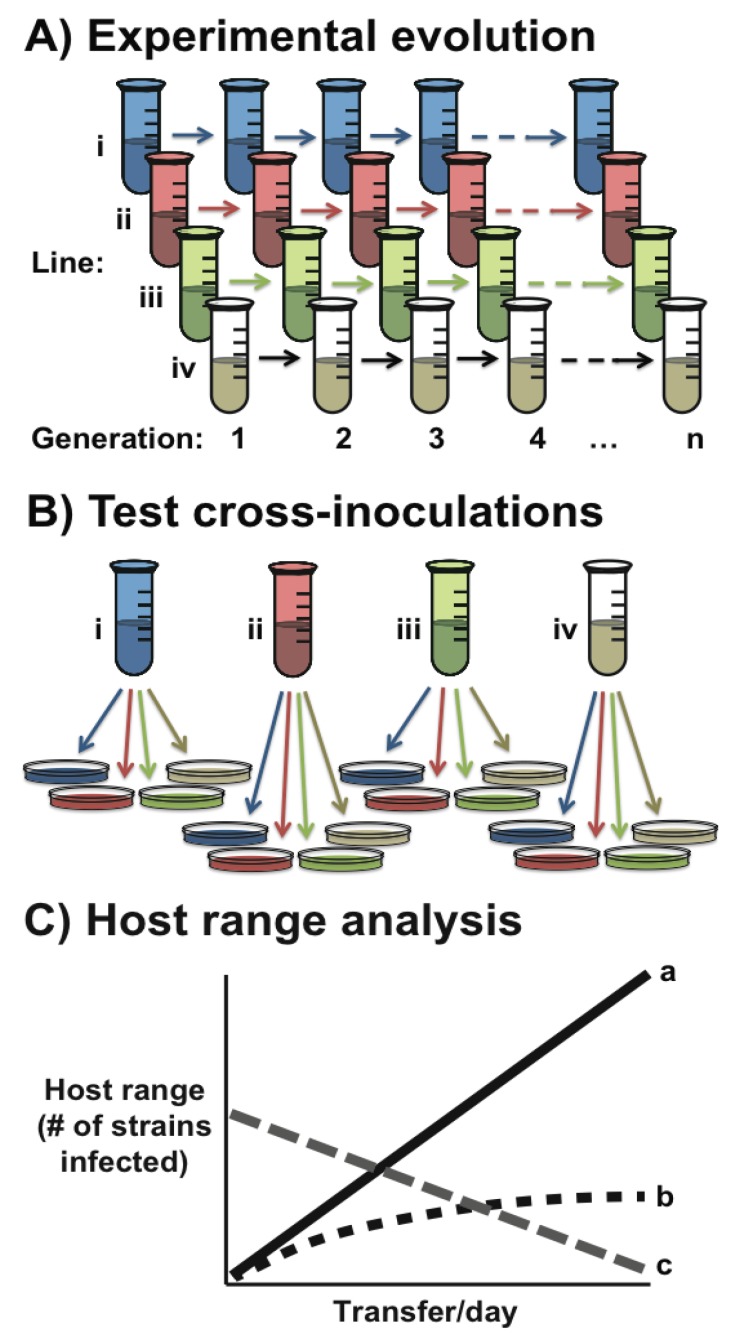
Figure 1
Figure 1
Illustrative example of experimental evolution of phage host range, where: (A) independent lines of genetically identical phage populations are propagated under different treatment regimens (e.g., different bacterial host species); and then (B) tested for infectivity on focal and alternate hosts. (C) Outcomes of these experiments might be a directional change towards increased host range over time (a), an initially increasing but then stable host range, perhaps indicative of coevolutionary response by the host population (b), or a decrease in host range associated with antagonistic pleiotropy during specialization on the focal host (c).
Figure 2
Figure 2
Neighbor-joining tree showing the phylogenetic relationships among bacteria used in this study and their susceptibility to bacteriophages from the phyllosphere (black) or from sewage (blue). Trees are based on 16S rRNA gene sequences (∼800 bp). Bacterial isolates in red have been classified previously to the pathovar level. Phages 4a and 102b had identical host ranges, despite being isolated from separate leaves, and their profiles have thus been collapsed into one.
Figure 3
Figure 3
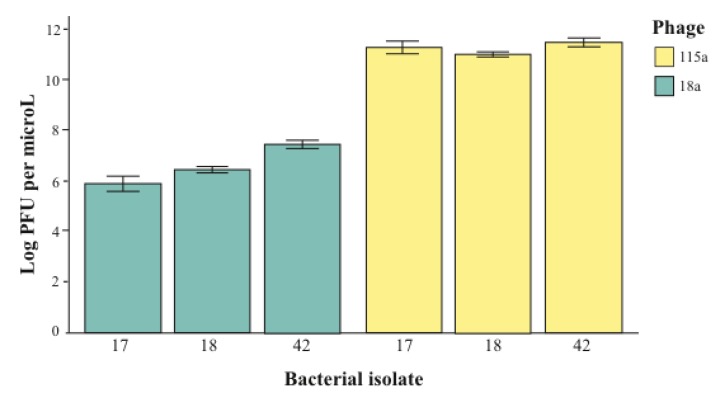
Results of the reciprocal cross-inoculation where the same phage inoculum was spotted in a dilution series onto lawns of each of three different Erwinia sp. bacterial isolates. The number of plaque forming units (PFUs) per microliter of inocula was measured for each cross, and the means across five replicates are shown on the Y-axis. Variation in PFU within a given inocula (i.e., among the blue bars or among the yellow bars) represents variation in phage success across bacterial hosts. Note that the important comparison is within-phage variation, as between-phage variation reflects absolute differences in phage titer.

References

    1. Gómez P., Buckling A. Bacteria-phage antagonistic coevolution in soil. Science. 2011;332:106–109. doi: 10.1126/science.1198767. - DOI - PubMed
    1. Griffiths R.I., Thomson B.C., James P., Bell T., Bailey M., Whiteley A.S. The bacterial biogeography of British soils. Environ. Microb. 2011;13:1642–1654. doi: 10.1111/j.1462-2920.2011.02480.x. - DOI - PubMed
    1. Koskella B., Thompson J.N., Preston G.M., Buckling A. Local biotic environment shapes the spatial scale of bacteriophage adaptation to bacteria. Am. Nat. 2011;177:440–451. doi: 10.1086/658991. - DOI - PubMed
    1. Lindow S.E., Brandl M.T. Microbiology of the Phyllosphere. Appl. Environ. Microbiol. 2003;69:1875–1883. doi: 10.1128/AEM.69.4.1875-1883.2003. - DOI - PMC - PubMed
    1. Marston M.F., Pierciey F.J., Shepard A., Gearin G., Qi J., Yandava C., Schuster S.C., Henn M.R., Martiny J.B.H. Rapid diversification of coevolving marine Synechococcus and a virus. PNAS. 2012;109:4544–4549. doi: 10.1073/pnas.1120310109. - DOI - PMC - PubMed