. 2013 Mar 26;110(13):5046-51.
doi: 10.1073/pnas.1221724110. Epub 2013 Mar 11.

Cdc48-associated complex bound to 60S particles is required for the clearance of aberrant translation products

Affiliations

Cdc48-associated complex bound to 60S particles is required for the clearance of aberrant translation products

Quentin Defenouillère et al. Proc Natl Acad Sci U S A. .

Abstract

Ribosome stalling on eukaryotic mRNAs triggers cotranslational RNA and protein degradation through conserved mechanisms. For example, mRNAs lacking a stop codon are degraded by the exosome in association with its cofactor, the SKI complex, whereas the corresponding aberrant nascent polypeptides are ubiquitinated by the E3 ligases Ltn1 and Not4 and become proteasome substrates. How translation arrest is linked with polypeptide degradation is still unclear. Genetic screens with SKI and LTN1 mutants allowed us to identify translation-associated element 2 (Tae2) and ribosome quality control 1 (Rqc1), two factors that we found associated, together with Ltn1 and the AAA-ATPase Cdc48, to 60S ribosomal subunits. Translation-associated element 2 (Tae2), Rqc1, and Cdc48 were all required for degradation of polypeptides synthesized from Non-Stop mRNAs (Non-Stop protein decay; NSPD). Both Ltn1 and Rqc1 were essential for the recruitment of Cdc48 to 60S particles. Polysome gradient analyses of mutant strains revealed unique intermediates of this pathway, showing that the polyubiquitination of Non-Stop peptides is a progressive process. We propose that ubiquitination of the nascent peptide starts on the 80S and continues on the 60S, on which Cdc48 is recruited to escort the substrate for proteasomal degradation.


Conflict of interest statement

The authors declare no conflict of interest.

Figures
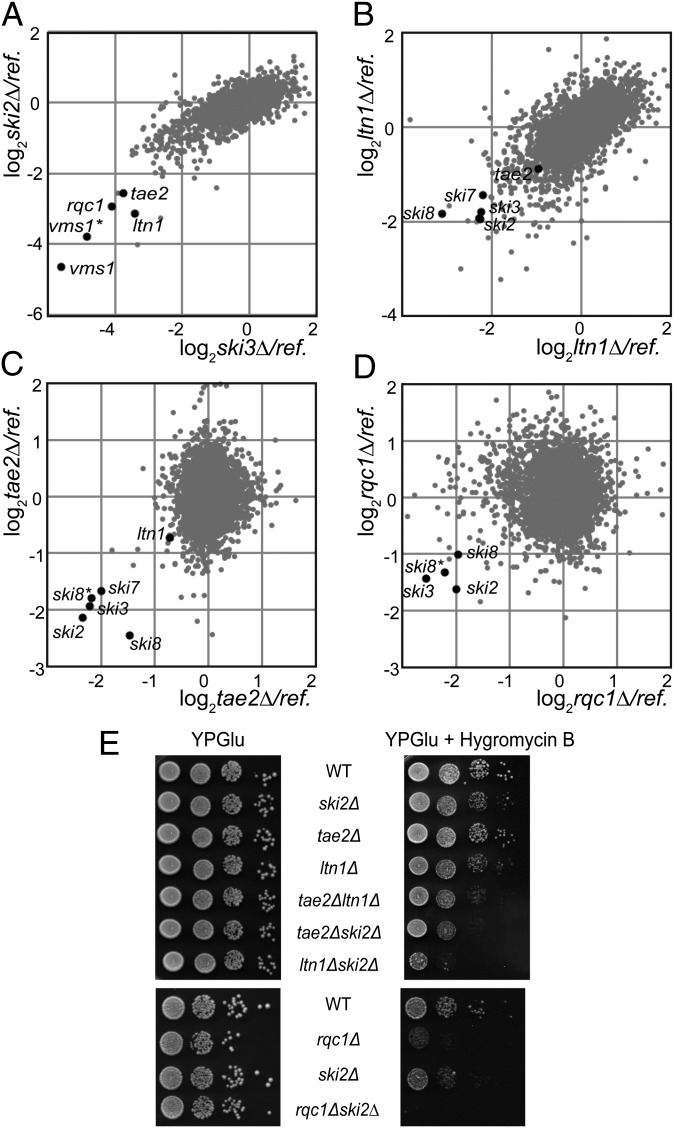
Fig. 1.
Fig. 1.
Tae2, Rqc1, and Ltn1 are functionally linked to the SKI complex. (A) GIM screens with ski2∆ and ski3∆ query strains. Each dot indicates a deletion mutant strain. In each screen, we compared the relative changes in given mutant levels in combination with the query or a reference mutation after 22 generations of a mixture of double-mutant populations. Microarray estimation of changes was normalized and the log2 of the ratio of query to reference was plotted. (B) GIM screens with the ltn1∆ query strain. Details are as in A. (C) GIM screens with the tae2∆ query strain. Details are as in A. (D) GIM screens with the rqc1∆ query strain. Details are as in A. (E) Serial dilutions of wild-type (BY4741) or deletion mutant strains were spotted on rich medium plates with or without hygromycin B (40 µg/mL) and incubated for 2 d at 30 °C.
Fig. 2.
Fig. 2.
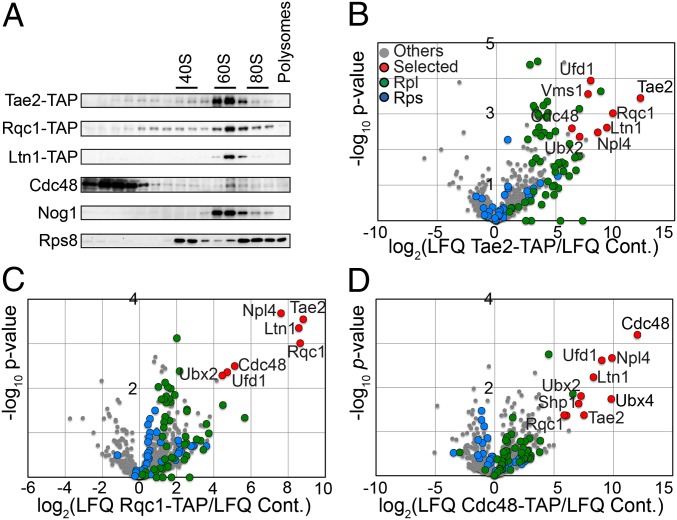
Tae2, Rqc1, Ltn1, and Cdc48 are associated to 60S ribosomal particles. (A) Total cellular extracts were prepared from each strain expressing Tae2-TAP or Rqc1-TAP or Ltn1-TAP and separated on a sucrose gradient (10–30%). Fractions of the gradient were analyzed by Western blot, using antibodies against TAP, Cdc48, Nog1, and Rps8, a ribosomal protein of the small subunit. (B) Affinity purification of the Tae2-TAP–associated complex was subjected to LC-MS/MS identification and quantification. Tae2-associated complex was compared with the BY4741 strain. Volcano plot shows the fold change (log2 LFQ cpx/LFQ ref.) (LFQ, label-free quantification) on the x axis and the P-value distribution (−log10 P value) on the y axis for the proteins identified in the TAP purification. Each circle indicates an identified protein (in red, for the most significant enriched candidates in the TAP purification; in green, for RPLs; in blue, for the RPSs). (C) TAP purification with Rqc1-TAP compared with the BY4741 strain. Details are as in B. (D) TAP purification with Cdc48-TAP compared with the BY4741 strain. Details are as in B.
Fig. 3.
Fig. 3.
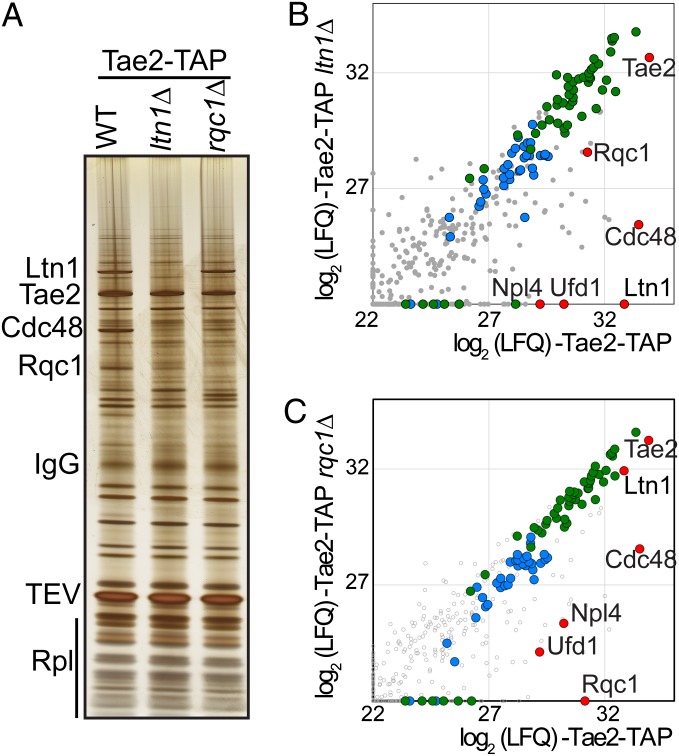
Cdc48 association with Tae2 depends on Ltn1 and Rqc1. (A) Affinity purification of the Tae2-TAP–associated complex in WT or in the absence of Ltn1 or in the absence of Rqc1. The associated proteins were separated on a polyacrylamide gel and revealed by silver staining. (B) Affinity purification of Tae2-TAP–associated complex in presence or absence of Ltn1. Graph shows the comparison between the intensities (LFQ) for each protein identified by LC-MS/MS (log2 scale). (Color legend is as in Fig. 2). (C) Affinity purification of the Tae2-TAP–associated complex in the presence or absence of Rqc1 as in B.
Fig. 4.
Fig. 4.
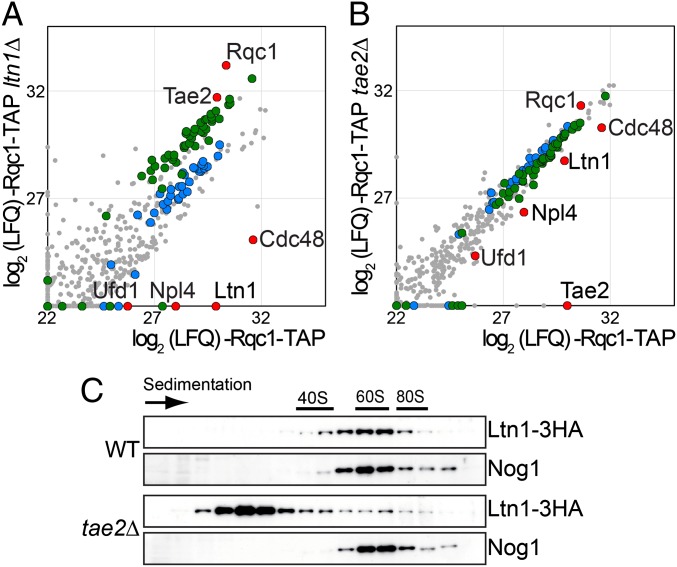
Ltn1 association to 60S ribosomal particles is affected by Tae2. (A) Affinity purification of the Rqc1-TAP–associated complex in the presence or absence of Ltn1. Graph shows the comparison of the intensities of each protein identified by LC-MS/MS (log2 scale) as in Fig. 3B. (Legend for the dots is as in Fig. 2A.) (B) Affinity purification of the Rqc1-TAP–associated complex in the presence or absence of Tae2 as in Fig. 3B. (C) Cellular extracts from the tagged strains Ltn1-3HA and Ltn1-3HA tae2∆ were separated on a sucrose gradient (10–30%) as in Fig. 2. The tagged proteins were revealed by Western blot as in Fig. 2, using HA antibody.
Fig. 5.
Fig. 5.
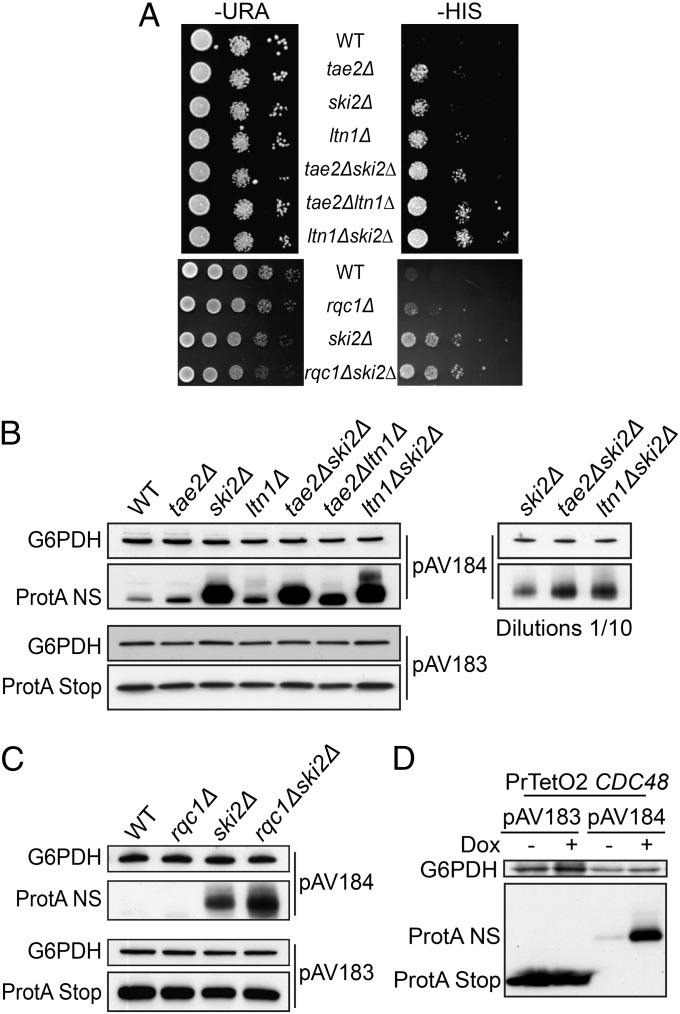
Absence of Tae2, Rqc1, and Ltn1 as well as Cdc48 leads to the accumulation of Non-Stop proteins. (A) Absence of Tae2 (Upper) or Rqc1 (Lower) enables the production of Non-Stop His3. Wild-type (BY4741) or deletion mutant strains were transformed with the Non-Stop HIS3-containing plasmid (pAV188). Serial dilutions of the strains were spotted on SC −Ura and on SC −His and the plates were incubated for 3 d at 30 °C. (B) The same strains as in A were transformed with the pAV184 plasmid containing the Non-Stop protA gene under the control of the GAL10 promoter and with the pAV183-containing protA gene with a Stop codon as a control. Nondiluted and 10-fold–diluted total cellular extracts were separated on a 10% SDS/PAGE polyacrylamide gel and the protein A was revealed by Western blot, using PAP antibody. A loading control of the total protein amounts was done using anti-G6PDH antibody. (C) As in B with the strains related to rqc1∆, ski2∆, and rqc1∆ ski2∆. (D) As in B with the strain PrTetO2:CDC48. The depletion of Cdc48 was obtained by incubation of the strain for 12 h in the presence of Doxycyclin (10 µg/mL).
Fig. 6.
Fig. 6.
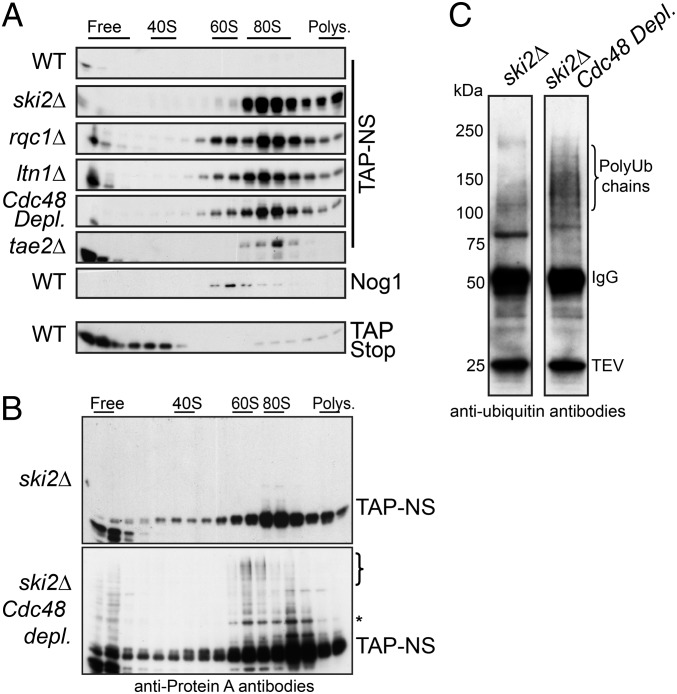
Stabilized Non-Stop proteins accumulate on 80S and 60S particles. (A) Cellular extracts from wild-type or deletion mutant strains bearing the TAP Non-Stop reporter were separated on sucrose gradients. The sedimentation profile of the TAP-stop protein expressed in the wild-type strain is shown as a control. The fractions were analyzed by Western blot, using antibodies against TAP. In addition, an antibody against Nog1 was used for the WT to mark the 60S position. (B) Polysome gradient of cellular extracts from ski2∆ single-mutant and ski2∆ Cdc48-depleted strains that express TAP-Non-Stop construct, detected as in A. (C) Immunoprecipitation of TAP-Non-Stop reporter in ski2∆ single-mutant and ski2∆ Cdc48-depleted strains. The cellular extracts from the strains in B were purified on IgG beads and eluted with TEV protease and the associated proteins were analyzed by Western blot, using monoclonal anti-Ubiquitin antibodies (clone P4D1).

References

    1. Kervestin S, Jacobson A. NMD: A multifaceted response to premature translational termination. Nat Rev Mol Cell Biol. 2012;13(11):700–712. - PMC - PubMed
    1. Frischmeyer PA, et al. (2002) An mRNA surveillance mechanism that eliminates transcripts lacking termination codons. Science 295:2258–2261. - PubMed
    1. van Hoof A, Frischmeyer PA, Dietz HC, Parker R. Exosome-mediated recognition and degradation of mRNAs lacking a termination codon. Science. 2002;295(5563):2262–2264. - PubMed
    1. Doma MK, Parker R. Endonucleolytic cleavage of eukaryotic mRNAs with stalls in translation elongation. Nature. 2006;440(7083):561–564. - PMC - PubMed
    1. Wilson MA, Meaux S, Parker R, van Hoof A. Genetic interactions between [PSI+] and nonstop mRNA decay affect phenotypic variation. Proc Natl Acad Sci USA. 2005;102(29):10244–10249. - PMC - PubMed

Publication types

MeSH terms