. 2013 May;222(5):518-25.
doi: 10.1111/joa.12036. Epub 2013 Mar 11.

The effects of joint immobilization on articular cartilage of the knee in previously exercised rats

Affiliations

The effects of joint immobilization on articular cartilage of the knee in previously exercised rats

Diogo Correa Maldonado et al. J Anat. 2013 May.

Abstract

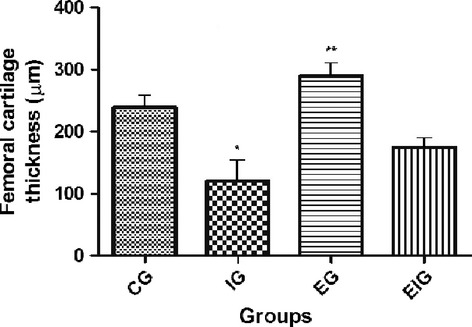
Studies have determined the effects of joint immobilization on the articular cartilage of sedentary animals, but we are not aware of any studies reporting the effects of joint immobilization in previously trained animals. The objective of the present study was to determine whether exercise could prevent degeneration of the articular cartilage that accompanies joint immobilization. We used light microscopy to study the thickness, cell density, nuclear size, and collagen density of articular cartilage of the femoral condyle of Wistar rats subjected to aerobic physical activity on an adapted treadmill five times per week. Four groups of Wistar rats were used: a control group (C), an immobilized group (I), an exercised group (E), and an exercised and then immobilized group (EI). The right knee joints from rats in groups I and EI were immobilized at 90 °C of flexion using a plastic cast for 8 weeks. Cartilage thickness decreased significantly in group I (mean, 120.14 ± 15.6 μm, P < 0.05), but not in group EI (mean, 174 ± 2.25), and increased significantly in group E (mean, 289.49 ± 9.15) compared with group C (mean, 239.20 ± 6.25). The same results were obtained for cell density, nuclear size, and collagen density (in all cases, P < 0.05). We concluded that exercise can prevent degenerative changes in femoral articular cartilage caused by immobilization of the knee joint.


Figures

Fig. 1
Fig. 1
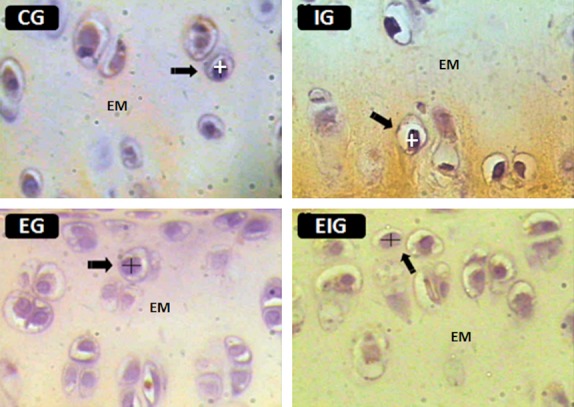
Histological sections of the femoral articular cartilage from each of the four groups of rats (C, I, E, and EI) were used to measure the major and minor nuclear diameters of chondrocytes (arrows). EM, ECM. Figures are from the intermediate zone of the cartilage. HE staining. Scale bar: 30 μm.
Fig. 2
Fig. 2
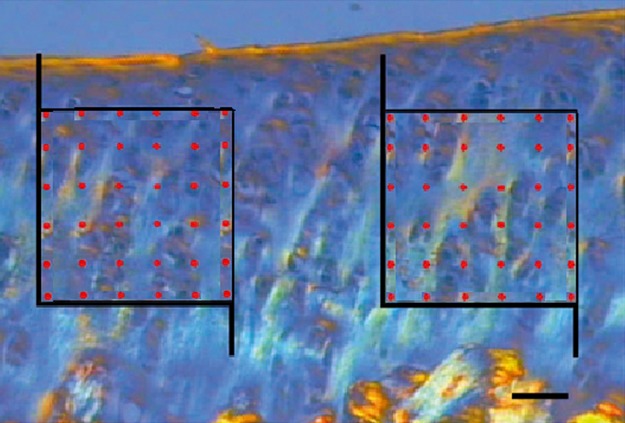
A photomicrograph showing unbiased counting using two square frames containing 36 points each and superimposed on the intermediate zone of the femoral articular cartilage. Collagen appears as orange, white, and green vertical fiber bundles on a blue background inside of the frames. Scale bar: 20 μm.
Fig. 3
Fig. 3
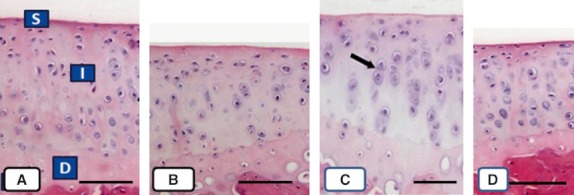
Microphotographs of sections of cartilage sectioned perpendicular to the articular surface from rats in groups C (A), I (B), E (C), and EI (D). Observations of the superficial (S), intermediate (I), and deep zones (D) were clearly differentiated in (A), (C), and (D), but not in (B). Two chondrocytes are indicated in (C) with arrows. Scale bars: 100 μm.
Fig. 4
Fig. 4
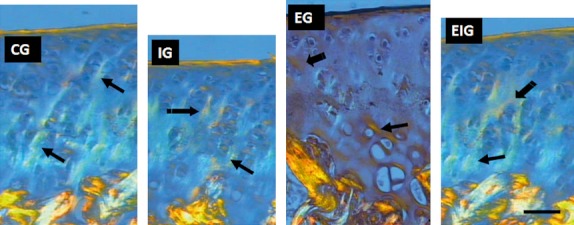
Light-field photomicrographs via polarization microscopy of the femoral cartilage sections from groups C, I, E, and EI stained with Picrosirius to observe the changes in collagen (arrows) in the immobilization (I) and exercise (E and EI) groups. Collagen appears as orange, white, and green vertical fiber bundles on a blue background above the cancellous bone. Collagen concentration seemed to have been reduced in group I and augmented in group E in relation to the other groups. Scale bar: 30 μm.
Fig. 5
Fig. 5
Articular cartilage thickness in the contact area from the four study groups (C, I, E, and EI). *Significance vs. groups C, E, and EI (P < 0.05); **Significance vs. groups C and EI (P < 0.05). No significant difference was observed between groups C and EI (P > 0.05), suggesting that exercise had no effect on cartilage thickness in immobilized animals. Five rats per group and nine tissue sections per animal.
Fig. 6
Fig. 6
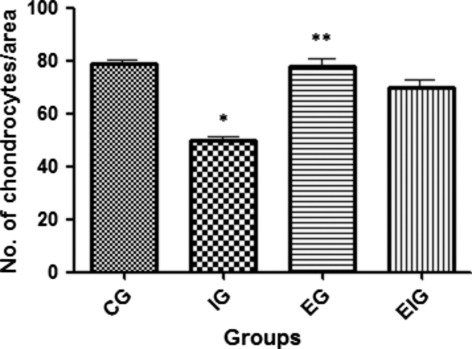
Cellular density (number per area) in femoral articular cartilage of the four study groups. *Significance vs. groups C, E, and EI (P < 0.05). No significant difference was observed among groups C, E, and EI (P > 0.05), suggesting that exercise had no effect on chondrocyte number from non-immobilized animals (group E), but prevented the effects of immobilization on the number of chondrocytes in immobilized animals (group EI). Five rats per group and nine tissue sections per animal.
Fig. 7
Fig. 7
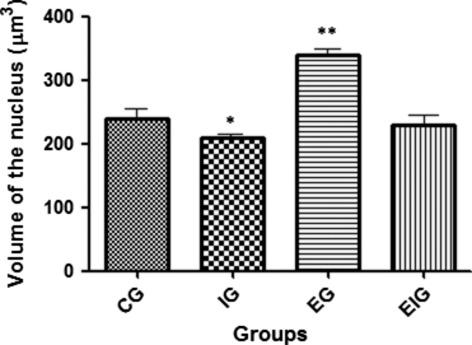
The volume of nuclear chondrocytes in articular cartilage of the femur in the four study groups of rats (C, I, E, and EI). *Significance vs. groups C, E, and EI (P < 0.05) and **significance vs. groups C and EI (P < 0.05). No significant difference was observed between groups C and EI (P > 0.05), suggesting that exercise did affect the nuclear volume of chondrocytes from immobilized animals (group EI) and prevented the effects of immobilization on nuclear volume. Five rats per group and nine sections per animal.
Fig. 8
Fig. 8
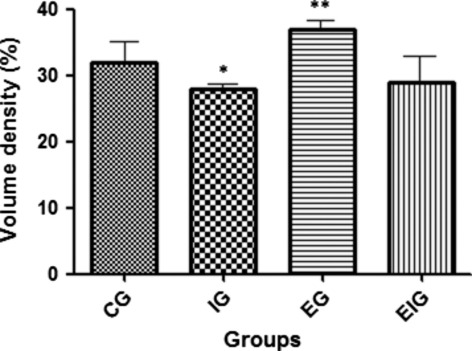
Vv of collagen fibers in femoral articular cartilage in the four study groups of rats (C, I, E, and EI). *Significance vs. groups C, E, and EI (P < 0.05) and **significance vs. groups C and EI (P < 0.05). No significant difference was observed between groups C and EI (P > 0.05), suggesting that exercise did affect collagen Vv in articular cartilage by immobilization (groups I and E). Five rats per group and nine sections per animal.

References

    1. Akeson WH, Amiel D, Abel MF, et al. Effects of immobilization on joints. Clin Orthop Relat Res. 1987;219:28–37. - PubMed
    1. Alford JW, Cole BJ. Cartilage restoration, part 1: basic science, historical perspective, patient evaluation, and treatment options. Am J Sports Med. 2005;33:295–306. - PubMed
    1. Ando A, Hagiwara Y, Chimoto E, et al. Intra-articular injection of hyaluronan diminishes loss of chondrocytes in a rat immobilized-knee model. Tohoku J Exp Med. 2008;215:321–331. - PubMed
    1. Angel J, Razzano P, Grande D. Defining the challenge: the basic science of articular cartilage repair and response to injury. Sports Med Arthrosc Rev. 2003;11:168–198.
    1. Aydelotte MB, Kuettner KE. Differences between sub-populations of cultured bovine articular chondrocytes. I. Morphology and cartilage matrix production. Connect Tissue Res. 1988;18:205–222. - PubMed

LinkOut - more resources