


Potato virus Y: a major crop pathogen that has provided major insights into the evolution of viral pathogenicity
- PMID: 23480826
- PMCID: PMC6638879
- DOI: 10.1111/mpp.12024
Potato virus Y: a major crop pathogen that has provided major insights into the evolution of viral pathogenicity
Abstract
Taxonomy: Potato virus Y (PVY) is the type member of the genus Potyvirus in the family Potyviridae. VIRION AND GENOME PROPERTIES: PVY virions have a filamentous, flexuous form, with a length of 730 nm and a diameter of 12 nm. The genomic RNA is single stranded, messenger sense, with a length of 9.7 kb, covalently linked to a viral-encoded protein (VPg) at the 5' end and to a 3' polyadenylated tail. The genome is expressed as a polyprotein of approximately 3062 amino acid residues, processed by three virus-specific proteases into 11 mature proteins.
Hosts: PVY is distributed worldwide and has a broad host range, consisting of cultivated solanaceous species and many solanaceous and nonsolanaceous weeds. It is one of the most economically important plant pathogens and causes severe diseases in cultivated hosts, such as potato, tobacco, tomato and pepper, as well as in ornamental plants.
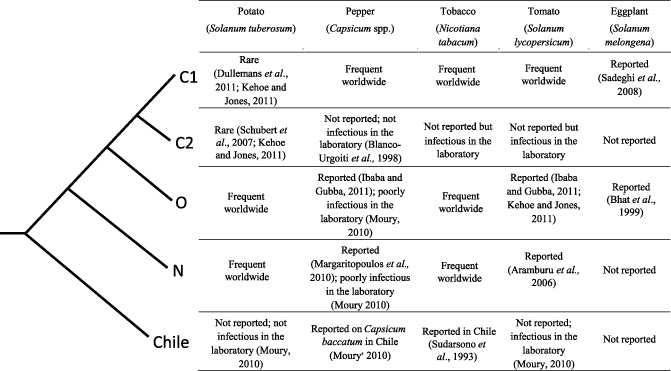
Transmission: PVY is transmitted from plant to plant by more than 40 aphid species in a nonpersistent manner and, in potato, by planting contaminated seed tubers. DIVERSITY: Five major clades, named C1, C2, Chile, N and O, have been described within the PVY species. In recent decades, a strong increase in prevalence of N × O recombinant isolates has been observed worldwide. A correlation has been observed between PVY phylogeny and certain pathogenicity traits. GENETIC CONTROL OF PVY: Resistance genes against PVY have been used widely in breeding programmes and deployed in the field. These resistance genes show a large diversity of spectrum of action, durability and genetic determinism. Notably, recessive and dominant major resistance genes show highly contrasting patterns of interaction with PVY populations, displaying rapid co-evolution or stable relationships, respectively.
© 2013 BSPP AND JOHN WILEY & SONS LTD.
Figures
References
-
- Abdul‐Razzak, A. , Guiraud, T. , Peypelut, M. , Walter, J. , Houvenaghel, C. , Candresse, T. , Le Gall, O. and German‐Retana, S. (2009) Involvement of the cylindrical inclusion (CI) protein in the overcoming of an eIF4E‐mediated resistance against Lettuce mosaic potyvirus. Mol. Plant Pathol. 10, 109–113. - PMC - PubMed
-
- Acosta‐Leal, R. and Xiong, Z. (2008) Complementary functions of two recessive R‐genes determine resistance durability of tobacco Virgin A Mutant (VAM) to Potato virus Y . Virology, 379, 275–283. - PubMed
-
- Andersen, K. and Johansen, I. (1998) A single conserved amino acid in the coat protein gene of pea seed‐borne mosaic potyvirus modulates the ability of the virus to move systemically in Chenopodium quinoa . Virology, 241, 304–311. - PubMed
-
- d'Aquino, L. , Dalmay, T. , Burgyán, J. , Ragozzino, A. and Scala, F. (1995) Host range and sequence analysis of an isolate of Potato virus Y inducing veinal necrosis in pepper. Plant Dis. 79, 1046–1050.
Publication types
MeSH terms
Substances
LinkOut - more resources
Full Text Sources
Other Literature Sources
Miscellaneous
