


Competing mortality in patients diagnosed with bladder cancer: evidence of undertreatment in the elderly and female patients
- PMID: 23481180
- PMCID: PMC3629420
- DOI: 10.1038/bjc.2013.106
Competing mortality in patients diagnosed with bladder cancer: evidence of undertreatment in the elderly and female patients
Abstract
Background: Bladder cancer (BC) predominantly affects the elderly and is often the cause of death among patients with muscle-invasive disease. Clinicians lack quantitative estimates of competing mortality risks when considering treatments for BC. Our aim was to determine the bladder cancer-specific mortality (CSM) rate and other-cause mortality (OCM) rate for patients with newly diagnosed BC.
Methods: Patients (n=3281) identified from a population-based cancer registry diagnosed between 1994 and 2009. Median follow-up was 48.15 months (IQ range 18.1-98.7). Competing risk analysis was performed within patient groups and outcomes compared using Gray's test.
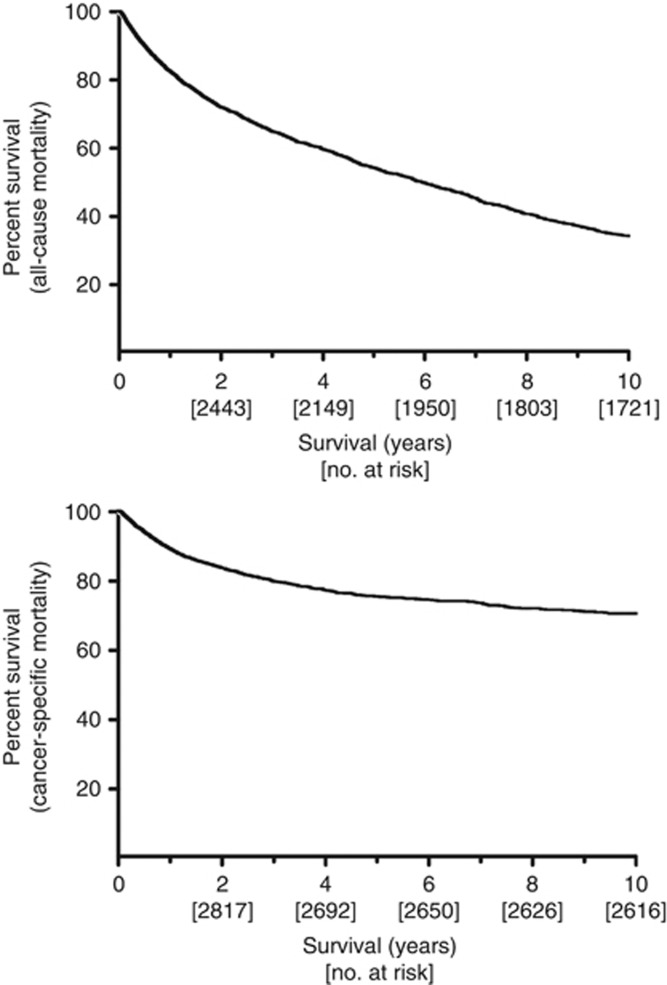
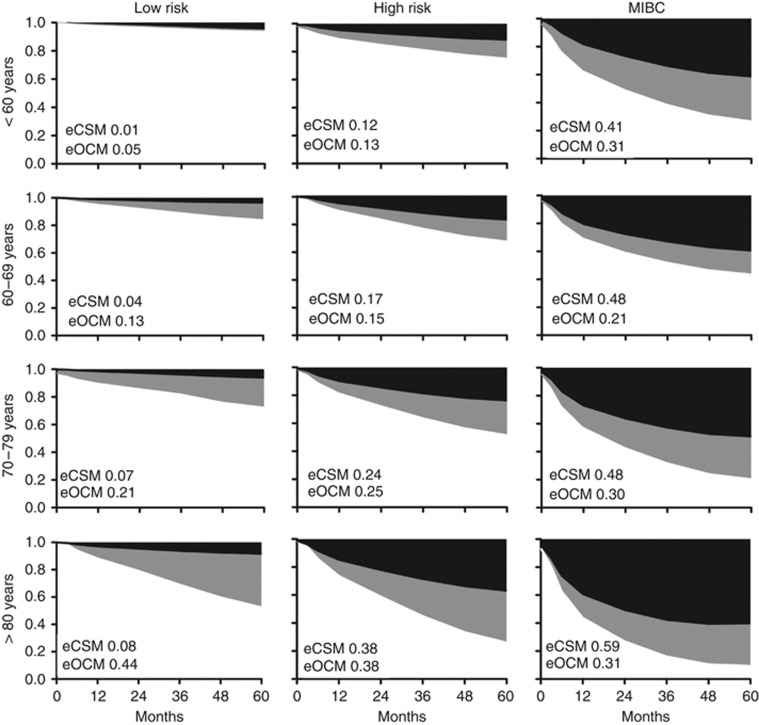
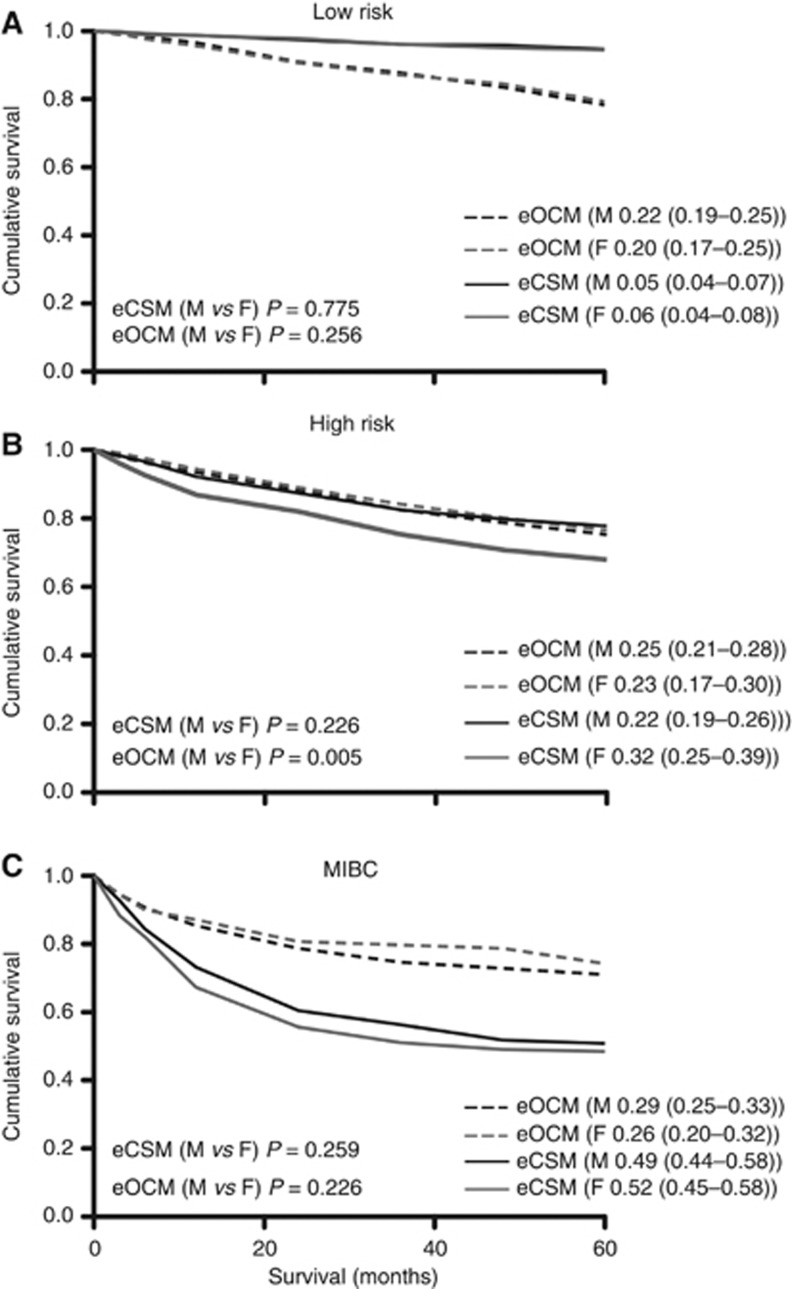
Results: At 5 years after diagnosis, 1246 (40%) patients were dead: 617 (19%) from BC and 629 (19%) from other causes. The 5-year BC mortality rate varied between 1 and 59%, and OCM rate between 6 and 90%, depending primarily on the tumour type and patient age. Cancer-specific mortality was highest in the oldest patient groups. Few elderly patients received radical treatment for invasive cancer (52% vs 12% for patients <60 vs >80 years, respectively). Female patients with high-risk non-muscle-invasive BC had worse CSM than equivalent males (Gray's P<0.01).
Conclusion: Bladder CSM is highest among the elderly. Female patients with high-risk tumours are more likely to die of their disease compared with male patients. Clinicians should consider offering more aggressive treatment interventions among older patients.
Figures
Comment in
-
Does age really matter in the choice of treatment for bladder cancer?Br J Cancer. 2013 Jun 11;108(11):2415-6. doi: 10.1038/bjc.2013.239. Epub 2013 May 14. Br J Cancer. 2013. PMID: 23674087 Free PMC article. No abstract available.
-
Bladder cancer: Elderly and female patients fare the worst and deserve better.Nat Rev Urol. 2013 Jul;10(7):371-2. doi: 10.1038/nrurol.2013.130. Epub 2013 Jun 18. Nat Rev Urol. 2013. PMID: 23774957 No abstract available.
References
-
- del Rey J, Placer J, Vallmanya F, Pujol N, Prat E, Miro R, Gelabert A. Are patients with non-muscle-invasive bladder cancer a suitable population for a lung cancer screening trial. BJU Int. 2010;106 (1:49–52. - PubMed
-
- Gray R. A class of K-sample tests for comparing the cumulative incidence of a competing risk. Ann Statist. 1988;16 (3:1141–1154.
-
- Inman BA, Tran VT, Fradet Y, Lacombe L. Carcinoma of the upper urinary tract: predictors of survival and competing causes of mortality. Cancer. 2009;115 (13:2853–2862. - PubMed
Publication types
MeSH terms
LinkOut - more resources
Full Text Sources
Other Literature Sources
Medical
