


The reach and adoption of a coach-led exercise training programme in community football
- PMID: 23482922
- PMCID: PMC3995237
- DOI: 10.1136/bjsports-2012-091797
The reach and adoption of a coach-led exercise training programme in community football
Abstract
Objective: To determine the reach and adoption of a coach-led exercise training programme for lower limb injury prevention.
Design: Secondary analysis of data from a group-clustered randomised controlled trial.
Setting: A periodised exercise training warm-up programme was delivered to players during training sessions over an 8-week preseason (weeks 1-8) and 18-week playing season.
Participants: 1564 community Australian football players.
Main outcome measurements: Reach, measured weekly, was the number of players who attended training sessions. Adoption was the number of attending players who completed the programme in full, partially or not at all. Reasons for partial or non-participation were recorded.
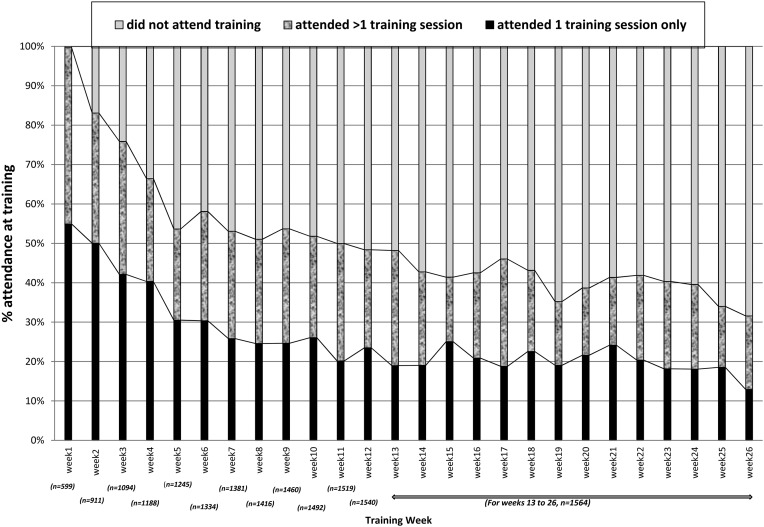
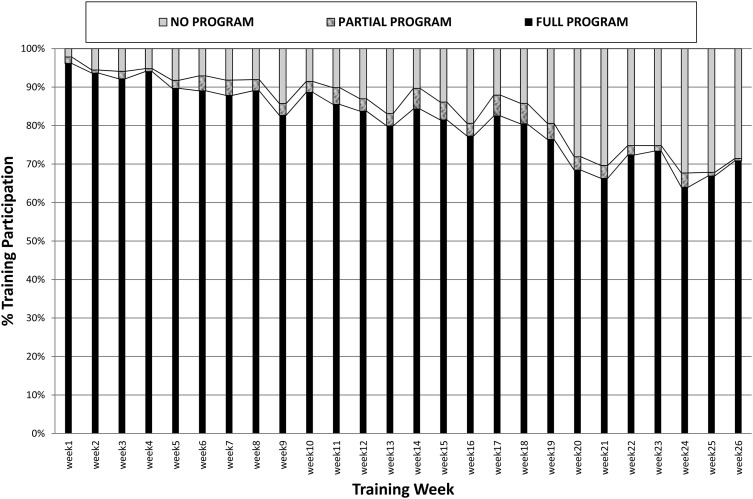
Results: In week 1, 599 players entered the programme; 55% attended 1 training session and 45% attended > 1 session. By week 12, 1540 players were recruited but training attendance (reach) decreased to <50%. When players attended training, the majority adopted the full programme-ranging from 96% (week 1) to above 80% until week 20. The most common reasons for low adoption were players being injured, too sore, being late for training or choosing their own warm-up.
Conclusions: The training programme's reach was highest preseason and halved at the playing season's end. However, when players attended training sessions, their adoption was high and remained close to 70% by season end. For sports injury prevention programmes to be fully effective across a season, attention also needs to be given to (1) encouraging players to attend formal training sessions and (2) considering the possibility of some form of programme delivery outside of formal training.
Keywords: Implementation; Injury Prevention.
Figures


References
-
- Hewett T, Lindenfeld T, Roiccobene J, et al. The effect of neuromuscular training on the incidence of knee injury in female athletes: a prospective study. Am J Sports Med 1999;27:699–706 - PubMed
-
- Lloyd D. Rationale for training programs to reduce anterior cruciate ligament injuries in Australian football. JOSPT 2001;31:645–54 - PubMed
-
- Verhagen E, Van Der Beek A, Twisk J, et al. The effect of a proprioceptive balance board training program for the prevention of ankle sprains: a prospective controlled trial. Am J Sports Med 2004;32:1385–93 - PubMed
-
- Mandelbaum B, Silvers H, Watanabe D, et al. Effectiveness of a neuromuscular and proprioceptive training program in preventing anterior cruciate ligament injuries in female athletes: 2-year follow-up. Am J Sports Med 2005;33:1003–10 - PubMed
-
- Dempsey A, Lloyd D, Elliott B, et al. The effect of technique change on knee loads during sidestep cutting. Med Sci Sports Exerc 2007;39:1765–73 - PubMed
Publication types
MeSH terms
LinkOut - more resources
Full Text Sources
Other Literature Sources
