


Ancient DNA analysis affirms the canid from Altai as a primitive dog
- PMID: 23483925
- PMCID: PMC3590291
- DOI: 10.1371/journal.pone.0057754
Ancient DNA analysis affirms the canid from Altai as a primitive dog
Abstract
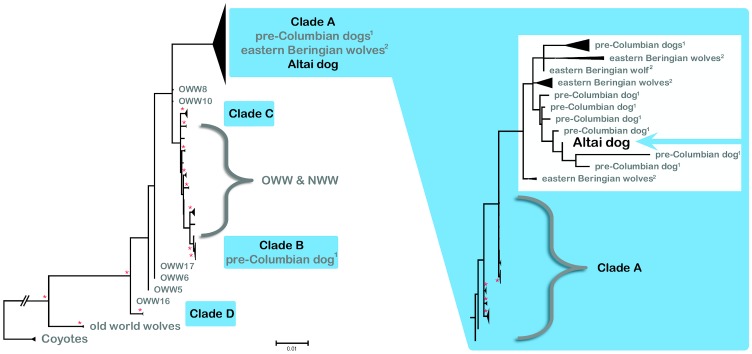
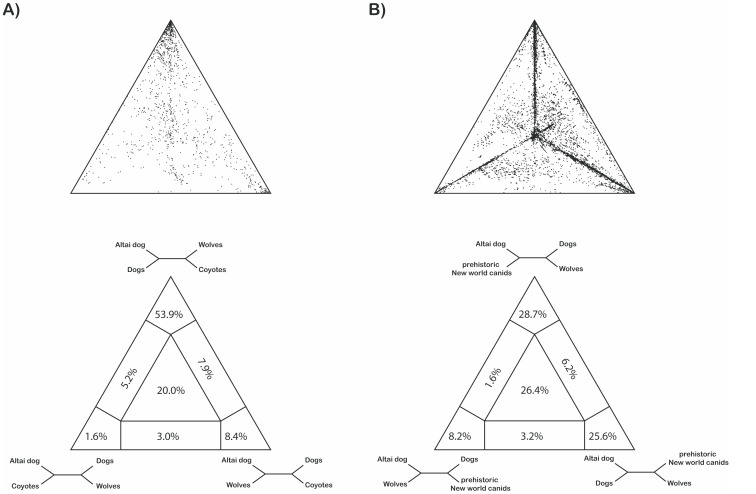
The origin of domestic dogs remains controversial, with genetic data indicating a separation between modern dogs and wolves in the Late Pleistocene. However, only a few dog-like fossils are found prior to the Last Glacial Maximum, and it is widely accepted that the dog domestication predates the beginning of agriculture about 10,000 years ago. In order to evaluate the genetic relationship of one of the oldest dogs, we have isolated ancient DNA from the recently described putative 33,000-year old Pleistocene dog from Altai and analysed 413 nucleotides of the mitochondrial control region. Our analyses reveal that the unique haplotype of the Altai dog is more closely related to modern dogs and prehistoric New World canids than it is to contemporary wolves. Further genetic analyses of ancient canids may reveal a more exact date and centre of domestication.
Conflict of interest statement
Figures

References
-
- Vila C, Savolainen P, Maldonado JE, Amorim IR, Rice JE, et al. (1997) Multiple and ancient origins of the domestic dog. Science 276: 1687–1689. - PubMed
-
- Germonpré M, Sablin MV, Stevens RE, Hedges REM, Hofreiter M, et al. (2009) Fossil dogs and wolves from Palaeolithic sites in Belgium, the Ukraine and Russia: osteometry, ancient DNA and stable isotopes. Journal of Archaeological Science 36: 473–490.
-
- Crockford SJ, Kuzmin YV (2012) Comments on Germonpre et al., Journal of Archaeological Science 36, 2009 “Fossil dogs and wolves from Palaeolithic sites in Belgium, the Ukraine and Russia: osteometry, ancient DNA and stable isotopes”. and Germonpre, Lazkickova-Galetova, and Sablin, Journal of Archaeological Science 39, 2012 “Palaeolithic dog skulls at the Gravettian Predmosti site, the Czech Republic” Journal of Archaeological Science 39: 2797–2801.
-
- Germonpré M, Sablin MV, Despres V, Hofreiter M, Laznickova-Galetova M, et al. (2013) Palaeolithic dogs and the early domestication of the wolf: a reply to the comments of Crockford and Kuzmin (2012). Journal of Archaeological Science 40: 786–792.
Publication types
MeSH terms
Substances
LinkOut - more resources
Full Text Sources
Other Literature Sources
