


Comment
doi: 10.1038/495176a.
Public health: Broad reception for coronavirus
- PMID: 23486053
- PMCID: PMC7095116
- DOI: 10.1038/495176a
Item in Clipboard
Comment
Public health: Broad reception for coronavirus
Nature.
.
Abstract
The discovery that a new coronavirus associated with lethal respiratory infections binds to an evolutionarily conserved receptor on airway cells suggests that direct transmission from bats to humans may occur. See Letter
Figures
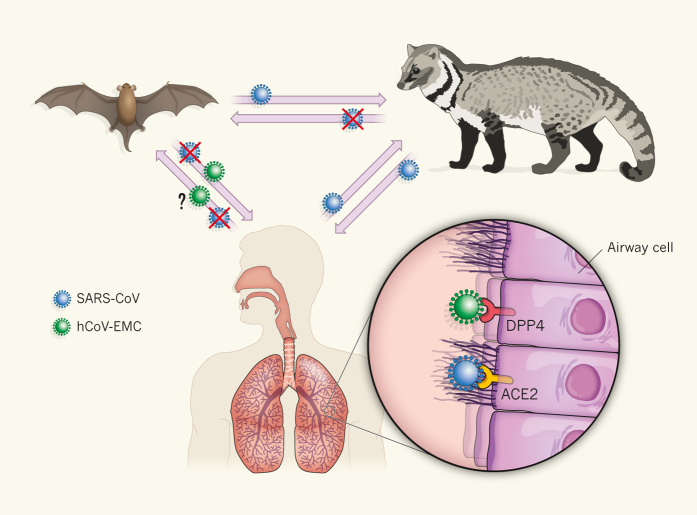
Raj and colleagues have identified the cell-surface protein DPP4 as the receptor for hCoV-EMC, a new coronavirus that causes severe respiratory infections in humans. DPP4 is expressed on non-ciliated cells in the human airway. The virus is also able to use the homologous protein in bats for infection, which suggests that direct and reversible transmission of the virus between bats and humans may occur (although transmission through an intermediate host remains a possibility). By contrast, another pathogenic coronavirus (SARS-CoV), which binds to the ACE2 receptor on ciliated airway cells, probably cannot be transmitted directly and is likely to have jumped from bats to humans through evolutionary processes in intermediate hosts, such as civet cats. Open arrows indicate putative routes of transmission, crosses indicate evidence against transmission and a question mark indicates speculation on transmission.
Comment on
-
Dipeptidyl peptidase 4 is a functional receptor for the emerging human coronavirus-EMC.Nature. 2013 Mar 14;495(7440):251-4. doi: 10.1038/nature12005. Nature. 2013. PMID: 23486063 Free PMC article.
References
Publication types
MeSH terms
Substances
Grants and funding
LinkOut - more resources
Full Text Sources
Other Literature Sources
Miscellaneous
