


Molecular mechanisms creating bistable switches at cell cycle transitions
- PMID: 23486222
- PMCID: PMC3718337
- DOI: 10.1098/rsob.120179
Molecular mechanisms creating bistable switches at cell cycle transitions
Abstract
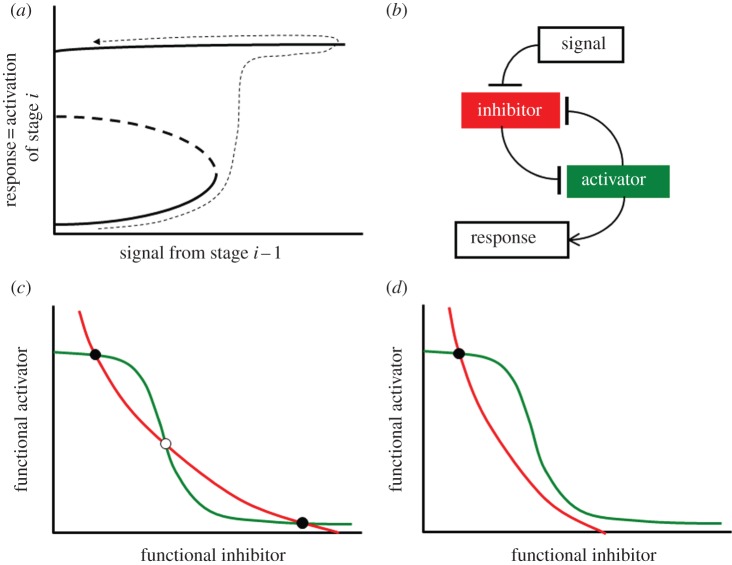
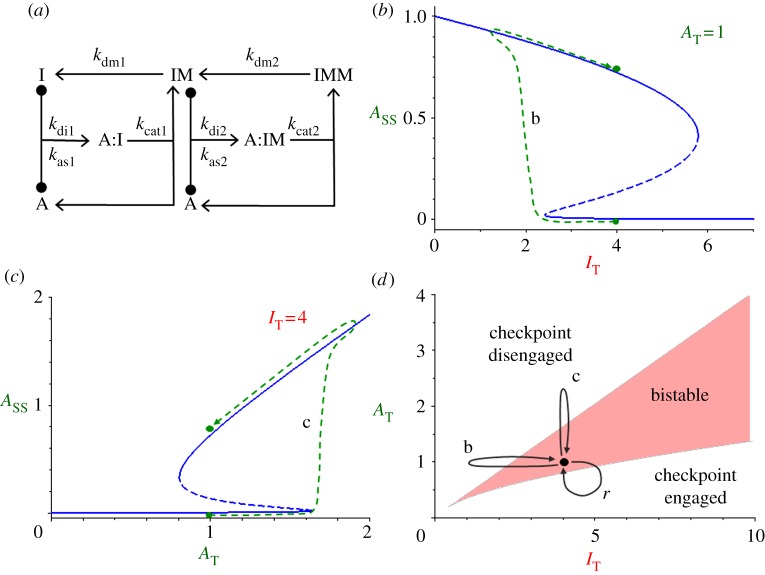
Progression through the eukaryotic cell cycle is characterized by specific transitions, where cells move irreversibly from stage i-1 of the cycle into stage i. These irreversible cell cycle transitions are regulated by underlying bistable switches, which share some common features. An inhibitory protein stalls progression, and an activatory protein promotes progression. The inhibitor and activator are locked in a double-negative feedback loop, creating a one-way toggle switch that guarantees an irreversible commitment to move forward through the cell cycle, and it opposes regression from stage i to stage i-1. In many cases, the activator is an enzyme that modifies the inhibitor in multiple steps, whereas the hypo-modified inhibitor binds strongly to the activator and resists its enzymatic activity. These interactions are the basis of a reaction motif that provides a simple and generic account of many characteristic properties of cell cycle transitions. To demonstrate this assertion, we apply the motif in detail to the G1/S transition in budding yeast and to the mitotic checkpoint in mammalian cells. Variations of the motif might support irreversible cellular decision-making in other contexts.
Figures
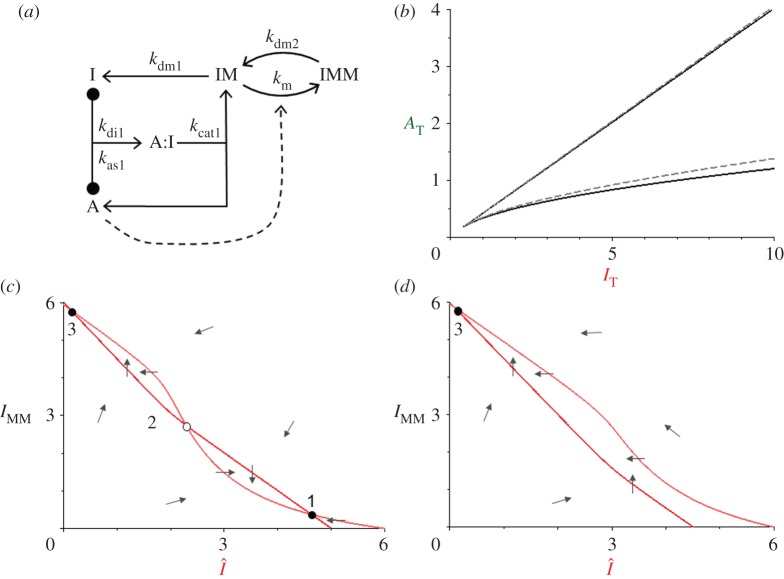
 , in the bistable zone (AT = 2 and IT = 6). There are two stable steady states—checkpoint engaged (1) and checkpoint disengaged (3)—separated by an unstable steady state (2). (d) Phase plane in the monostable zone (AT = 3 and IT = 6). There is now a single steady state: the stable checkpoint-disengaged state (3). In (c,d), the arrows indicate the direction of change of the state variables, IMM and
  , as predicted by the dynamical system, equations (3.8) and (3.9).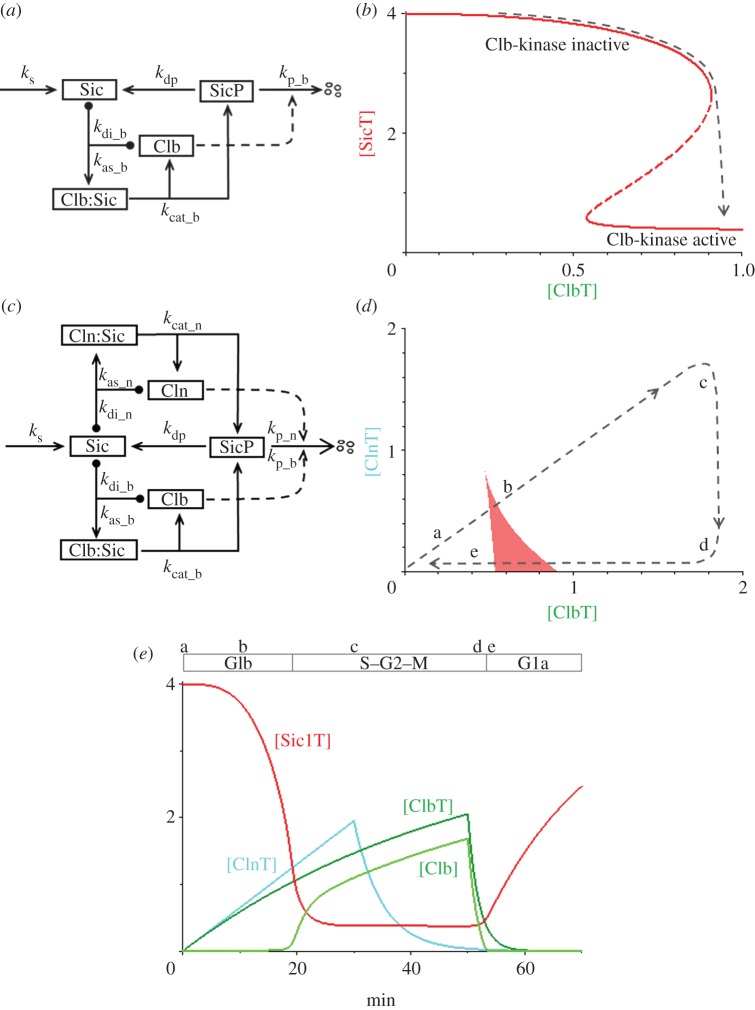
References
-
- Nasmyth K, Hunt T. 1993. Dams and sluices. Nature 366, 634–63510.1038/366634a0 (doi:10.1038/366634a0) - DOI - DOI - PubMed
-
- Nasmyth K. 1995. Evolution of the cell cycle. Phil. Trans. R. Soc. Lond. B 349, 271–28110.1098/rstb.1995.0113 (doi:10.1098/rstb.1995.0113) - DOI - DOI - PubMed
-
- Novak B, Tyson JJ. 1993. Numerical analysis of a comprehensive model of M-phase control in Xenopus oocyte extracts and intact embryos. J. Cell Sci. 106, 1153–1168 - PubMed
-
- Tyson JJ, Novak B, Chen K, Val J. 1995. Checkpoints in the cell cycle from a modeler's perspective. Prog. Cell Cycle Res. 1, 1–810.1007/978-1-4615-1809-9_1 (doi:10.1007/978-1-4615-1809-9_1) - DOI - DOI - PubMed
-
- Novak B, Tyson JJ, Gyorffy B, Csikasz-Nagy A. 2007. Irreversible cell-cycle transitions are due to systems-level feedback. Nat. Cell Biol. 9, 724–72810.1038/ncb0707-724 (doi:10.1038/ncb0707-724) - DOI - DOI - PubMed
Publication types
MeSH terms
Substances
Grants and funding
LinkOut - more resources
Full Text Sources
Other Literature Sources
Molecular Biology Databases
