


New macroecological insights into functional constraints on mammalian geographical range size
- PMID: 23486441
- PMCID: PMC3619465
- DOI: 10.1098/rspb.2013.0140
New macroecological insights into functional constraints on mammalian geographical range size
Abstract
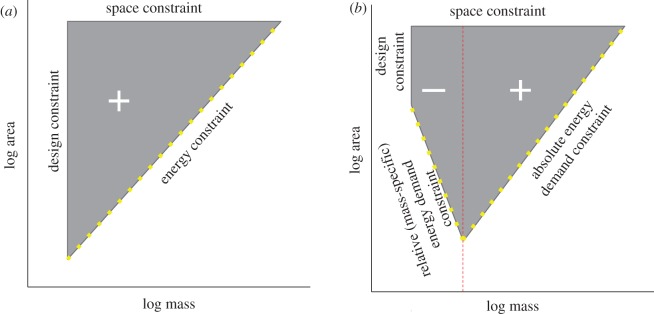
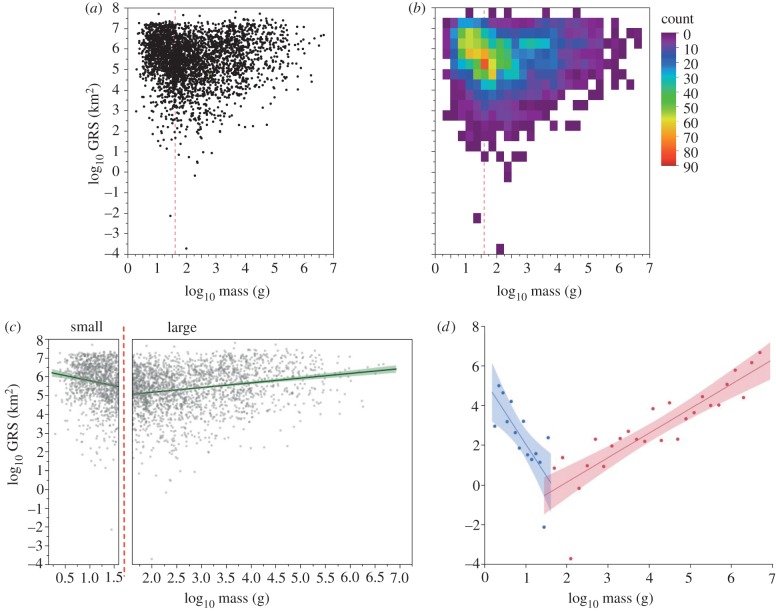
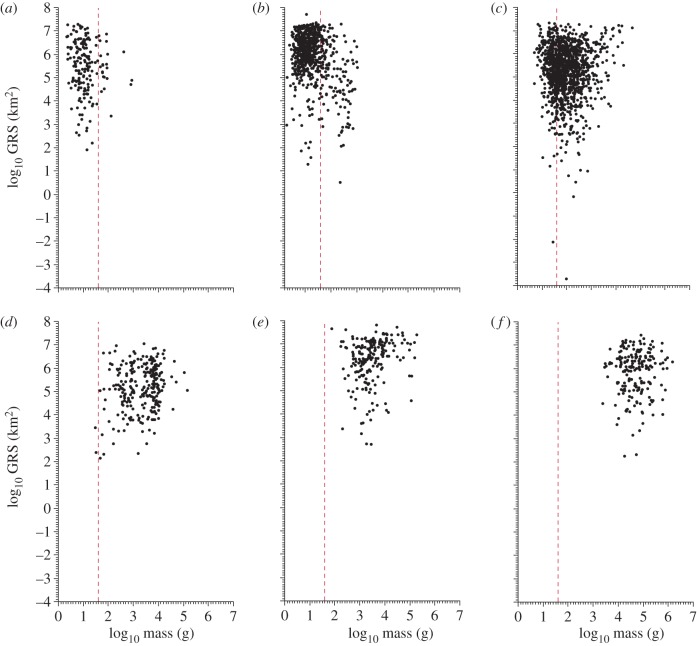
Understanding the determinants of variation in the extent of species distributions is a fundamental goal of ecology. The diversity of geographical range sizes (GRSs) in mammals spans 12 orders of magnitude. A long-standing macroecological model of this diversity holds that as body size increases, species are increasingly restricted to occupying larger GRS. Here, we show that the body size-GRS relationship is more complex than previously recognized. Our study reveals that the positive relationship between body size and GRS does not hold across the entire size range of mammals. Instead, there is a break point in the relationship around the modal mammal body size. For species smaller than the mode, GRS actually decreases with body size. We discuss mechanisms to account for these observations in the context of the energetics of body size. We also examine the possibility that the patterns are the result of a statistical artefact from combining two random, uni-modal, skewed distributions, but conclude that the patterns we describe are not artefactual. Our results redefine our view of the functional relationship between body size, energetics and GRS in mammals with implications for assessing vulnerability to extinction resulting from range size reductions driven by large-scale environmental change.
Figures
References
-
- Darwin C. 1859. On the origin of species by means of natural selection, or the preservation of favored races in the struggle for life. London, UK: John Murray
-
- Willis JC. 1922. Age and area: a study in geographic distribution and origin of species. Cambridge, UK: Cambridge University Press
-
- Darlington PJ., Jr 1957. Zoogeography: the geographical distribution of animals. New York, NY: Wiley
-
- MacArthur RH. 1972. Geographical ecology: patterns in the distribution of species. Princeton, NJ: Princeton University Press
-
- Rapoport EH. 1982. Aerography: geographical strategies of species. Oxford, UK: Pergamon Press
MeSH terms
LinkOut - more resources
Full Text Sources
Other Literature Sources
