. 2013 Jun;94(Pt 6):1220-1229.
doi: 10.1099/vir.0.050526-0. Epub 2013 Mar 13.

Mutations in haemagglutinin that affect receptor binding and pH stability increase replication of a PR8 influenza virus with H5 HA in the upper respiratory tract of ferrets and may contribute to transmissibility

Affiliations

Mutations in haemagglutinin that affect receptor binding and pH stability increase replication of a PR8 influenza virus with H5 HA in the upper respiratory tract of ferrets and may contribute to transmissibility

Holly Shelton et al. J Gen Virol. 2013 Jun.

Abstract

The H5N1 influenza A viruses have circulated widely in the avian population for 10 years with only sporadic infection of humans observed and no sustained human to human transmission. Vaccination against potential pandemic strains is one strategy in planning for future influenza pandemics; however, the success of live attenuated vaccines for H5N1 has been limited, due to poor replication in the human upper respiratory tract (URT). Mutations that increase the ability of H5N1 viruses to replicate in the URT will aid immunogenicity of these vaccines and provide information about humanizing adaptations in H5N1 strains that may signal transmissibility. As well as mediating receptor interactions, the haemagglutinin (HA) protein of influenza facilitates fusion of the viral membrane and genome entry into the host cell; this process is pH dependent. We have shown in this study that the pH at which a panel of avian influenza HA proteins, including H5, mediate fusion is higher than that for human influenza HA proteins, and that mutations in the H5 HA can reduce the pH of fusion. Coupled with receptor switching mutations, increasing the pH stability of the H5 HA resulted in increased viral shedding of H5N1 from the nasal cavity of ferrets and contact transmission to a co-housed animal. Ferret serum antibodies induced by infection with any of the mutated H5 HA viruses neutralized HA pseudotyped lentiviruses bearing homologous or heterologous H5 HAs, suggesting that this strategy to increase nasal replication of a vaccine virus would not compromise vaccine efficacy.


Figures
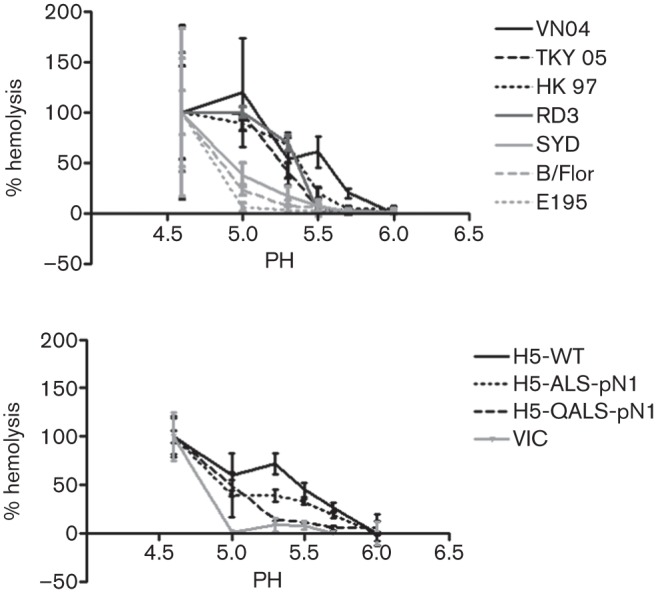
Fig. 1.
Fig. 1.
Influenza viruses with human- or avian-adapted HA were tested for their ability to cause fusion in hRBCs at varying pHs. A total of 64 HA units of each virus was mixed with hRBCs in differing pH conditions and the degree of fusion monitored by the release of haemoglobin by measuring the optical density at 405 nm. Each virus was tested in quadruplicate and the percentage of maximum fusion achieved at each pH was calculated for each virus. The means of quadruplicate tests were plotted with sds indicated. (a) Comparison between human-adapted influenza strains E195 - A/England/195/2009 (pH 1N1), B/Flor - B/Florida/4/2006 and SYD - A/Sydney/5/1997 (H3N2) (grey lines), and viruses bearing the surface antigens of HPAI avian viruses from which the multi-basic site had been removed from the HA on an internal genetic background of A/PR/8/34 virus as follows: VN04 - A/Vietnam/1194/04 (H5N1), TKY05 - A/turkey/Turkey/01/05 (H5N1), HK97 - A/Hong/Kong/156/97 (H5N1) and RD3 - A/chicken/Italy/13474/99 (H7N1) (black lines). (b) H5 HA mutant viruses with the multi-basic site engineered away from H5 HA and on an internal genetic background of A/PR/8/34 (H5-ALS-pN1 and H5-QALS-pN1) (black lines) were compared to H5-wt (black line) and a human virus (VIC - A/Victoria/3/75 (H3N2) (grey line). Table 1 shows the details of the genetic composition of each virus.
Fig. 2.
Fig. 2.
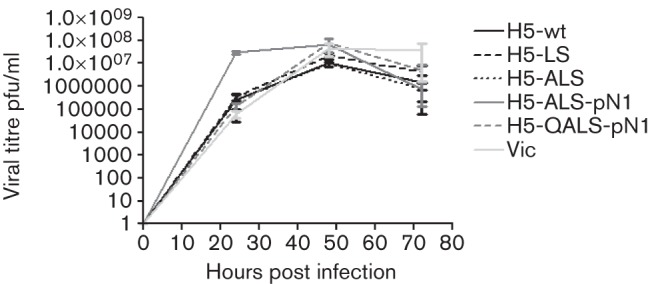
Growth of H5 HA mutant viruses in comparison to H5-wt and a recombinant virus bearing the surface antigens of a human H3N2 virus (VIC) under multicycle conditions in MDCK cells. Infectivity released into cell supernatant at various time points was titrated by plaque assay on MDCK cells. Each virus was assayed in triplicate and the mean p.f.u. ml−1 plotted with sd error bars. Student’s t-test was performed comparing each virus titre to that for H5-wt virus at each time point; H5-ALS-pN1 was significantly different at 24 h p.i. (***P<0.005). This result is representative of two independent experiments.
Fig. 3.
Fig. 3.
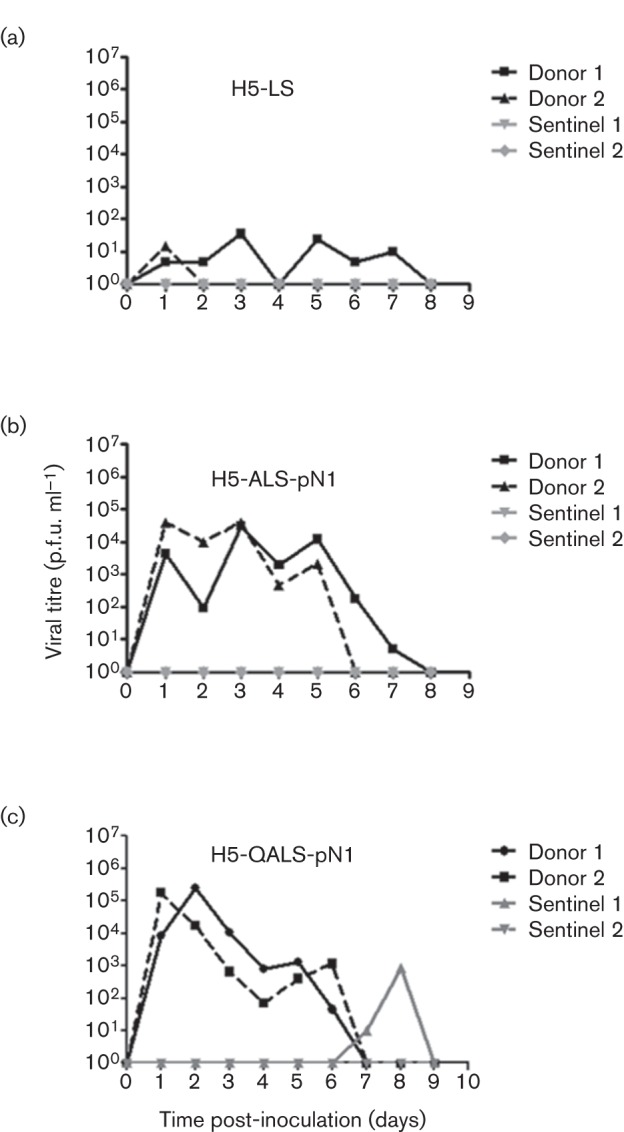
Two donor ferrets were inoculated intranasally with 106 p.f.u. of each of the H5 HA mutant viruses (a) H5-LS, (b) H5-ALS-pN1 and (c) H5-QALS-pN1, then 24 h later each ferret was co-housed individually with a naive contact ferret (sentinel). All ferrets were nasal washed daily and viral titre determined by plaque assay on MDCK cells.

References

    1. Aditama T. Y., Samaan G., Kusriastuti R., Sampurno O. D., Purba W., Misriyah, Santoso H., Bratasena A., Maruf A. & other authors (2012). Avian influenza H5N1 transmission in households, Indonesia. PLoS ONE 7, e29971 10.1371/journal.pone.0029971 - DOI - PMC - PubMed
    1. Alberini I., Del Tordello E., Fasolo A., Temperton N. J., Galli G., Gentile C., Montomoli E., Hilbert A. K., Banzhoff A. & other authors (2009). Pseudoparticle neutralization is a reliable assay to measure immunity and cross-reactivity to H5N1 influenza viruses. Vaccine 27, 5998–6003 10.1016/j.vaccine.2009.07.079 - DOI - PubMed
    1. Auewarakul P., Suptawiwat O., Kongchanagul A., Sangma C., Suzuki Y., Ungchusak K., Louisirirotchanakul S., Lerdsamran H., Pooruk P. & other authors (2007). An avian influenza H5N1 virus that binds to a human-type receptor. J Virol 81, 9950–9955 10.1128/JVI.00468-07 - DOI - PMC - PubMed
    1. Ayora-Talavera G., Shelton H., Scull M. A., Ren J., Jones I. M., Pickles R. J., Barclay W. S. (2009). Mutations in H5N1 influenza virus hemagglutinin that confer binding to human tracheal airway epithelium. PLoS ONE 4, e7836 10.1371/journal.pone.0007836 - DOI - PMC - PubMed
    1. Bender C., Hall H., Huang J., Klimov A., Cox N., Hay A., Gregory V., Cameron K., Lim W., Subbarao K. (1999). Characterization of the surface proteins of influenza A (H5N1) viruses isolated from humans in 1997-1998. Virology 254, 115–123 10.1006/viro.1998.9529 - DOI - PubMed

Publication types

MeSH terms

Substances