


Effectiveness of pentavalent and monovalent rotavirus vaccines in concurrent use among US children <5 years of age, 2009-2011
- PMID: 23487388
- PMCID: PMC4618548
- DOI: 10.1093/cid/cit164
Effectiveness of pentavalent and monovalent rotavirus vaccines in concurrent use among US children <5 years of age, 2009-2011
Abstract
Background: We assessed vaccine effectiveness (VE) for RotaTeq (RV5; 3 doses) and Rotarix (RV1; 2 doses) at reducing rotavirus acute gastroenteritis (AGE) inpatient and emergency department (ED) visits in US children.
Methods: We enrolled children <5 years of age hospitalized or visiting the ED with AGE symptoms from November 2009-June 2010 and from November 2010-June 2011 at 7 medical institutions. Fecal specimens were tested for rotavirus by enzyme immunoassay and genotyped. Vaccination among laboratory-confirmed rotavirus cases was compared with rotavirus-negative AGE controls. Regression models calculated VE estimates for each vaccine, age, ethnicity, genotype, and clinical setting.
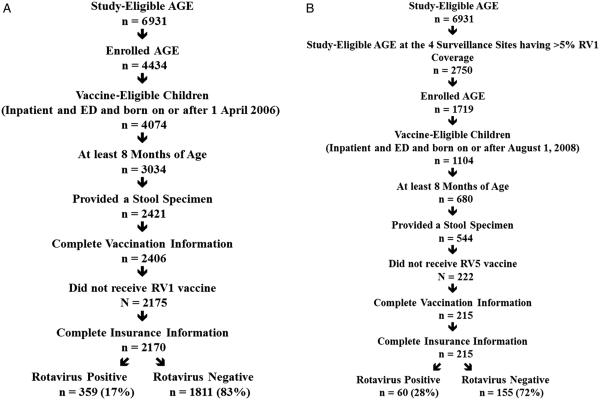
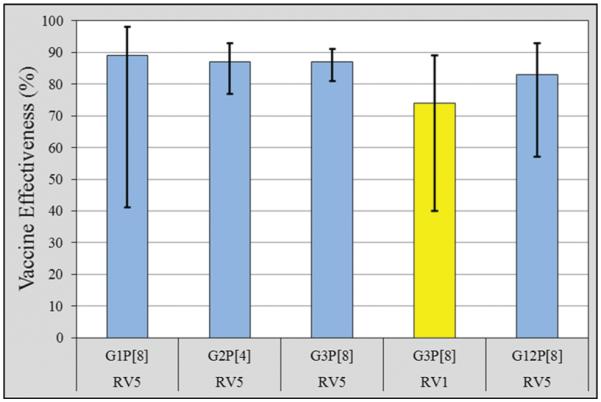
Results: RV5-specific analyses included 359 rotavirus cases and 1811 rotavirus-negative AGE controls. RV1-specific analyses included 60 rotavirus cases and 155 rotavirus-negative AGE controls. RV5 and RV1 were 84% (95% confidence interval [CI], 78%-88%) and 70% (95% CI, 39%-86%) effective, respectively, against rotavirus-associated ED visits and hospitalizations combined. By clinical setting, RV5 VE against ED and inpatient rotavirus-associated visits was 81% (95% CI, 70%-84%) and 86% (95% CI, 74%-91%), respectively. RV1 was 78% (95% CI, 46%-91%) effective against ED rotavirus disease; study power was insufficient to evaluate inpatient RV1 VE. No waning of immunity was evident during the first 4 years of life for RV5, nor during the first 2 years of life for RV1. RV5 provided genotype-specific protection against each of the predominant strains (G1P[8], G2P[4], G3P[8], G12P[8]), while RV1 VE was statistically significant for the most common genotype, G3P[8].
Conclusions: Both RV5 and RV1 significantly protected against medically attended rotavirus gastroenteritis in this real-world assessment.
Keywords: New Vaccine Surveillance Network; RotaTeq; rotavirus; vaccine.
Figures
References
-
- Widdowson MA, Meltzer MI, Xang X, et al. Cost effectiveness and potential impact of rotavirus vaccination in the United States. Pediatrics. 2007;119:684–97. - PubMed
-
- Widdowson MA, Meltzer M. Update on cost-effectiveness of rotavirus vaccination in the United States. Advisory Committee for Immunization Practices; Atlanta, GA: 2008.
-
- Centers for Disease Control and Prevention Prevention of rotavirus gastroenteritis among infants and children: recommendations of the Advisory Committee on Immunization Practices (ACIP) MMWR Recomm Rep. 2009;58:1–26. - PubMed
-
- Tate JE, Panozzo CA, Payne DC, et al. Decline and change in seasonality of US rotavirus activity after the introduction of rotavirus vaccine. Pediatrics. 2009;124:465–71. - PubMed
-
- Tate JE, Mutuc JD, Panozzo CA, et al. Sustained decline in rotavirus detections in the United States following the introduction of rotavirus vaccine in 2006. Pediatr Infect Dis J. 2011;30(1 suppl):S30–4. - PubMed
Publication types
MeSH terms
Substances
Grants and funding
LinkOut - more resources
Full Text Sources
Other Literature Sources
Medical
