Review
. 2013 Jun;169(4):719-35.
doi: 10.1111/bph.12155.

Non-invasive molecular imaging for preclinical cancer therapeutic development

Affiliations
Review

Non-invasive molecular imaging for preclinical cancer therapeutic development

A C O'Farrell et al. Br J Pharmacol. 2013 Jun.

Abstract

Molecular and non-invasive imaging are rapidly emerging fields in preclinical cancer drug discovery. This is driven by the need to develop more efficacious and safer treatments, the advent of molecular-targeted therapeutics, and the requirements to reduce and refine current preclinical in vivo models. Such bioimaging strategies include MRI, PET, single positron emission computed tomography, ultrasound, and optical approaches such as bioluminescence and fluorescence imaging. These molecular imaging modalities have several advantages over traditional screening methods, not least the ability to quantitatively monitor pharmacodynamic changes at the cellular and molecular level in living animals non-invasively in real time. This review aims to provide an overview of non-invasive molecular imaging techniques, highlighting the strengths, limitations and versatility of these approaches in preclinical cancer drug discovery and development.


Figures

Figure 1
Figure 1
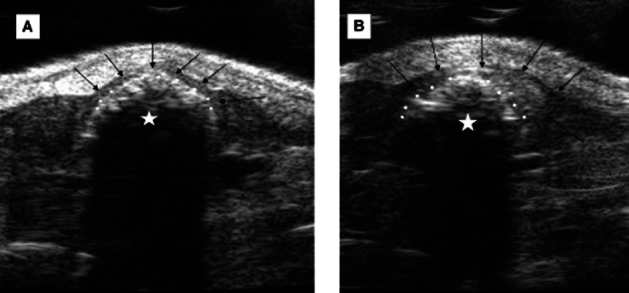
(HF-US) imaging of the proximal colon of an ApcMin/+ mouse. The VisualSonics Vevo770 system has a resolution of 30 μm allowing identification of normal and pathological colon. (A) shows normal colon where an even thickness of colon wall surrounds the fecal pellet. The wall thickness was measured as 0.18 mm (measurement not shown). (B) shows an adjacent section of colon where an adenoma had formed. This was identified in vivo as a significant thickening of the colon wall. The maximum wall thickness was measured as 0.87 mm (measurement not shown). Black arrows show the outer colon wall, white circles delineate the border between fecal pellet and the inner colon wall, and white stars indicate the fecal pellet.
Figure 2
Figure 2
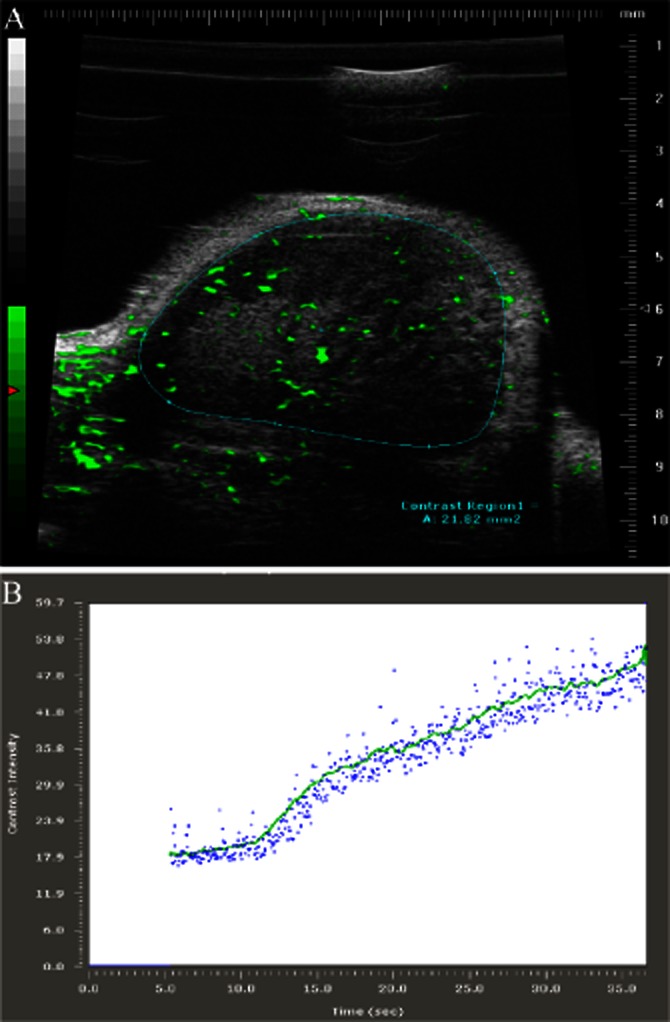
Contrast-enhanced HF-US imaging. The use of microbubble contrast agents with HF-US imaging protocols allows the visualization and relative quantification of tumour blood flow and perfusion. (A) shows a contrast-enhanced HF-US image of an SW480 human colorectal cancer xenograft where microbubbles are coloured green and the region of interest (tumour) is delineated by the blue line. By imaging the contrast agent over time, both qualitative and quantitative data on tumour vascularity and tumour blood flow, respectively, can be obtained. (B) shows a wash-in time intensity curve where the contrast intensity in arbitrary units is plotted against time in seconds. Analysis of these curves provides values for the maximum intensity of the contrast agent or relative perfusion and the maximum relative rate of tumour blood flow.
Figure 3
Figure 3
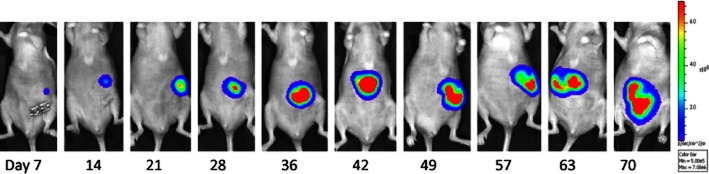
Bioluminescence imaging of orthotopic tumour growth. Mice were orthotopically implanted on the caecum with DLD1-1 colorectal cancer cells engineered to express firefly luciferase (under control of the Simian Virus-40 promoter). At weekly intervals, the mice were injected with D-luciferin and imaged using an IVIS-50 system (Caliper Life Sciences, Runcorn, UK). The image shown depicts the growth of the orthotopic tumour over time.
Figure 4
Figure 4
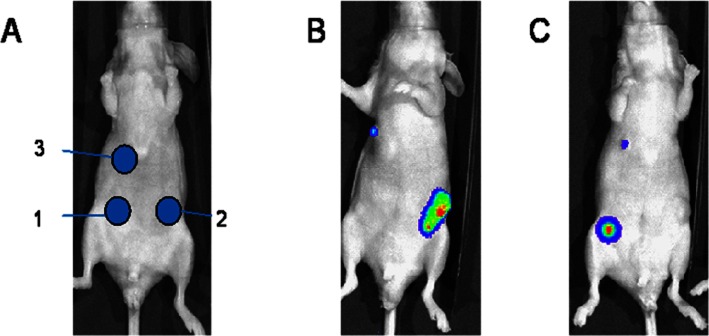
Potential for dual bioluminescence imaging of tumours in vivo. (A) Mice bearing subcutaneous tumours engineered to express either firefly luciferase (tumour site 1, FLuc), Renilla luciferase (tumour site 2, RLuc) or both luciferase systems (tumour site 3). (B) Bioluminescence image following injection of coelenterazine (substrate for Renilla luciferase) with light detected from tumours 2 and 3. (C) The same mouse imaged 4 h later following injection with D-luciferin (substrate for firefly luciferase) with light detected from tumours 1 and 3. Neither of the substrates showed any cross-reactivity with the alternative luciferase enzyme, and tumour 3 (a mixture of both cell types) emitted a signal when both substrates were administered, supporting the potential for dual BLI imaging in preclinical cancer pharmacology studies. All images were collected using the IVIS-50 system.

References

    1. Abdelrahman MA, Marston G, Hull MA, Markham AF, Jones PF, Evans JA, et al. High-frequency ultrasound for in vivo measurement of colon wall thickness in mice. Ultrasound Med Biol. 2012;38:432–442. - PubMed
    1. Ahlgren S, Wallberg H, Tran TA, Widstrom C, Hjertman M, Abrahmsen L, et al. Targeting of HER2-expressing tumors with a site-specifically 99mTc-labeled recombinant affibody molecule, ZHER2:2395, with C-terminally engineered cysteine. J Nucl Med. 2009;50:781–789. - PubMed
    1. Ali MM, Janic B, Babajani-Feremi A, Varma NR, Iskander AS, Anagli J, et al. Changes in vascular permeability and expression of different angiogenic factors following anti-angiogenic treatment in rat glioma. PLoS One. 2010;5:e8727. - PMC - PubMed
    1. Amoh Y, Nagakura C, Maitra A, Moossa AR, Katsuoka K, Hoffman RM, et al. Dual-color imaging of nascent angiogenesis and its inhibition in liver metastases of pancreatic cancer. Anticancer Res. 2006;26:3237–3242. - PubMed
    1. Angst E, Chen M, Mojadidi M, Hines OJ, Reber HA, Eibl G. Bioluminescence imaging of angiogenesis in a murine orthotopic pancreatic cancer model. Mol Imaging Biol. 2010;12:570–575. - PMC - PubMed

Publication types

MeSH terms

Substances

LinkOut - more resources