


Comparison of the respiratory microbiome in healthy nonsmokers and smokers
- PMID: 23491408
- PMCID: PMC3734620
- DOI: 10.1164/rccm.201210-1913OC
Comparison of the respiratory microbiome in healthy nonsmokers and smokers
Abstract
Rationale: Results from 16S rDNA-encoding gene sequence-based, culture-independent techniques have led to conflicting conclusions about the composition of the lower respiratory tract microbiome.
Objectives: To compare the microbiome of the upper and lower respiratory tract in healthy HIV-uninfected nonsmokers and smokers in a multicenter cohort.
Methods: Participants were nonsmokers and smokers without significant comorbidities. Oral washes and bronchoscopic alveolar lavages were collected in a standardized manner. Sequence analysis of bacterial 16S rRNA-encoding genes was performed, and the neutral model in community ecology was used to identify bacteria that were the most plausible members of a lung microbiome.
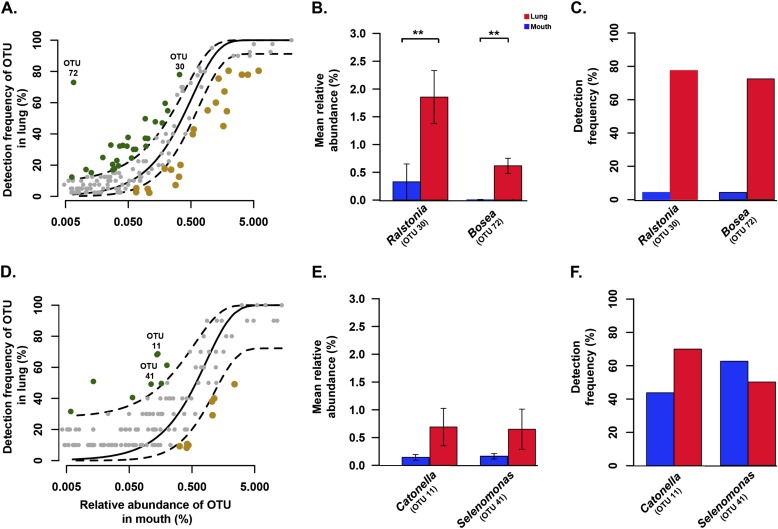
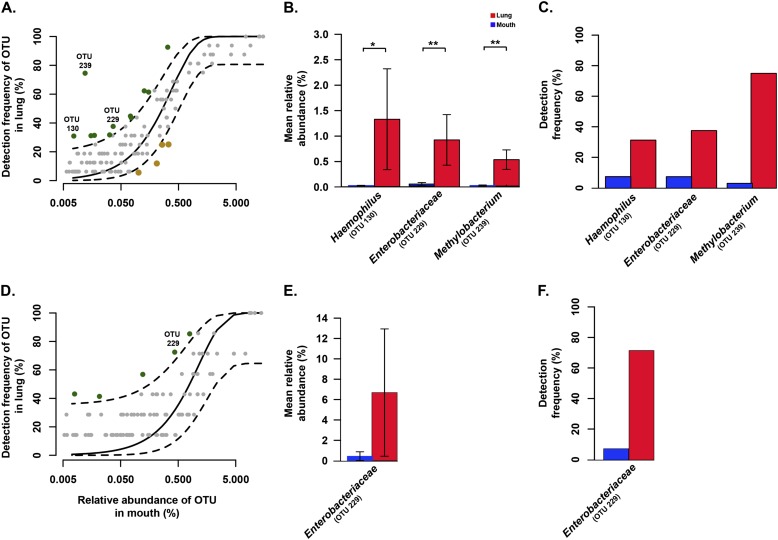
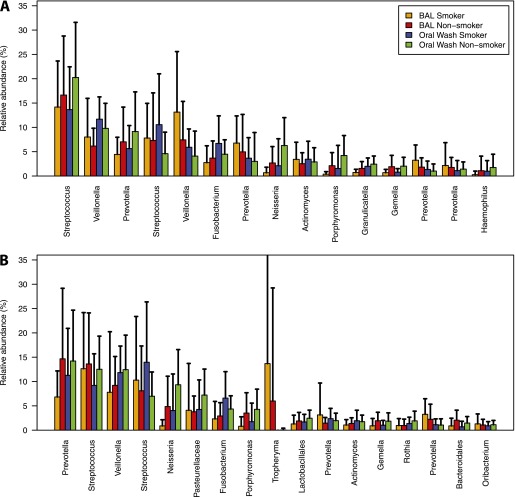
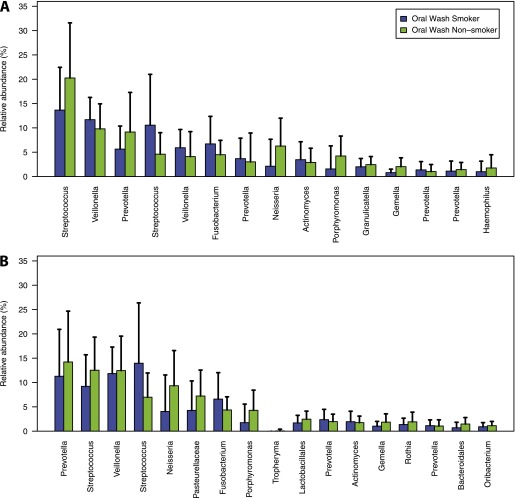
Measurements and main results: Sixty-four participants were enrolled. Most bacteria identified in the lung were also in the mouth, but specific bacteria such as Enterobacteriaceae, Haemophilus, Methylobacterium, and Ralstonia species were disproportionally represented in the lungs compared with values predicted by the neutral model. Tropheryma was also in the lung, but not the mouth. Mouth communities differed between nonsmokers and smokers in species such as Porphyromonas, Neisseria, and Gemella, but lung bacterial populations did not.
Conclusions: This study is the largest to examine composition of the lower respiratory tract microbiome in healthy individuals and the first to use the neutral model to compare the lung to the mouth. Specific bacteria appear in significantly higher abundance in the lungs than would be expected if they originated from the mouth, demonstrating that the lung microbiome does not derive entirely from the mouth. The mouth microbiome differs in nonsmokers and smokers, but lung communities were not significantly altered by smoking.
Figures
Comment in
-
The dynamics of polymicrobial biofilms.Am J Respir Crit Care Med. 2013 Nov 15;188(10):1266. doi: 10.1164/rccm.201305-0916LE. Am J Respir Crit Care Med. 2013. PMID: 24236594 No abstract available.
References
-
- Walker AW, Sanderson JD, Churcher C, Parkes GC, Hudspith BN, Rayment N, Brostoff J, Parkhill J, Dougan G, Petrovska L. High-throughput clone library analysis of the mucosa-associated microbiota reveals dysbiosis and differences between inflamed and non-inflamed regions of the intestine in inflammatory bowel disease. BMC Microbiol. 2011;11:7. - PMC - PubMed
Publication types
MeSH terms
Grants and funding
- U01 AI035004/AI/NIAID NIH HHS/United States
- U01-AI-35004/AI/NIAID NIH HHS/United States
- R01 HL090335/HL/NHLBI NIH HHS/United States
- U01-AI-35039/AI/NIAID NIH HHS/United States
- U01 AI035040/AI/NIAID NIH HHS/United States
- U01 AI034993/AI/NIAID NIH HHS/United States
- UL1 TR000004/TR/NCATS NIH HHS/United States
- U01HL098958/HL/NHLBI NIH HHS/United States
- U01 AI035042/AI/NIAID NIH HHS/United States
- T32 HL007749/HL/NHLBI NIH HHS/United States
- K24HL087713/HL/NHLBI NIH HHS/United States
- U01HL098964/HL/NHLBI NIH HHS/United States
- UL1 TR000005/TR/NCATS NIH HHS/United States
- U01 HL098962/HL/NHLBI NIH HHS/United States
- U01-AI-35043/AI/NIAID NIH HHS/United States
- U01-AI-35042/AI/NIAID NIH HHS/United States
- U01-AI-42590/AI/NIAID NIH HHS/United States
- U01 HL098958/HL/NHLBI NIH HHS/United States
- UL1 RR024153/RR/NCRR NIH HHS/United States
- UL1 RR025005/RR/NCRR NIH HHS/United States
- U01 AI031834/AI/NIAID NIH HHS/United States
- U01-HD-32632/HD/NICHD NIH HHS/United States
- U01HL098960/HL/NHLBI NIH HHS/United States
- U01 HL098960/HL/NHLBI NIH HHS/United States
- U01HL098996/HL/NHLBI NIH HHS/United States
- UL1 TR000154/TR/NCATS NIH HHS/United States
- R01 HL090342/HL/NHLBI NIH HHS/United States
- UL1 RR024131/RR/NCRR NIH HHS/United States
- U01 AI034989/AI/NIAID NIH HHS/United States
- U01HL98961/HL/NHLBI NIH HHS/United States
- UL1TR000005/TR/NCATS NIH HHS/United States
- U01-AI-35041/AI/NIAID NIH HHS/United States
- U01-AI-34994/AI/NIAID NIH HHS/United States
- R01 HG005975/HG/NHGRI NIH HHS/United States
- U01 HL098964/HL/NHLBI NIH HHS/United States
- K24 HL102245/HL/NHLBI NIH HHS/United States
- U01 AI035041/AI/NIAID NIH HHS/United States
- R0100417746/PHS HHS/United States
- U01-AI-31834/AI/NIAID NIH HHS/United States
- U01 AI034994/AI/NIAID NIH HHS/United States
- K24 HL087713/HL/NHLBI NIH HHS/United States
- U01 HL098961/HL/NHLBI NIH HHS/United States
- R01HG005975/HG/NHGRI NIH HHS/United States
- UL1-RR025005/RR/NCRR NIH HHS/United States
- U01-AI-35040/AI/NIAID NIH HHS/United States
- R01 HL090339/HL/NHLBI NIH HHS/United States
- UL1TR000004/TR/NCATS NIH HHS/United States
- R01HL090342/HL/NHLBI NIH HHS/United States
- U01 AI035043/AI/NIAID NIH HHS/United States
- R01HL090335/HL/NHLBI NIH HHS/United States
- U01-AI-34993/AI/NIAID NIH HHS/United States
- R01HL090339/HL/NHLBI NIH HHS/United States
- U01 AI035039/AI/NIAID NIH HHS/United States
- U01 HL098996/HL/NHLBI NIH HHS/United States
- U01HL098962/HL/NHLBI NIH HHS/United States
- U01-AI-34989/AI/NIAID NIH HHS/United States
- U01 HD032632/HD/NICHD NIH HHS/United States
- U01 AI042590/AI/NIAID NIH HHS/United States
LinkOut - more resources
Full Text Sources
Other Literature Sources
Medical
Molecular Biology Databases
