Review
. 2013 Apr;14(4):337-46.
doi: 10.1038/embor.2013.29. Epub 2013 Mar 15.

Breathing-in epigenetic change with vitamin C

Affiliations
Review

Breathing-in epigenetic change with vitamin C

Asun Monfort et al. EMBO Rep. 2013 Apr.

Abstract

Vitamin C is an antioxidant that maintains the activity of iron and α-ketoglutarate-dependent dioxygenases. Despite these enzymes being implicated in a wide range of biological pathways, vitamin C is rarely included in common cell culture media. Recent studies show that reprogramming of pluripotent stem cells is enhanced when vitamin C is present, thereby illustrating previous limitations in reprogramming cultures. Here, we summarize understanding of dioxygenase function in reprogramming and epigenetic regulation. The available data suggest a link between dioxygenase function and stem cell differentiation, which is exposed to environmental influence and is relevant for human disease.


Conflict of interest statement

The authors declare that they have no conflict of interest.

Figures
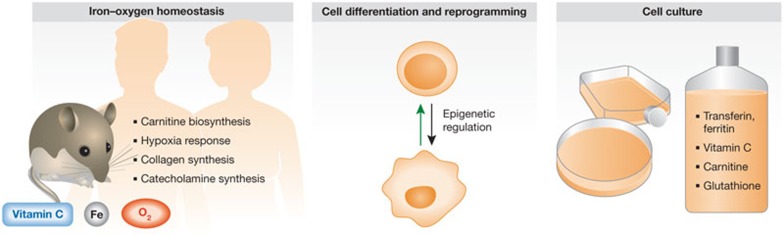
Figure 1
Figure 1
Overview of processes influenced by vitamin C. Vitamin C regulates crucial enzymatic functions in the organism in cooperation with oxygen and iron metabolism. Dioxygenases are essential for regulating collagen, carnitin and catecholamine synthesis as well as the hypoxia response. In addition, dioxygenases catalyse chromatin, and DNA modifications thereby contribute to epigenetic regulation and cell differentiation. This aspect is also important in reprogramming of cell fates (green arrow). In the organism, iron (Fe) and vitamin C sources are environmental factors that affect the activity of dioxygenases. Similarly, in cell culture systems appropriate supplements can be used to mimic physiological levels of activity.
Figure 2
Figure 2
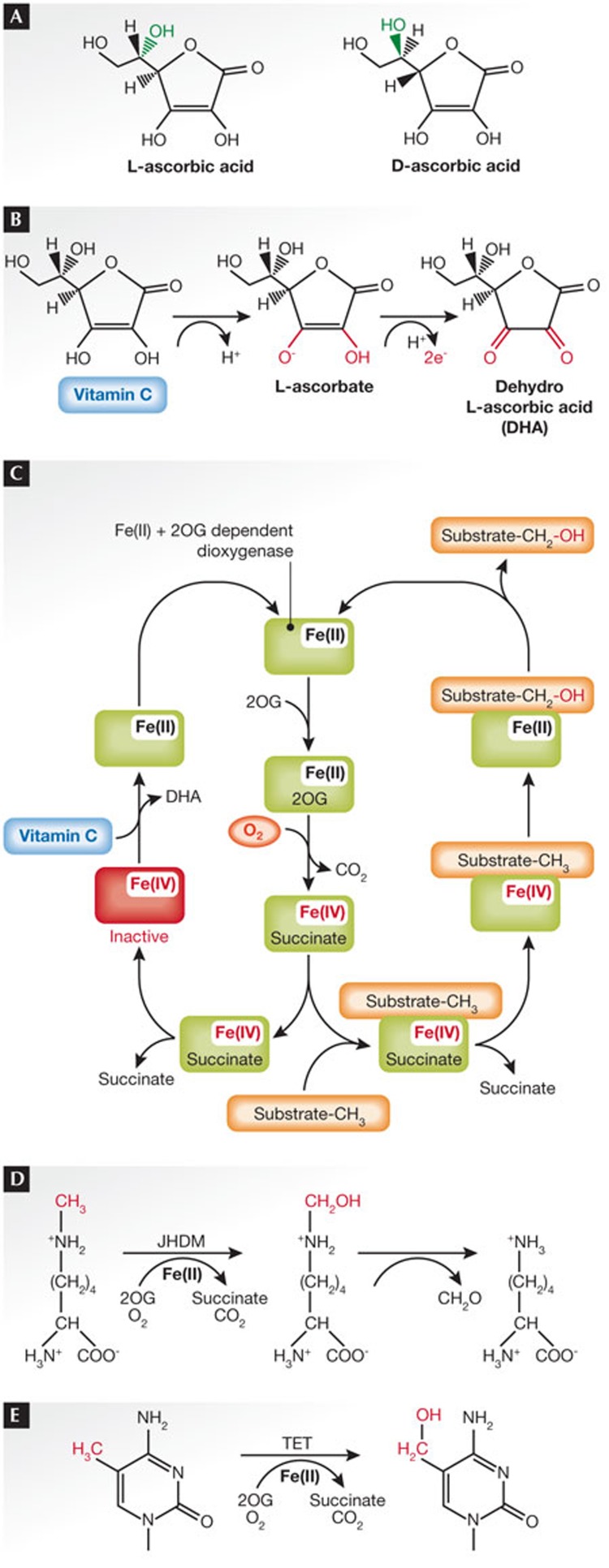
Redox chemistry of vitamin C. (A) Ascorbic acid has chirality. L-ascorbic acid is vitamin C, whereas its enanziomere D-ascorbic acid does not confer the same biological effect. However, chemical antioxidant properties are equivalent in the L- and D-forms. (B) Oxidation of vitamin C to dehydroascorbic acid (DHA) yields two electrons that are used as a reducing agent in redox reactions. For the purpose of this review, these electrons are transferred to an iron atom to reduce its oxidation state. (C) Schematic overview of dioxygenase catalysis indicates different cycles of either substrate hydroxylation or vitamin-C-dependent regeneration. Molecular oxygen is used for the decarboxylation of 2OG, leading to the formation of an activated enzyme with an Fe(IV) intermediate (iron oxidation state is indicated in red). In the presence of substrate, the activated enzymatic complex hydroxylates the methyl group of the substrate and Fe(IV) is reduced to Fe(II) after the release of succinate. In the absence of a substrate, succinate is released without reduction of Fe(IV) leading to an inactive enzyme. Vitamin C can be used to reduce iron to Fe(II), restoring catalytic activity for the next cycle. Several histone- and DNA-modifying enzymes belong to the Fe(II) 2OG-dependent oxidase family. (D) Jumonji C (JmjC)-domain-containing histone demethylases catalyse the removal of methyl groups from lysine residues of histone proteins in a two-step mechanism. The first step, an hydroxylation reaction that converts the methyl group through an oxidative reaction that requires Fe(II) and 2OG, results in an instable intermediate. In a second step, spontaneous elimination of formaldehyde completes the demethylation reaction. (E) TET DNA hydroxylases catalyse the oxidation of methyl groups in the 5′-position of cytosine in DNA. Although the reaction seems to be similar overall to the first step in panel D, the hydroxymethyl group linked through a carbon–carbon bond is stable and is not spontaneously eliminated. 2OG, 2-oxoglutarate; TET, ten-eleven-translocation.
Figure 3
Figure 3
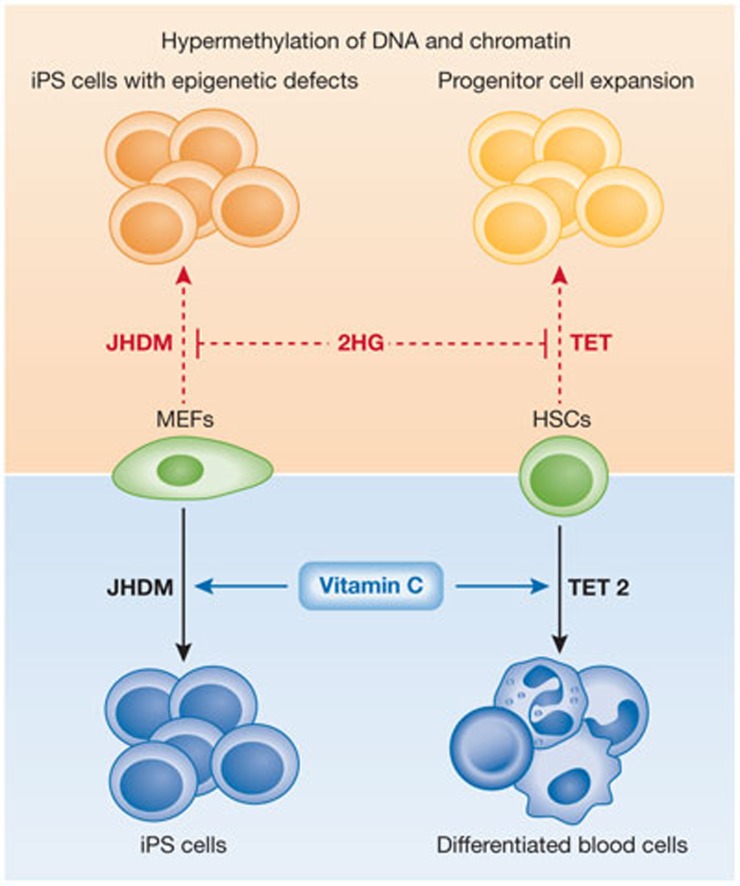
Summary of ten-eleven-translocation and Jumonji family of histone demethylase function in reprogramming and differentiation. JHDM activity has been shown to be crucial for reprogramming of fibroblasts to iPS cells through heterologous expression of reprogramming factors. Conversely, TET2 has been implicated in facilitating differentiation of haematopoietic stem cells and progenitors. Both activities are dependent on vitamin C and are inhibited by the onco-metabolite 2HG. Loss of these activities, either due to inhibition of 2HG or unphysiologically low levels of vitamin C and iron results in aberrant epigenetic patterns and can block a change in cell identity. 2HG, 2-hydroxyglutarate; iPS, induced pluripotent stem; MEF, mouse embryonic fibroblast; JHDM, Jumonji family of histone demethylase; TET, ten-eleven-translocation.
None
Asun Monfort & Anton Wutz

References

    1. Drouin G, Godin JR, Pagé B (2011) The genetics of vitamin C loss in vertebrates. Curr Genomics 12: 371–378 - PMC - PubMed
    1. Peterkofsky B (1991) Ascorbate requirement for hydroxylation and secretion of procollagen: relationship to inhibition of collagen synthesis in scurvy. Am J Clin Nutr 54: 1135S–1140S - PubMed
    1. Baron JH (2009) Sailors' scurvy before and after James Lind—a reassessment. Nutr Rev 67: 315–332 - PubMed
    1. Nelson PJ, Pruitt RE, Henderson LL, Jenness R, Henderson LM (1981) Effect of ascorbic acid deficiency on the in vivo synthesis of carnitine. Biochim Biophys Acta 672: 123–127 - PubMed
    1. Nytko KJ, Maeda N, Schläfli P, Spielmann P, Wenger RH, Stiehl DP (2011) Vitamin C is dispensable for oxygen sensing in vivo. Blood 117: 5485–5493 - PMC - PubMed

Publication types