. 2013 Mar 13:4:111.
doi: 10.3389/fpsyg.2013.00111. eCollection 2013.

Encoding conditions affect recognition of vocally expressed emotions across cultures

Affiliations

Encoding conditions affect recognition of vocally expressed emotions across cultures

Rebecca Jürgens et al. Front Psychol. .

Abstract

Although the expression of emotions in humans is considered to be largely universal, cultural effects contribute to both emotion expression and recognition. To disentangle the interplay between these factors, play-acted and authentic (non-instructed) vocal expressions of emotions were used, on the assumption that cultural effects may contribute differentially to the recognition of staged and spontaneous emotions. Speech tokens depicting four emotions (anger, sadness, joy, fear) were obtained from German radio archives and re-enacted by professional actors, and presented to 120 participants from Germany, Romania, and Indonesia. Participants in all three countries were poor at distinguishing between play-acted and spontaneous emotional utterances (58.73% correct on average with only marginal cultural differences). Nevertheless, authenticity influenced emotion recognition: across cultures, anger was recognized more accurately when play-acted (z = 15.06, p < 0.001) and sadness when authentic (z = 6.63, p < 0.001), replicating previous findings from German populations. German subjects revealed a slight advantage in recognizing emotions, indicating a moderate in-group advantage. There was no difference between Romanian and Indonesian subjects in the overall emotion recognition. Differential cultural effects became particularly apparent in terms of differential biases in emotion attribution. While all participants labeled play-acted expressions as anger more frequently than expected, German participants exhibited a further bias toward choosing anger for spontaneous stimuli. In contrast to the German sample, Romanian and Indonesian participants were biased toward choosing sadness. These results support the view that emotion recognition rests on a complex interaction of human universals and cultural specificities. Whether and in which way the observed biases are linked to cultural differences in self-construal remains an issue for further investigation.

Keywords: acoustics; culture; emotion; play-acting; recognition; speech; vocalization.


Figures
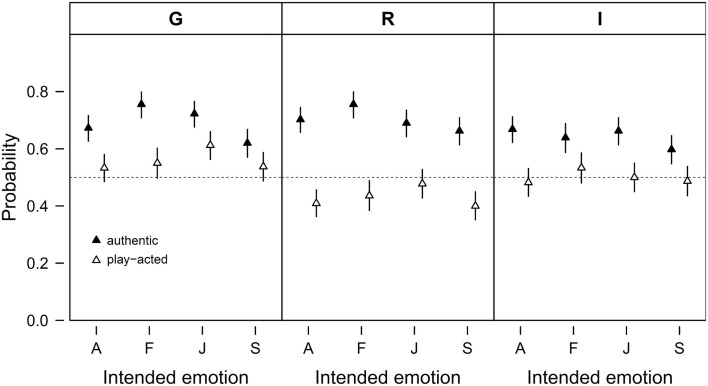
Figure 1
Figure 1
Probability of correct authenticity recognition by intended emotion (A – anger, F – fear, J – joy, S – sadness) and stimulus authenticity (authentic or play-acted). The data are split by cultural affiliation (G – Germany, R – Romania, I – Indonesia). Given are means and 95% confidence intervals. The probability of correct authenticity recognition by chance is 0.5 as indicated by the dashed horizontal lines.
Figure 2
Figure 2
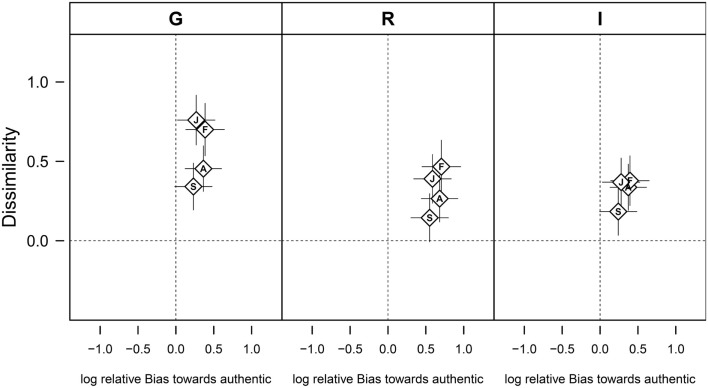
Discrimination of authentic and play-acted vocal expressions of emotions as assessed by choice theory. The discriminatory ability is described by the dissimilarity between authentic and play-acted stimuli (depicting how well the stimuli could be discriminated) and by the participants’ relative bias toward choosing authentic as a response, which are plotted against each other. The figure shows how these parameters vary in dependence of cultural affiliation (G – Germany, R – Romania, I – Indonesia) and the intended emotional content (A – anger, F – fear, J – joy, S – sadness). Positive values on the x-axis indicate a bias toward preferentially choosing the response “authentic,” while higher dissimilarity values indicates a better ability to distinguish the stimuli. Data are given are as means ± 95% confidence intervals.
Figure 3
Figure 3
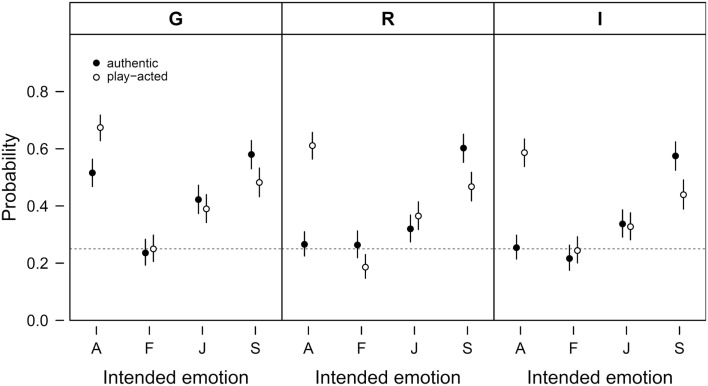
Probability of correct emotion recognition. Given is the probability of correct emotion recognition with respect to the intended emotion (A – anger, F – fear, J – joy, S – sadness) and stimulus authenticity (authentic or play-acted). The data are split by cultural affiliation (G – Germany, R – Romania, I – Indonesia). Given are means and 95% confidence intervals. The probability of correct emotion recognition by chance is 0.25 as indicated by the dashed horizontal lines.
Figure 4
Figure 4
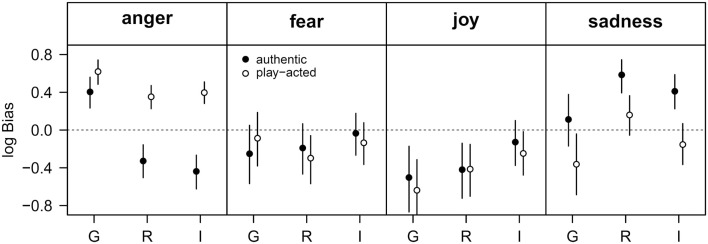
Analysis of emotion recognition data by choice theory. Given is the log-transformed response bias for each of the four possible choices (anger, fear, joy, sadness) with respect to cultural affiliation (G – Germany, R – Romania, I – Indonesia). The filled and open symbols indicate the response bias for authentic and play-acted stimuli. Data are given as means and 95% uncertainty interval. In the absence of any bias, all four log-transformed bias values would be zero. Positive values indicate a bias toward choosing the response named in the headline, whereas a value below zero indicates a bias against choosing the respective response.
Figure 5
Figure 5
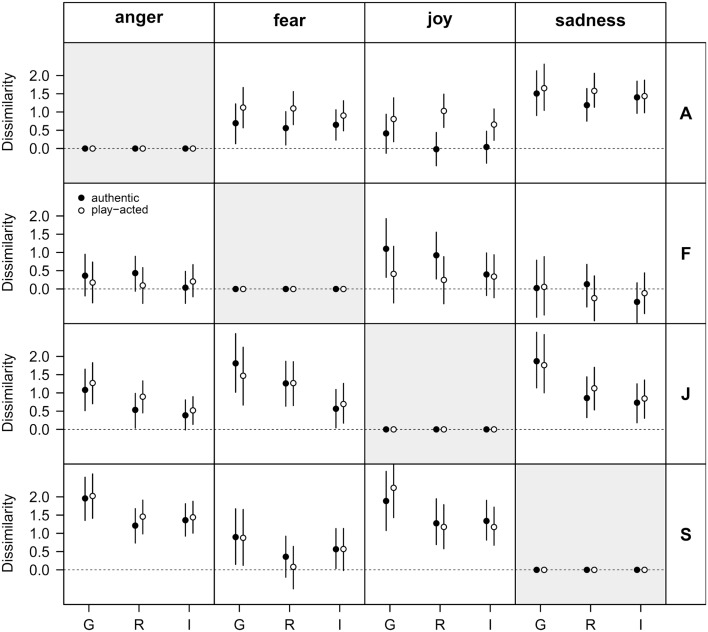
Analysis of emotion recognition data using choice theory. Given is the dissimilarity for different pairs of emotion stimuli with respect to cultural affiliation (G – Germany, R – Romania, I – Indonesia). The rows and columns of this matrix plot indicate the four emotion stimuli (A – anger, F – fear, J – joy, S – sadness) and the four possible responses (anger, fear, joy, sadness), respectively. Filled and open symbols refer to authentic and play-acted conditions, respectively. Data are given as means and 95% uncertainty interval. The dissimilarity describes how well each stimulus (depicted by rows) is discriminated from each other stimulus (depicted by response columns).

References

    1. Agresti A. (2007). An Introduction to Categorical Data Analysis. New Jersey: Wiley
    1. Audibert N., Aubergé V., Rilliard A. (2008). “How we are not equally competent for discriminating acted from spontaneous expressive speech,” in Proceedings of the Speech Prosody 2008, Campinas
    1. Averill J. R. (1980). “A constructivist view of emotion,” in Emotion, Theory, Research and Experience, eds Plutchik R., Kellermann H. (New York: Academic Press; ), 305–339
    1. Banse R., Scherer K. R. (1996). Acoustic profiles in vocal emotion expression. J. Pers. Soc. Psychol. 70, 614–636 10.1037/0022-3514.70.3.614 - DOI - PubMed
    1. Barkhuysen P., Krahmer E., Swerts M. (2007). “Cross-modal perception of emotional speech,” in Proceedings of the International Congress of Phonetic Sciences (ICPhS’ 07), Saarbrücken

LinkOut - more resources