Review
. 2013 Mar 1;4(2):176-90.
doi: 10.3945/an.112.003210.

Discovery of human zinc deficiency: its impact on human health and disease

Affiliations
Review

Discovery of human zinc deficiency: its impact on human health and disease

Ananda S Prasad. Adv Nutr. .

Abstract

The essentiality of zinc in humans was established in 1963. During the past 50 y, tremendous advances in both clinical and basic sciences of zinc metabolism in humans have been observed. The major factor contributing to zinc deficiency is high phytate-containing cereal protein intake in the developing world, and nearly 2 billion subjects may be zinc deficient. Conditioned deficiency of zinc has been observed in patients with malabsorption syndrome, liver disease, chronic renal disease, sickle cell disease, and other chronic illnesses. Major clinical problems resulting from zinc deficiency in humans include growth retardation; cell-mediated immune dysfunction, and cognitive impairment. In the Middle East, zinc-deficient dwarfs did not live beyond the age of 25 y, and they died because of intercurrent infections. In 1963, we knew of only 3 enzymes that required zinc for their activities, but now we know of >300 enzymes and >1000 transcription factors that are known to require zinc for their activities. Zinc is a second messenger of immune cells, and intracellular free zinc in these cells participate in signaling events. Zinc has been very successfully used as a therapeutic modality for the management of acute diarrhea in children, Wilson's disease, the common cold and for the prevention of blindness in patients with age-related dry type of macular degeneration and is very effective in decreasing the incidence of infection in the elderly. Zinc not only modulates cell-mediated immunity but is also an antioxidant and anti-inflammatory agent.


Conflict of interest statement

Author disclosure: A. Prasad, no conflicts of interest.

Figures
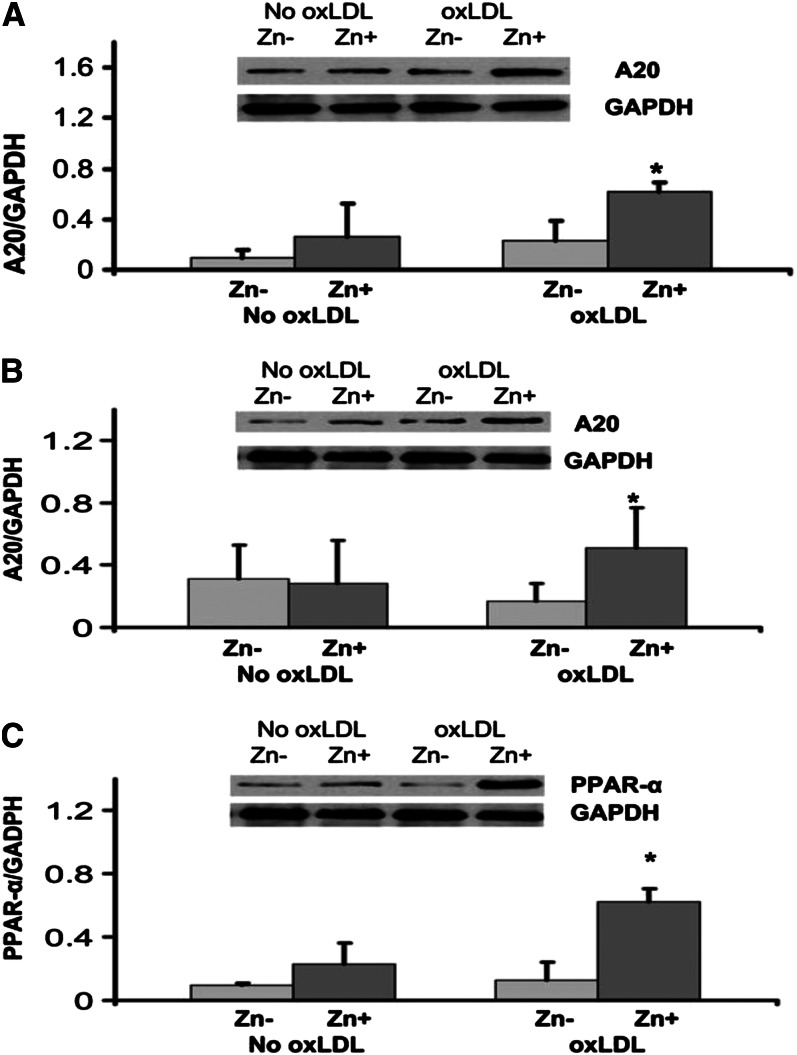
Figure 1
Figure 1
The effect of zinc on A20 and peroxisome proliferator–activated receptor α (PPAR-α) in the human monocytic leukemia cell line (THP-1) (A) and human aortic endothelial cells (HAECs) (B and C) after oxidized LDL (oxLDL) stimulation. The cells were incubated either in zinc-deficient (Zn−, 1 μmol/L) or zinc-sufficient (Zn+, 15 μmol/L) medium for 8 d (for the THP-1) and for 6 d (for HAECs), followed by 24 h of stimulation with 50 μg oxLDL/mL. A20 and PPAR-α proteins were measured by Western blot analysis. *P < 0.05 for Zn− compared with Zn+ (Values are SD; n = 3). GADPH, glyceraldehyde 3-phosphate dehydrogenase. Reproduced with permission from (46).
Figure 2
Figure 2
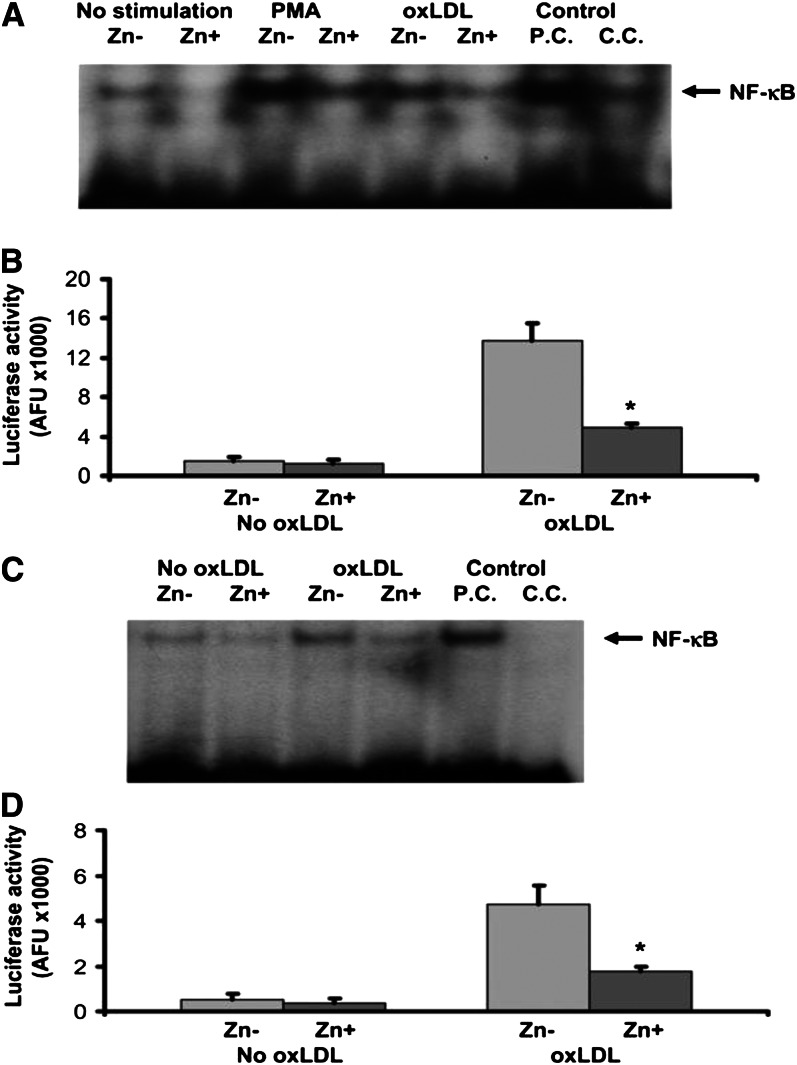
Effect of zinc on nuclear transcription factor κB (NF-κB) activation in the human monocytic leukemia cell line (THP-1) after oxidized LDL (oxLDL) or phorbol myristate acetate (PMA) stimulation. Zinc-deficient (Zn−) THP-1 cells and zinc-sufficient (Zn+) THP-1 cells were used for the measurement of NF-κB activation by electrophoretic mobility shift assay (EMSA) (A) and luciferase reporter gene assay (B). Effect of zinc on NF-κB activation in human aortic endothelial cells (HAECs) after oxLDL stimulation. Zn− HAECs and Zn+ HAECs were used for the measurement of NF-κB activation by EMSA (C) and luciferase reporter gene assay (D). *P < 0.05 for Zn− compared with Zn+ (Values are SD; n = 3). AFU, arbitrary fluorescent unit/β-galactosidase U/100 μg protein; P.C., positive control; C.C., competition control. Reproduced with permission from (46).
Figure 3
Figure 3
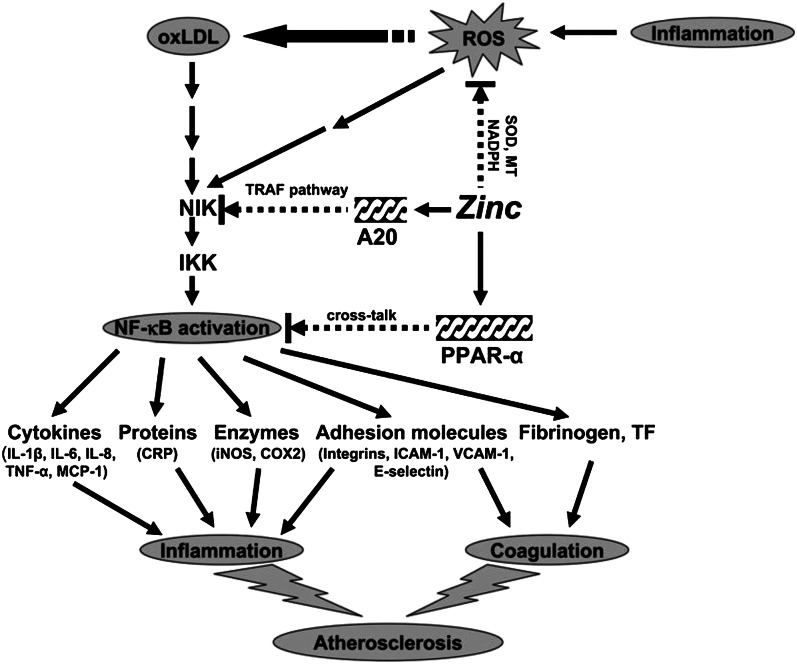
Signaling pathway for zinc prevention of atherosclerosis in monocytes/macrophages and vascular endothelial cells: a proposed hypothesis. Reactive oxygen species (ROS) induced by many stimuli modifies LDL into oxidized LDL (oxLDL) in macrophages and vascular endothelial cells. oxLDL or ROS can activate the apoptotic pathway via activation of proapoptotic enzymes and the nuclear transcription factor κB (NF-κB) pathway via NF-κB inducible kinase (NIK) activation, which eventually results in the development and progression of atherosclerosis. Zinc might have an atheroprotective function by the following mechanisms: 1) inhibition of ROS generation via metallothionein (MT), superoxide dismutase (SOD), and inhibition of NADPH oxidase and 2) downregulation of atherosclerotic cytokines/molecules such as inflammatory cytokines, adhesion molecules, inducible nitric oxide synthase (iNOS), cyclooxygenase 2 (COX2), fibrinogen, and tissue factor (TF) through inhibition of NF-κB activation by A20-mediating TNF–receptor associated factor (TRAF) signaling and peroxisome proliferator–activated receptor α (PPAR-α)–mediating crosstalk signaling. The black arrows indicate upregulation; arrows with a broken line indicate downregulation or the inhibitory pathway. IKK, IκB kinase; MCP-1, macrophage chemoattractant protein 1; CRP, C-reactive protein; ICAM-1, intercellular adhesion molecule 1; VCAM-1, vascular cell adhesion molecule 1. Reproduced with permission from (46).

References

    1. Raulin J. Chemical studies on vegetation [in French]. Ann Sci Nat. 1869;11:93–9.
    1. Todd WR, Elvehjem CA, Hart EB. Zinc in the nutrition of the rat. Am J Physiol. 1933;107:146–56
    1. Prasad AS, Halsted JA, Nadimi M. Syndrome of iron deficiency anemia, hepatosplenomegaly, hypogonadism, dwarfism, and geophagia. Am J Med. 1961;31:532–46 - PubMed
    1. Prasad AS, Miale A, Farid Z, Schulert A, Sandstead HH. Zinc metabolism in patients with the syndrome of iron deficiency anemia, hypogonadism and dwarfism. J Lab Clin Med. 1963;61:537–49 - PubMed
    1. Sandstead HH, Prasad AS, Schulert AR, Farid Z, Miale A, Jr, Bassily S, Darby WJ. Human zinc deficiency, endocrine manifestations and response to treatment. Am J Clin Nutr. 1967;20:422–42 - PubMed

Publication types

MeSH terms