


Assessment of lung volume collapsibility in chronic obstructive lung disease patients using CT
- PMID: 23494492
- PMCID: PMC3657332
- DOI: 10.1007/s00330-012-2746-1
Assessment of lung volume collapsibility in chronic obstructive lung disease patients using CT
Abstract
Objective: To investigate the collapsibility of the lung and individual lobes in patients with COPD during inspiration/expiration and assess the association of whole lung and lobar volume changes with pulmonary function tests (PFTs) and disease severity.
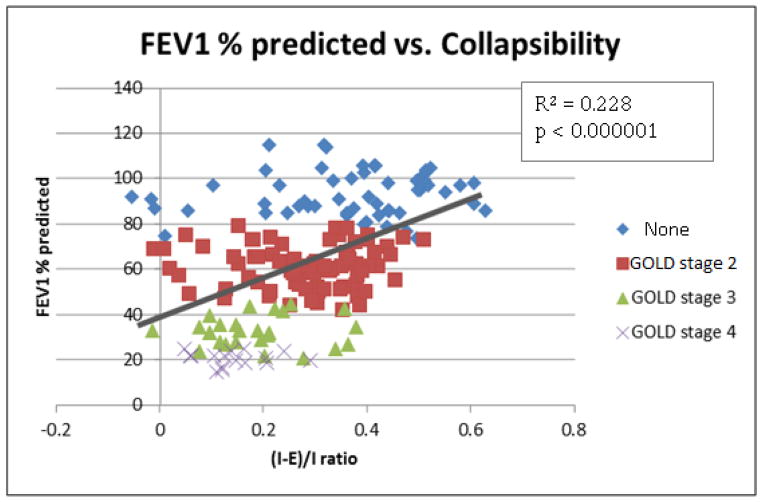
Methods: PFT measures used were RV/TLC%, FEV1% predicted, FVC, FEV1/FVC%, DLco% predicted and GOLD category. A total of 360 paired inspiratory and expiratory CT examinations acquired in 180 subjects were analysed. Automated computerised algorithms were used to compute individual lobe and total lung volumes. Lung volume collapsibility was assessed quantitatively using the simple difference between CT computed inspiration (I) and expiration (E) volumes (I-E), and a relative measure of volume changes, (I-E)/I.
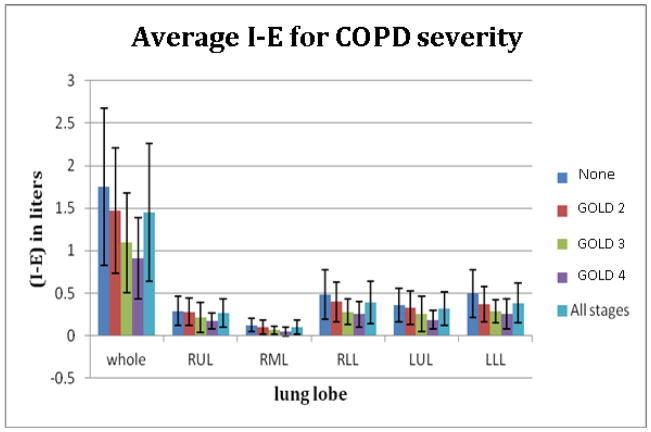
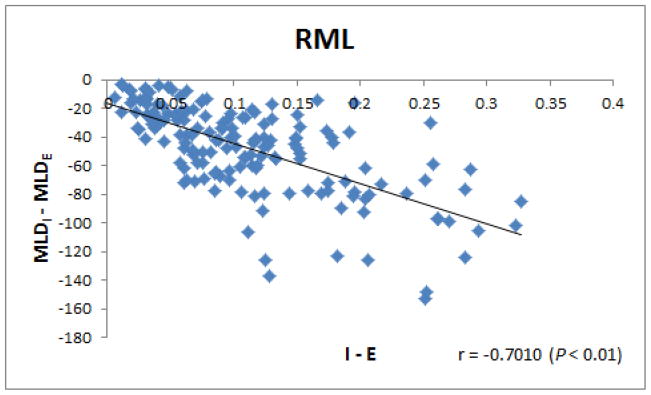
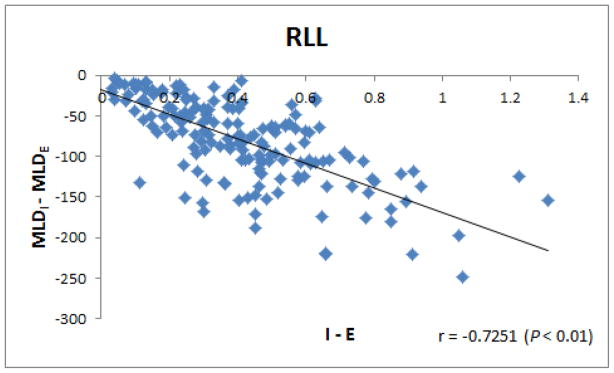
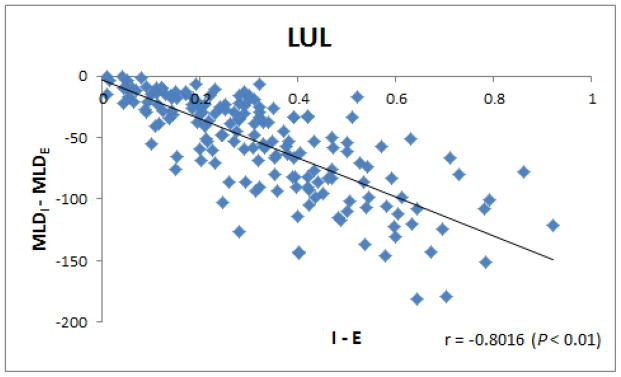
Results: Mean absolute collapsibility (I-E) decreased in all lung lobes with increasing disease severity defined by GOLD classification. Relative collapsibility (I-E)/I showed a similar trend. Upper lobes had lower volume collapsibility across all GOLD categories and lower lobes collectively had the largest volume collapsibility. Whole lung and left lower lobe collapsibility measures tended to have the highest correlations with PFT measures. Collapsibility of lung lobes and whole lung was also negatively correlated with the degree of air trapping between expiration and inspiration, as measured by mean lung density. All measured associations were statistically significant (P < 0.01).
Conclusion: Severity of COPD appears associated with increased collapsibility in the upper lobes, but change (decline) in collapsibility is faster in the lower lobes.
Key points: • Inspiratory and expiratory computed tomography allows assessment of lung collapsibility • Lobe volume collapsibility is significantly correlated with measures of lung function. • As COPD severity increases, collapsibility of individual lung lobes decreases. • Upper lobes exhibit more severe disease, while lower lobes decline faster.
Figures





References
-
- Berend N, Woolcock AJ, Marlin GE. Correlation between the function and structure of the lung in smokers. Am Rev Respir Dis. 1979;119:695–705. - PubMed
-
- Petty TL, Silvers GW, Stanford RE. Mild emphysema is associated with reduced elastic recoil and increased lung size but not with airflow limitation. Am Rev Respir Dis. 1987;136:867–871. - PubMed
-
- Carroll N, Elliot J, Morton A, James A. The structure of large and small airways in nonfatal and fatal asthma. Am J Respir Crit Care Med. 1993;147:405–410. - PubMed
-
- Pascual RM, Peters SP. Airway remodelling contributes to the progressive loss of lung function in asthma: An overview. J Allergy Clin Immunol. 2005;116:477–486. - PubMed
Publication types
MeSH terms
Grants and funding
LinkOut - more resources
Full Text Sources
Other Literature Sources
Medical
