


Netting barriers to prevent mosquito entry into houses in southern Mozambique: a pilot study
- PMID: 23497325
- PMCID: PMC3602670
- DOI: 10.1186/1475-2875-12-99
Netting barriers to prevent mosquito entry into houses in southern Mozambique: a pilot study
Abstract
Background: One of the best ways to control the transmission of malaria is by breaking the vector-human link, either by reducing the effective population size of mosquitoes or avoiding infective bites. Reducing house entry rates in endophagic vectors by obstructing openings is one simple way of achieving this. Mosquito netting has previously been shown to have this effect. More recently different materials that could also be used have come onto the market. Therefore, a pilot study was conducted to investigate the protective effect of three types of material against Anopheles funestus and Anopheles gambiae s.l entry into village houses in Mozambique when applied over the large opening at the gables and both gables and eaves.
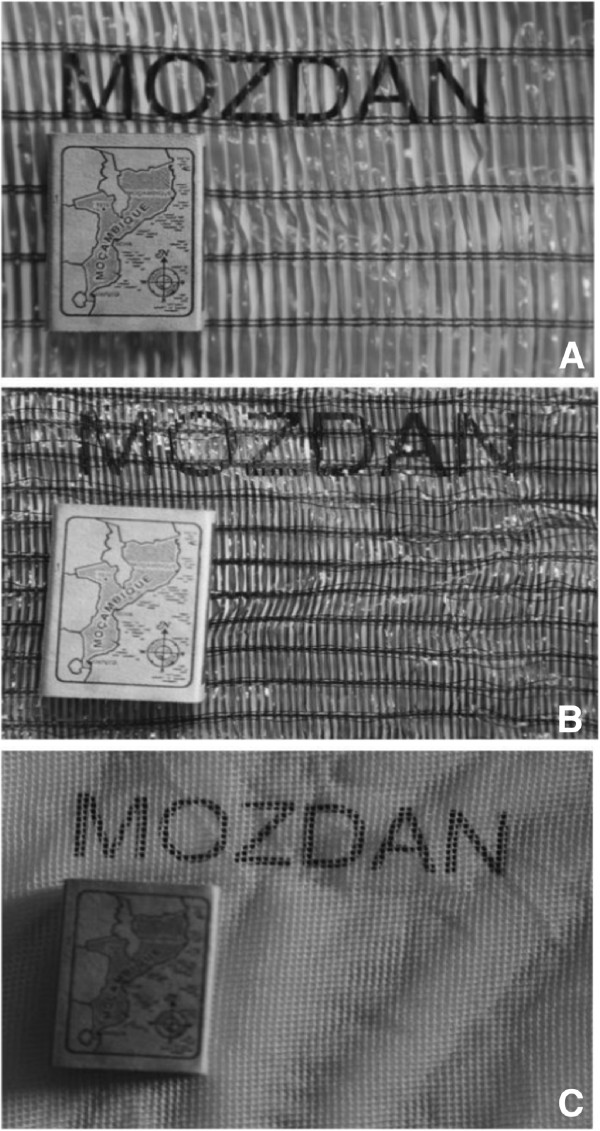
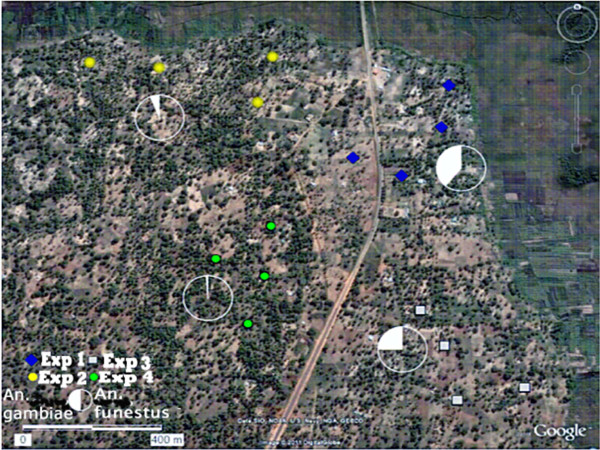
Methods: A two-step intervention was implemented in which the gable ends of houses (the largest opening) were covered with one of three materials (four year old mosquito bed nets; locally purchased untreated shade cloth or deltamethrin-impregnated shade cloth) followed by covering both gable ends and eaves with material. Four experimental rounds (each of three weeks duration), from four houses randomly assigned to be a control or to receive one of the three intervention materials, were undertaken from March to August 2010 in the village of Furvela in southern Mozambique. Mosquito entry rates were assessed by light-trap collection and the efficacy of the different materials was determined in terms of incidence rate ratio (IRR), obtained through a Generalized Estimating Equations (GEE), of mosquito entry in a treated house compared to the untreated (control) house.
Results: Altogether 9,692 An. funestus and 1,670 An. gambiae s.l. were collected. Houses treated with mosquito netting or the untreated shade cloth had 61.3% [IRR = 0.39 (0.32-0.46); P <0.0001] and 70% [IRR = 0.30 (0.25 - 0.37); P <0.001] fewer An. funestus in relation to untreated houses, but there was no difference in An. funestus in houses treated with the deltamethrin-impregnated shade cloth [IRR = 0.92 (0.76 -1.12); P = 0.4] compared to untreated houses. Houses treated with mosquito netting reduced entry rates of An. gambiae s.l, by 84% [IRR = 0.16 (0.10 - 0.25); P <0.001], whilst untreated shade cloth reduced entry rates by 69% [IRR = 0.31 (0.19 -0.53); P <0.001] and entry rates were reduced by 76% [IRR = 0.24 (0.15 0.38); P <0.001] in houses fitted with deltamethrin-impregnated shade cloth.
Figures
References
-
- Celli A. Collected papers on malaria Angelo Celli, 1899–1912. London: London School of Hygiene & Tropical Medicine; 1901. The new preventative treatment of malaria in Latium; pp. 1–12.
-
- Boyd MF. The influence of obstacles unconsciously erected against Anophelines (housing and screening) upon the incidence of malaria. Am J Trop Med Hyg. 1926;2:157–160.
Publication types
MeSH terms
LinkOut - more resources
Full Text Sources
Other Literature Sources
