. 2013 Mar 4:9:9.
doi: 10.1186/1744-8069-9-9.

TRPV1, but not TRPA1, in primary sensory neurons contributes to cutaneous incision-mediated hypersensitivity

Affiliations

TRPV1, but not TRPA1, in primary sensory neurons contributes to cutaneous incision-mediated hypersensitivity

Marie E Barabas et al. Mol Pain. .

Abstract

Background: Mechanisms underlying postoperative pain remain poorly understood. In rodents, skin-only incisions induce mechanical and heat hypersensitivity similar to levels observed with skin plus deep incisions. Therefore, cutaneous injury might drive the majority of postoperative pain. TRPA1 and TRPV1 channels are known to mediate inflammatory and nerve injury pain, making them key targets for pain therapeutics. These channels are also expressed extensively in cutaneous nerve fibers. Therefore, we investigated whether TRPA1 and TRPV1 contribute to mechanical and heat hypersensitivity following skin-only surgical incision.

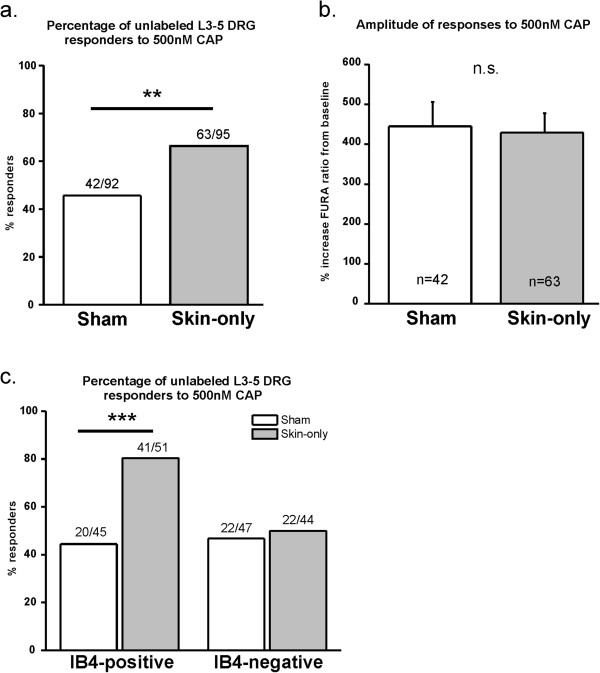
Results: Behavioral responses to mechanical and heat stimulation were compared between skin-incised and uninjured, sham control groups. Elevated mechanical responsiveness occurred 1 day post skin-incision regardless of genetic ablation or pharmacological inhibition of TRPA1. To determine whether functional changes in TRPA1 occur at the level of sensory neuron somata, we evaluated cytoplasmic calcium changes in sensory neurons isolated from ipsilateral lumbar 3-5 DRGs of skin-only incised and sham wild type (WT) mice during stimulation with the TRPA1 agonist cinnamaldehyde. There were no changes in the percentage of neurons responding to cinnamaldehyde or in their response amplitudes. Likewise, the subpopulation of DRG somata retrogradely labeled specifically from the incised region of the plantar hind paw showed no functional up-regulation of TRPA1 after skin-only incision. Next, we conducted behavior tests for heat sensitivity and found that heat hypersensitivity peaked at day 1 post skin-only incision. Skin incision-induced heat hypersensitivity was significantly decreased in TRPV1-deficient mice. In addition, we conducted calcium imaging with the TRPV1 agonist capsaicin. DRG neurons from WT mice exhibited sensitization to TRPV1 activation, as more neurons (66%) from skin-incised mice responded to capsaicin compared to controls (46%), and the sensitization occurred specifically in isolectin B4 (IB4)-positive neurons where 80% of incised neurons responded to capsaicin compared to just 44% of controls.

Conclusions: Our data suggest that enhanced TRPA1 function does not mediate the mechanical hypersensitivity that follows skin-only surgical incision. However, the heat hypersensitivity is dependent on TRPV1, and functional up-regulation of TRPV1 in IB4-binding DRG neurons may mediate the heat hypersensitivity after skin incision injury.


Figures
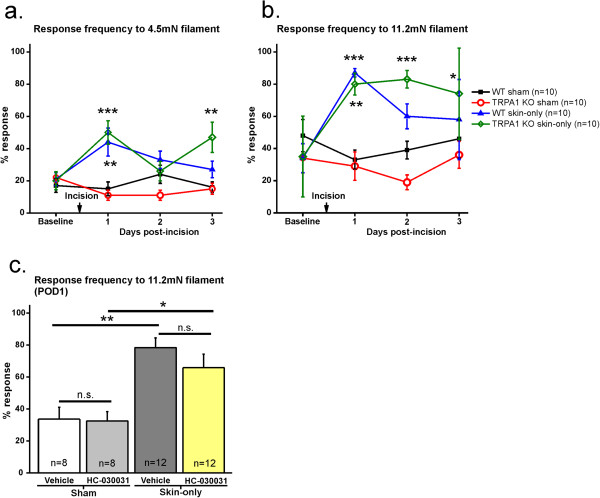
Figure 1
Figure 1
Mechanical hypersensitivity is prevalent after skin incision with either genetic knockout or pharamacological block of TRPA1. a. Response frequency to 4.5mN filament for WT and TRPA1 KO skin incised and sham mice. Measurements are reported as percent responses (out of 10 total applications of force). Both WT and TRPA1 KO mice exhibit increased mechanical sensitivity on postoperative day 1 (POD1) compared to sham controls (p = 0.0002; **p < 0.01; ***p < 0.0001; represents difference between skin-only and corresponding sham). There is no difference between WT and TRPA1 KO skin-only incised mice at any time point. 10 mice per group. b. Response frequency to 11.2mN filament for WT and TRPA1 KO skin incised and sham mice. Both WT and TRPA1 KO mice exhibit increased mechanical sensitivity at POD1 as compared to sham controls (p < 0.0001; **p < 0.001; ***p < 0.0001; *p < 0.05; represents difference between skin-only and corresponding sham). There is no difference between WT and TRPA1 KO skin-only incised mice at any time point after skin incision. These mice are the same as those used in Figure 1a. c. Response frequencies to 11.2mN filament on POD1 after skin-only incision or sham with treatment with vehicle or TRPA1 antagonist, HC-030031. Skin-only incised mice treated with vehicle as well as those treated with HC-030031 exhibit significantly more responses to the mechanical force than the sham groups (p < 0.0001; **p < 0.001; *p < 0.05). 8 mice per sham group; 12 mice per skin-only incision group.
Figure 2
Figure 2
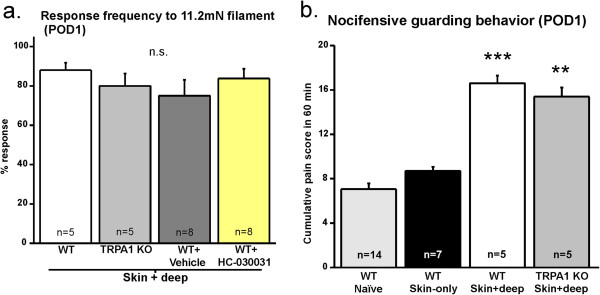
Mechanical hypersensitivity and guarding behavior is prevalent after skin plus deep incision with genetic knockout and pharmacological inhibition of TRPA1. a. Response frequency to 11.2mN filament on POD1 for skin plus deep incised WT, TRPA1 KO, WT treated with vehicle and WT treated with TRPA1 antagonist, HC-030031. There is no difference in mechanical hypersensitivity after skin plus deep incision with genetic knockout or pharmacological block of TRPA1. 5 mice per each WT and TRPA1 KO groups; 8 mice per each WT groups treated with either vehicle or HC-030031. b. Guarding nocifensive (non-evoked) behavior on POD1 for naïve, skin-only and skin plus deep incised mice. There is no difference in pain score between naïve and skin-only incised mice. Both WT and TRPA1 KO skin plus deep incised mice exhibit increased pain scores, compared to naïve and skin-only incised mice (p < 0.0001; **p < 0.001; applies to comparison to both naïve and skin-only). 14 naïve; 7 WT skin-only incision mice. The skin plus deep incised mice are the same as those used in Figure 2a.
Figure 3
Figure 3
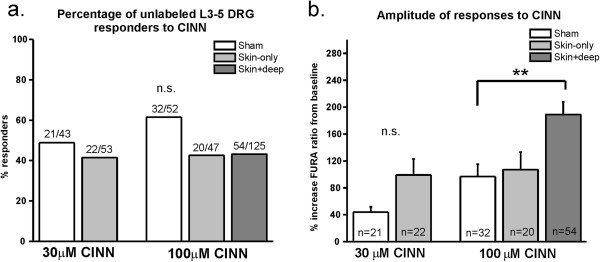
TRPA1 is not functionally up-regulated in DRG neurons with mixed peripheral targets following skin-only incision injury. a. Percentage of neurons with mixed peripheral targets responding to cinnamaldehyde (CINN). There is no difference in the percentage of neurons responding to 30 or 100 μM CINN between neurons cultures from sham mice and those from skin-only or skin plus deep incised mice. Neurons were pooled from 6 mice per sham and skin-only incision groups and 4 mice in skin plus deep group. b. Amplitude of responses of neurons with mixed peripheral targets to CINN. There is no difference in the amplitude or responses between sham and skin-only neurons to 30 or 100 μM CINN. The amplitude of responses of neurons from skin plus deep incised mice is significantly greater than those from sham and skin-only incised mice (p < 0.0001; **p < 0.01). Same neurons as those in Figure 3a.
Figure 4
Figure 4
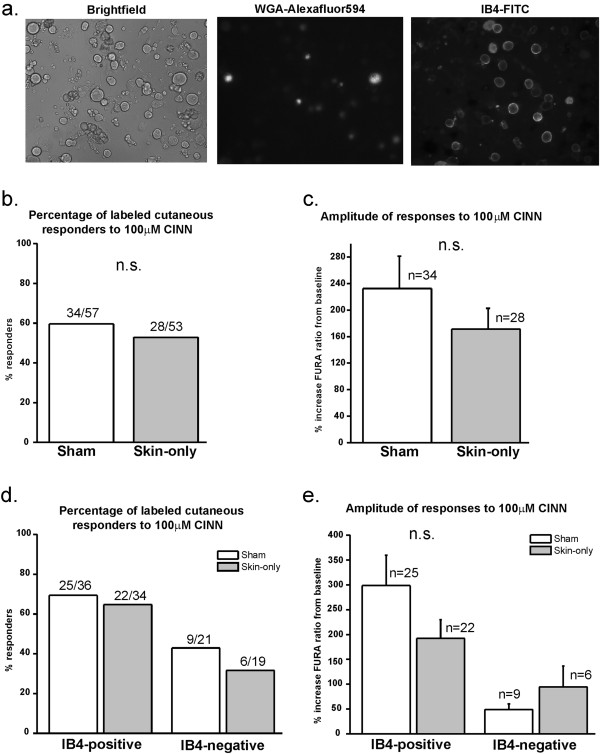
TRPA1 is not functionally up-regulated in retrogradely labeled cutaneous neurons from glabrous plantar skin following skin-only incision injury. a. Representative brightfield (left), WGA-Alexafluor594 retrograde label (middle), and IB4-FITC (right) images of ipsilateral lumbar 3–5 neurons from incised mice with retrograde label and IB4 staining (20x objective). Neurons that brightly fluoresced with Alexafluor594 at least 2-times the standard deviation above autofluorescence were considered to be positively stained for the retrograde tracer and recorded. IB4-positive neurons were defined by a halo of FITC labeling around the entire perimeter of the somata of small-diameter (<27 μm) neurons. b. Percentage of cutaneous neurons responding to CINN. There is no difference in the percentage of labeled WT neurons responding to 100μM CINN from skin-only incised and sham mice. Neurons were pooled from 3 mice per group. c. Amplitude of responses of cutaneous neurons to CINN. Ipsilateral retrograde-labeled neurons from skin-only incised WT mice respond with the same amplitude of intracellular increase to 100μM CINN as neurons from sham mice. Same neurons as those in Figure 4b. d. Percentage of cutaneous neurons responding to CINN defined by IB4 staining. There is no difference in percentage of labeled neurons responding to 100μM CINN defined by IB4 binding. Same neurons as those in Figure 4b. e. Amplitude of responses of cutaneous neurons responding to CINN defined by IB4 staining. There was no difference in amplitude of responses to 100μM CINN in labeled neurons defined by IB4 staining. Same neurons as those in Figure 4b.
Figure 5
Figure 5
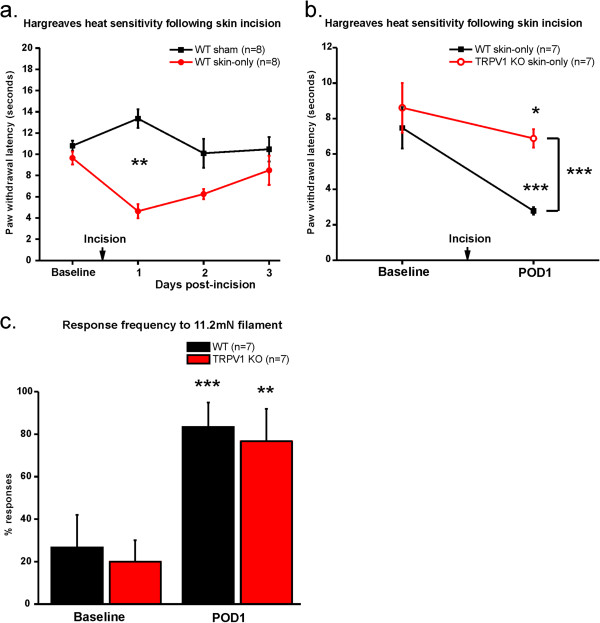
Skin-only incision induced thermal hypersensitivity is dependent on TRPV1. a. Heat behavior assay for WT skin-only incised and sham mice. WT mice exhibit decreased paw withdrawal latencies on POD1 after skin-only incision injury as compared to sham controls (p = 0.0013; ***p < 0.0001). 8 mice per group. b. Heat behavior assay for WT and TRPV1 KO skin-only incised mice. TRPV1 KO skin-only incised mice exhibit significantly longer paw withdrawal latencies at POD1 than skin incised WT mice (2-way repeated measures ANOVA: p < 0.0001; ***p < 0.0001). TRPV1 mice exhibit an increase in heat sensitivity compared to baseline (paired t-test *p = 0.0022); however, WT mice exhibit a much greater increase in heat sensitivity compared to their baseline values (paired t-test ***p < 0.0001). 7 mice per group. Since multiple statistical tests were conducted, we used assumed p-values <0.025 were significant rather than 0.05. Through nonparametric testing we reached the same conclusion. c. Response frequency to 11.2mN filament for WT and TRPV1 KO mice following skin-only incision injury. There was no difference at baseline or POD1 between WT and TRPV1 KO mice (2-way repeated measures ANOVA: p > 0.05; n.s.). Both WT and TRPV1 KO mice exhibit increase mechanical sensitivity on POD1 following skin-only incision injury compared to their respective baseline values (paired t-tests; ***p = 0.0002; **p = 0.0003). Same mice as those in Figure 5b. Since multiple statistical tests were conducted, we assumed p-values <0.025 were significant rather than 0.05. Through nonparametric testing we reached the same conclusion.
Figure 6
Figure 6
TRPV1 is functionally up-regulated in IB4-positive, DRG neurons with mixed peripheral targets following skin incision injury. a. Percentage of neurons with mixed peripheral targets responding to capsaicin (CAP). There are significantly more responders to 500nM CAP among ipsilateral lumber 3–5 neurons from skin-only incised WT mice than from sham mice (**p = 0.0052). Neurons pooled from 3 mice per group. b. Amplitude of responses of neurons with mixed peripheral targets to CAP. There is no difference in the amplitude of responses to 500nM CAP between neurons from skin-only incised and sham mice. Same neurons as in Figure 6a. c. Percentage of neurons with mixed peripheral targets responding to CAP defined by IB4 binding. Significantly more IB4-positive neurons respond to 500nM CAP from skin-only incised mice than sham mice (overall effect: p = 0.0007; ***p = 0.0003). There is no difference in CAP responsiveness in IB4-negative neurons from incised and sham mice. Same neurons as in Figure 6a.
Figure 7
Figure 7
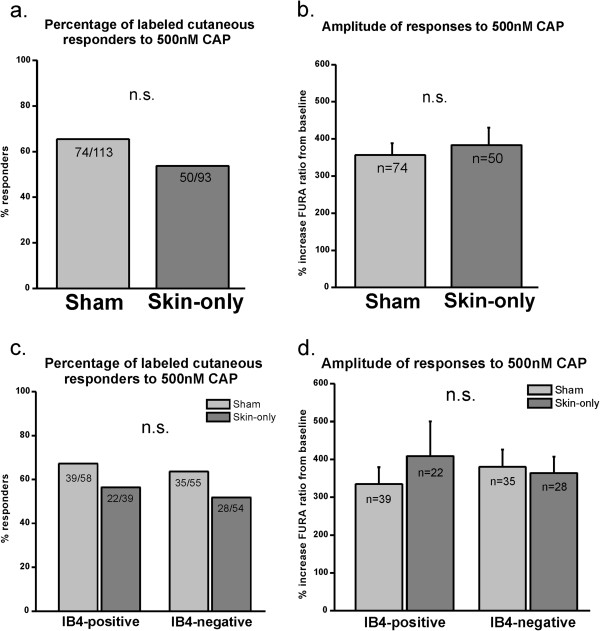
TRPV1 is not functionally up-regulated in retrogradely labeled cutaneous neurons following skin-only incision injury. a. Percentage of cutaneous neurons responding to CAP. There is no difference in the percentage of labeled WT neurons responding to 500nM CAP from skin-only incised and sham mice. Neurons were pooled from 9 sham and 8 incised mice; three independent experiments were performed with no differences between experiments. b. Amplitude of responses of cutaneous neurons to CAP. The amplitude of responses to 500nM CAP for neurons from skin-only incised mice is not different than those from sham mice. Same neurons as in Figure 7a. c. Percentage of cutaneous neurons responding to CAP defined by IB4 staining. There is no difference in percentage of labeled neurons responding to 500nM CAP defined by IB4 binding. Same neurons as in Figure 7a. d. Amplitude of responses of cutaneous neurons responding to CAP defined by IB4 staining. The amplitude of responses to 500nM CAP for IB4-positive, labeled neurons from skin-only incised mice is not different than those from sham mice. Likewise, there is no difference in CAP responsiveness in IB4-negative neurons from incised and sham mice. Same neurons as in Figure 7a.

References

    1. Apfelbaum JL, Chen C, Mehta SS, Gan TJ. Postoperative pain experience: results from a national survey suggest postoperative pain continues to be undermanaged. Anesth Analg. 2003;97:534–540. doi: 10.1213/01.ANE.0000068822.10113.9E. table. - DOI - PubMed
    1. Guignard B, Bossard AE, Coste C, Sessler DI, Lebrault C, Alfonsi P, Fletcher D, Chauvin M. Acute opioid tolerance: intraoperative remifentanil increases postoperative pain and morphine requirement. Anesthesiology. 2000;93:409–417. doi: 10.1097/00000542-200008000-00019. - DOI - PubMed
    1. Gear RW, Miaskowski C, Gordon NC, Paul SM, Heller PH, Levine JD. The kappa opioid nalbuphine produces gender- and dose-dependent analgesia and antianalgesia in patients with postoperative pain. Pain. 1999;83:339–345. doi: 10.1016/S0304-3959(99)00119-0. - DOI - PubMed
    1. Bennett DL, Dmietrieva N, Priestley JV, Clary D, McMahon SB. TrkA, CGRP and IB4 expression in retrogradely labelled cutaneous and visceral primary sensory neurones in the rat. Neurosci Lett. 1996;206:33–36. doi: 10.1016/0304-3940(96)12418-6. - DOI - PubMed
    1. Perry MJ, Lawson SN. Differences in expression of oligosaccharides, neuropeptides, carbonic anhydrase and neurofilament in rat primary afferent neurons retrogradely labelled via skin, muscle or visceral nerves. Neuroscience. 1998;85:293–310. doi: 10.1016/S0306-4522(97)00629-5. - DOI - PubMed

MeSH terms