. 2013 Mar 13;5(1):6.
doi: 10.1186/1866-1955-5-6.

Neurodevelopmental alcohol exposure elicits long-term changes to gene expression that alter distinct molecular pathways dependent on timing of exposure

Affiliations

Neurodevelopmental alcohol exposure elicits long-term changes to gene expression that alter distinct molecular pathways dependent on timing of exposure

Morgan L Kleiber et al. J Neurodev Disord. .

Abstract

Background: Maternal alcohol consumption is known to adversely affect fetal neurodevelopment. While it is known that alcohol dose and timing play a role in the cognitive and behavioral changes associated with prenatal alcohol exposure, it is unclear what developmental processes are disrupted that may lead to these phenotypes.

Methods: Mice (n=6 per treatment per developmental time) were exposed to two acute doses of alcohol (5 g/kg) at neurodevelopmental times representing the human first, second, or third trimester equivalent. Mice were reared to adulthood and changes to their adult brain transcriptome were assessed using expression arrays. These were then categorized based on Gene Ontology annotations, canonical pathway associations, and relationships to interacting molecules.

Results: The results suggest that ethanol disrupts biological processes that are actively occurring at the time of exposure. These include cell proliferation during trimester one, cell migration and differentiation during trimester two, and cellular communication and neurotransmission during trimester three. Further, although ethanol altered a distinct set of genes depending on developmental timing, many of these show interrelatedness and can be associated with one another via 'hub' molecules and pathways such as those related to huntingtin and brain-derived neurotrophic factor.

Conclusions: These changes to brain gene expression represent a 'molecular footprint' of neurodevelopmental alcohol exposure that is long-lasting and correlates with active processes disrupted at the time of exposure. This study provides further support that there is no neurodevelopmental time when alcohol cannot adversely affect the developing brain.


Figures
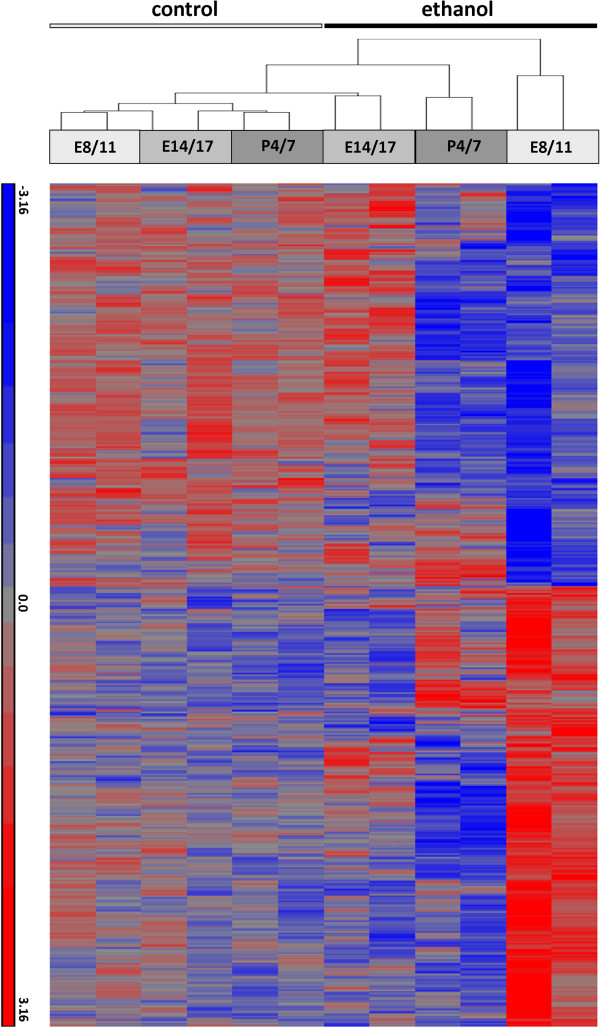
Figure 1
Figure 1
Heat map representing hierarchical clustering of arrays based on the normalized intensity of the probe sets. Control and ethanol-treated samples are indicated (n=2), with each replicate consisting of RNA pooled from three male mice obtained from six litters. Treatment times are also indicated. Heat map was generated by Partek® Genomics Suite software based on ANOVA-calculated significance levels at a fold-change cutoff of 1.2 and a FDR-corrected P value <0.05.
Figure 2
Figure 2
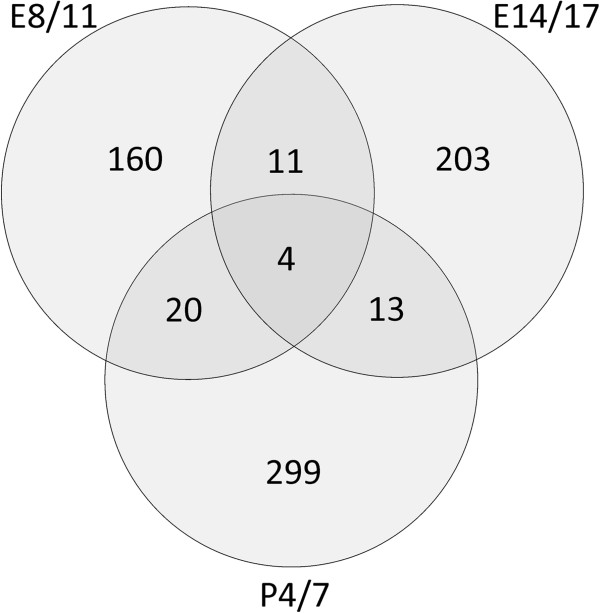
Venn diagram indicating the number of differentially expressed genes identified by each treatment paradigm (E8/11, E14/16, P4/7), including the number of genes that overlapped between multiple treatments.
Figure 3
Figure 3
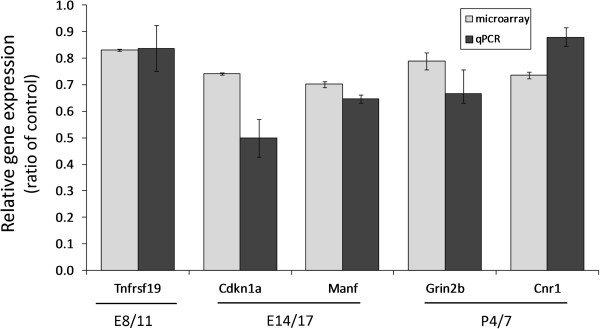
Quantitative PCR confirmation of genes identified as altered by neurodevelopmental ethanol exposure by microarray analysis. Expression values are shown as a ratio of the control value ± SEM. Microarray values represent the results of ANOVA comparison of two biological replicates, each consisting of the RNA from three non-littermate male mice. Quantitative PCR values were generated using six biological replicates consisting of the RNA from six ethanol-exposed males mice. Significance differences from control values were determined using unpaired t-tests. All bars are significantly different from their respective controls (P <0.05). We were unable to confirm the expression of Htr5a (P >0.05) and therefore this gene is not included in this figure.
Figure 4
Figure 4
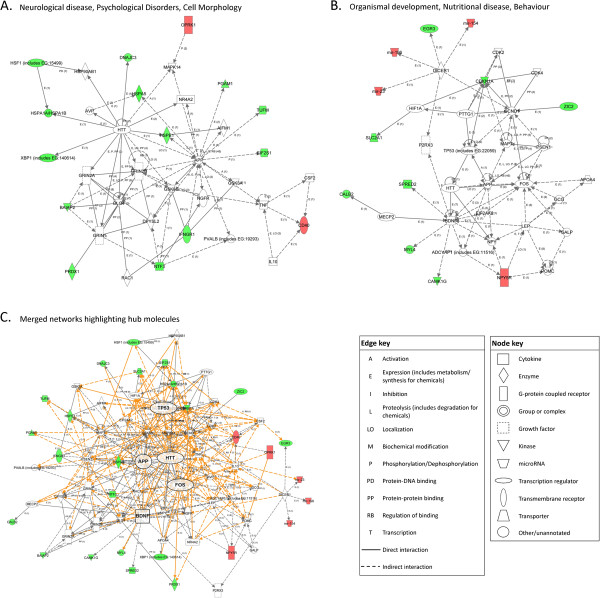
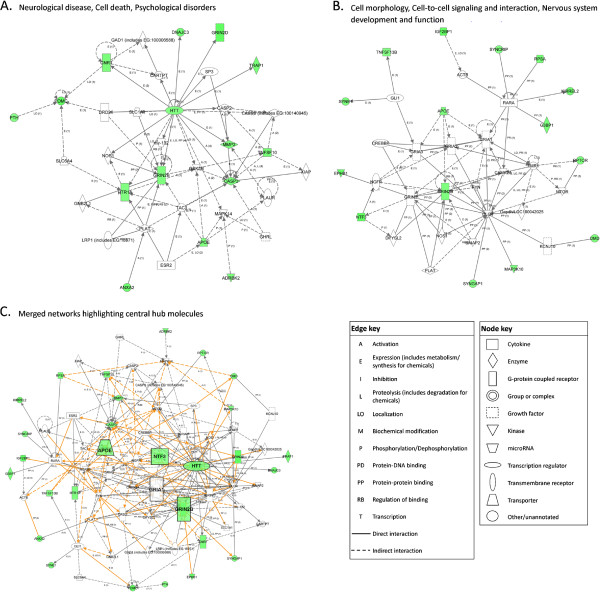
Ingenuity pathway analysis (IPA) network analysis indicating annotated interactions between genes affected in the adult brain by ethanol exposure at E8 and 11. Up- (red) and down- (green) regulated genes are indicated. Significant networks identified, as well as their IPA functional category, are shown in (A) and (B). (C) Merged image of networks shown in (A) and (B) showing the interrelatedness of the genes involved. Centralized ‘hub’ molecules linking multiple interacting genes are enlarged.
Figure 5
Figure 5
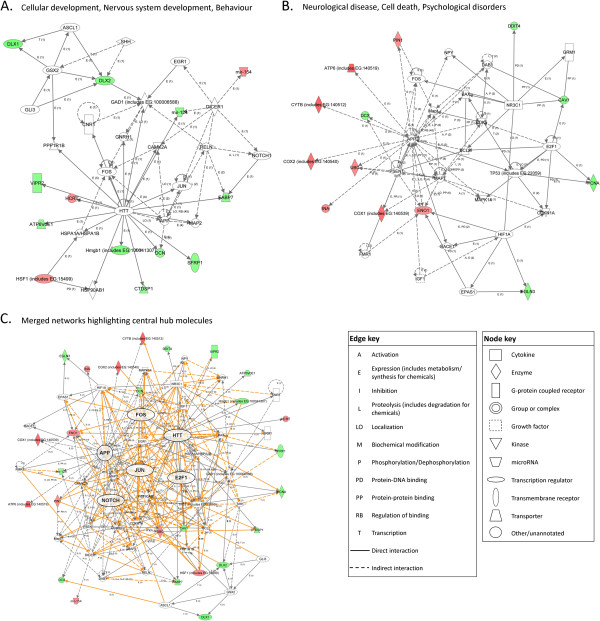
Ingenuity pathway analysis (IPA) network analysis indicating annotated interactions between genes affected in the adult brain by ethanol exposure at E14 and 16. Up- (red) and down- (green) regulated genes are indicated. Significant networks identified, as well as their IPA functional category, are shown in (A) and (B). (C) Merged image of networks shown in (A) and (B) showing the interrelatedness of the genes involved. Centralized ‘hub’ molecules linking multiple interacting genes are enlarged.
Figure 6
Figure 6
Ingenuity pathway analysis (IPA) network analysis indicating annotated interactions between genes affected in the adult brain by ethanol exposure at P4 and P7. Up- (red) and down- (green) regulated genes are indicated. Significant networks identified, as well as their IPA functional category, are shown in (A) and (B). (C) Merged image of networks shown in (A) and (B) showing the interrelatedness of the genes involved. Centralized ‘hub’ molecules linking multiple interacting genes are enlarged.

References

    1. Chudley AE, Conry J, Cook JL, Loock C, Rosales T, LeBlanc N. Fetal alcohol spectrum disorder: Canadian guidelines for diagnosis. CMAJ. 2005;172:S1–S21. - PMC - PubMed
    1. Rasmussen C. Executive functioning and working memory in fetal alcohol spectrum disorder. Alcohol Clin Exp Res. 2005;29:1359–1367. - PubMed
    1. Streissguth AP, O’Malley K. Neuropsychiatric implications and long-term consequences of fetal alcohol spectrum disorders. Semin Clin Neuropsychiatry. 2000;5:177–190. - PubMed
    1. Marchetta CM, Denny CH, Floyd RL, Cheal NE, Sniezek JE. Alcohol use and binge drinking among women of childbearing age-United States, 2006-2010. MMWR Morb Mortal Wkly Rep. 2012;61:534–538. - PubMed
    1. Bertrand J, Floyd LL, Weber MK. Guidelines for identifying and referring persons with fetal alcohol syndrome. MMWR Recomm Rep. 2005;54:1–14. - PubMed