. 2013 Mar 13;14(3):R23.
doi: 10.1186/gb-2013-14-3-r23.

DDIG-in: discriminating between disease-associated and neutral non-frameshifting micro-indels

DDIG-in: discriminating between disease-associated and neutral non-frameshifting micro-indels

Huiying Zhao et al. Genome Biol. .

Abstract

Micro-indels (insertions or deletions shorter than 21 bps) constitute the second most frequent class of human gene mutation after single nucleotide variants. Despite the relative abundance of non-frameshifting indels, their damaging effect on protein structure and function has gone largely unstudied. We have developed a support vector machine-based method named DDIG-in (Detecting disease-causing genetic variations due to indels) to prioritize non-frameshifting indels by comparing disease-associated mutations with putatively neutral mutations from the 1,000 Genomes Project. The final model gives good discrimination for indels and is robust against annotation errors. A webserver implementing DDIG-in is available at http://sparks-lab.org/ddig.


Figures
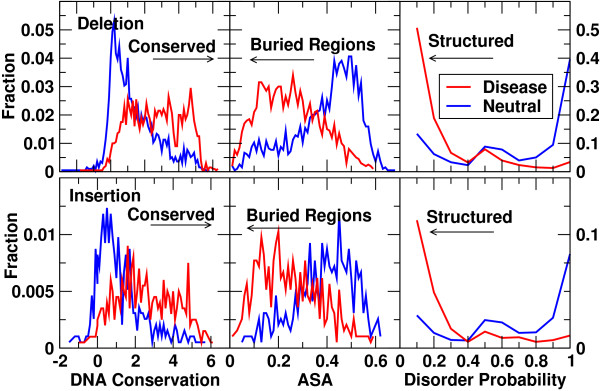
Figure 1
Figure 1
Distributions of the average DNA conservation score from phyloP (phylogenetic P values) (left), the average solvent accessible surface area (ASA, middle), and the average disorder probability (right) of disease-causing (red) and neutral (blue) indels (microdeletions (top panel) and microinsertions (bottom panel)).
Figure 2
Figure 2
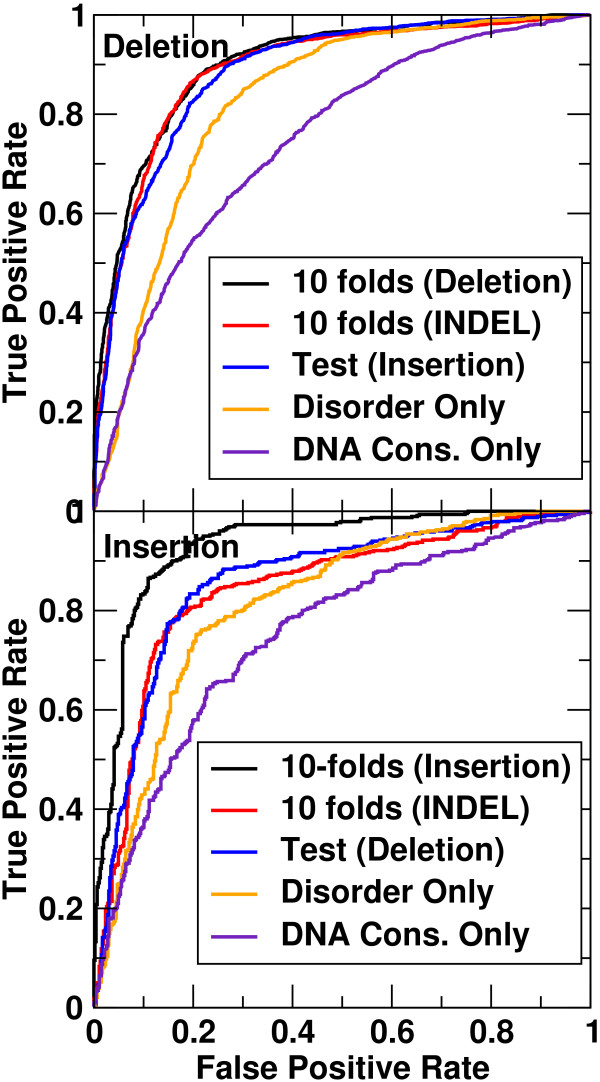
The ROC curves for the microdeletion (top) and microinsertion (bottom) sets, respectively, by 10-fold cross-validation on the set (black), 10-fold cross-validation on both insertions and deletions (red), independent test by training on the microinsertions (top) or microdeletions (bottom) (blue), by disorder feature only (orange), and by DNA conservation score only (purple) as labeled.
Figure 3
Figure 3
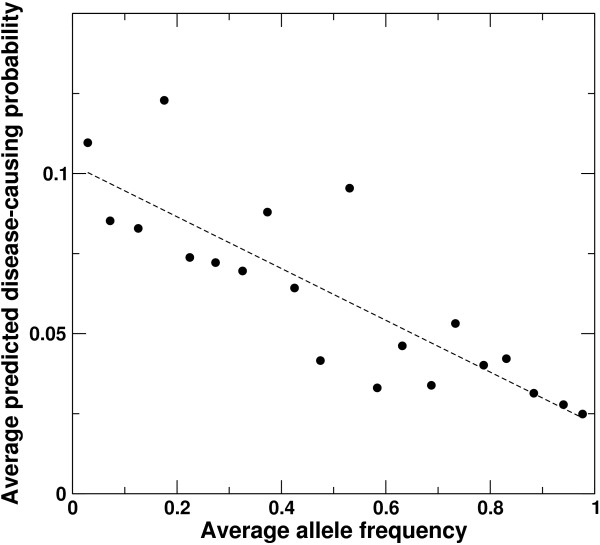
The average predicted disease-causing probabilities as a function of the average allele frequency in the neutral indel dataset derived from the 1,000 Genomes Project data. This was done by dividing allele frequencies into 20 bins. The dashed line is from a linear regression fit. The correlation coefficient is -0.84.
Figure 4
Figure 4
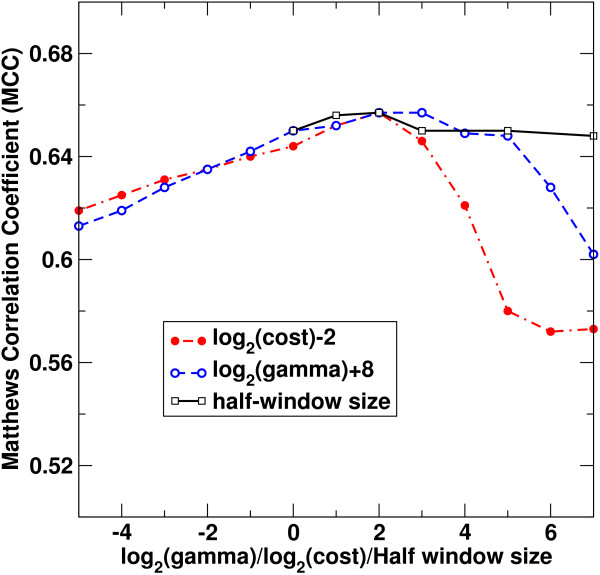
Ten-fold cross-validated Matthews correlation coefficient for the NFS-indel set as a function of SVM gamma and cost parameters and half window size when trained on all features. Note that a logarithmic scale is used for gamma and cost parameters and log2(gamma) and log2(cost) are shifted to facilitate comparison.

References

    1. Stenson PD, Ball EV, Mort M, Phillips AD, Shiel JA, Thomas NS, Abeysinghe S, Krawczak M, Cooper DN. Human Gene Mutation Database (HGMD): 2003 update. Hum Mutat. 2003;14:577–581. doi: 10.1002/humu.10212. - DOI - PubMed
    1. Ball EV, Stenson PD, Abeysinghe SS, Krawczak M, Cooper DN, Chuzhanova NA. Microdeletions and microinsertions causing human genetic disease: common mechanisms of mutagenesis and the role of local DNA sequence complexity. Hum Mutat. 2005;14:205–213. doi: 10.1002/humu.20212. - DOI - PubMed
    1. Mullaney JM, Mills RE, Pittard WS, Devine SE. Small insertions and deletions (INDELs) in human genomes. Hum Mol Genet. 2010;14:R131–136. doi: 10.1093/hmg/ddq400. - DOI - PMC - PubMed
    1. Mills RE, Luttig CT, Larkins CE, Beauchamp A, Tsui C, Pittard WS, Devine SE. An initial map of insertion and deletion (INDEL) variation in the human genome. Genome Res. 2006;14:1182–1190. doi: 10.1101/gr.4565806. - DOI - PMC - PubMed
    1. Kondrashov AS, Rogozin IB. Context of deletions and insertions in human coding sequences. Hum Mutat. 2004;14:177–185. doi: 10.1002/humu.10312. - DOI - PubMed

Publication types

LinkOut - more resources